
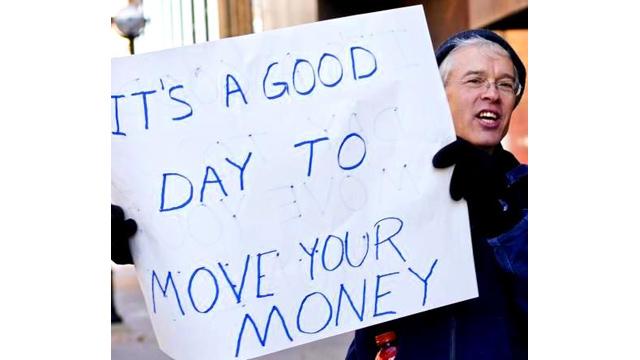
On this, the one-year anniversary of the Occupy Wall Street movement, it’s important to understand the financial system that drives economic injustice – the reason why the scales always seem to be tilted towards the 1%.
Every time we participate in this system, by using our banking account and its front end, the payment system, we are reinforcing both the power structure and the values that keep the system in place. Thomas Jefferson named money the “circulating medium”; to participate in economic activity means that you will likely participate in the money system. Two centuries later, in our country, that system is a private franchise that is owned, operated and controlled by Wall Street banks.
But there is a way to break the system’s grip and free ourselves from participating in the existing money system: public banking.
Hardly a radical idea, since it is a part of every other developed country, public banking offers a transformative approach to democratizing money and establishing the post-Wall Street era. It holds a key that can unlock us from this fundamentally unjust system because it puts the reins of control into the hands of the citizens who are, after all, the owners of the banks. Public banking creates the opportunity to build a democratic consensus around core concepts such as how much new money is created and who gets to receive it - facts that are now the exclusive purview of Wall Street bankers.
Most significantly, public banking provides a chance for people to conduct economic activity and participate in a system entirely separate from the private banking system. It’s a way for us to take back our economy and put into place the funding needed for local, city, county or state solutions to local problems.
As more evidence of economic injustice is uncovered (LIBOR fraud, muni bond rigging, “mortgage relief” for homeowners as a cover for more bank bailouts) and as the collusion between Wall Street and the federal government continues, Occupy Wall Street can become even more of a moving force. It can do this by continuing to bear testimony that an oligarchy is systematically benefiting from the labor of the 99%, that the 1% are using the corporate-owned media to blame government and use divisive social issues as a distracting sideshow, and that Wall Street banks and their top shareholders control our money supply and our government at the federal and some state levels.
In this system, interest is used as a tax, generating an endless stream of payments as a kind of tithe to our masters. Some studies show that over 40% of the cost of ANY product is the cost of interest all the way up the supply chain. Guess who receives that benefit?
The silent candlelight vigil held by Occupy Wall Street participants one year ago on the evening of September 17 was the beginning of the end of our fealty to the money system and its private masters. Not only was the crime scene identified, but our masters were named. The Department of Justice is no longer investigating these crimes, but on some level, that no longer matters. After all, this latest injustice is just a continuation of what has been going on for decades. But beginning that night, the light was turned on for many of us. Now, a commitment is growing to build an alternative money system with economic justice and democratic participation at its core.
We don’t have to look too far for examples of alternatives in the banking arena. New Zealand has the very successful KiwiBank, a publicly-owned post office bank that provides a full complement of banking services, including loans, to its customers. Three of the four national letter carrier unions in the U.S., in their national conventions this past August, adopted a similar platform. North Dakota, the only state in the country with its own bank, has low cost loan programs for students, homeowners, commercial business owners and farmers.
Local currency systems are already multiplying around the country. Some, like Mountain Hours in Colorado, democratize money by issuing their new debt-free money in a fair and just process. These public, democratic and sometimes nascent efforts are important ways to re-create a money system that better reflects the values of the people.
Here is a platform for the post-Wall Street era that public banking advocates are working to create:
• Public banks are capitalized with funds from local investors and pension funds, which receive a reasonable and guaranteed rate of return.
• Public banks fund loans at very low interest rates for students attending public higher education institutions.
• Public banks fund home mortgages without undermining the integrity of the public registry (County Recorders Offices).
• Public banks have commercial loan programs that reflect the values of the people (renewable energy, sustainable agriculture, co-operatives, etc.).
• Public banks serve as a mutual credit exchange system, where commerce is done without the need to transfer money except as an ultimate clearing agent.
• Public banks have their own payment systems for use with multiple currencies (national and local).
The post-Wall Street era is about stepping out of the existing system and creating banking and investment opportunities at a local level. There is plenty of money to fund this – over $1 trillion of public monies are now deposited in Wall Street banks. These same deposits could be placed in public banks to serve the very same public that generated the money in the first place.
The post-Wall Street banking era begins with taking public money out of Wall Street banks and putting it into a banking system that better serves the needs of the people. That’s what we mean by public banking.
3 WAYS TO SHOW YOUR SUPPORT



- Log in to post comments


