
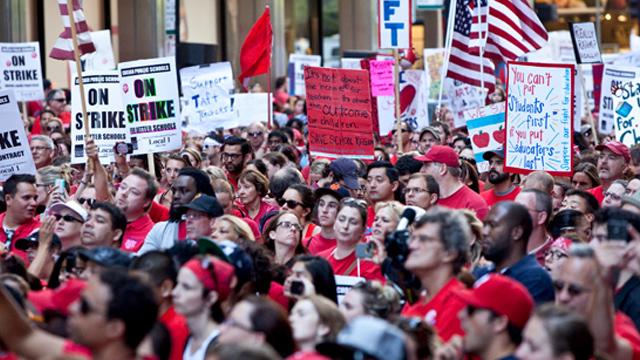
Photo: Nathan Weber
What the world is witnessing in Chicago as thousands of teachers, staff and support personnel strike is the emergence of a revolutionary ideal.
This is an ideal rooted in the promise of democracy - one that challenges corrupt neo-liberal practices, such as giving corporations and markets the right to define the purpose and meaning of public education; opposes policies that systemically defund public education by shifting the burden of low tax rates for the rich, and the cost of bloated military expenditures, to teachers and other public servants; and refuses to support educational reforms that debase educational leadership and teaching in order to undermine public education as a bulwark of democracy.
The enemies of public education and other vital social services are committed to draconian cuts in education, while simultaneously refusing to increase state and federal spending. But this is not solely an economic problem. Rather, it is also a political issue wrapped up in the "gutting [of] vital social services such as education, health care, police and public transit services, spending for the disabled and other areas of state services and employment."
Under the guise of austerity measures, the burden of deficit reduction now becomes an excuse to remove public education from the discourse of freedom and social transformation. Within this regime of repressive schooling, education for the masses now consists of a "dumbing down" logic that enshrines top-down high-stakes testing, vocationalized education for the poor, schools modeled after prisons and teachers reduced to the status of mindless technicians.
The brave teachers in Chicago have had enough of this authoritarian and anti-democratic view of education. They have revolted in the name of a revolutionary ideal that inserts dignity and power back into teaching, and breathes vitality and substance back into the relationship between education and democracy. In rejecting the primacy of "the market as the sole principle of social and political organization," they have recognized that what is at stake in the current struggle they face is "a whole generation 's sense of the future."
They are reclaiming the right, if not the responsibility, to assert the civic duty of public education, address the issues of race, class and agency that over-determine the relations of power that bear down on schools; and assert that the real crisis of education is about the conditions of its democratic institutions and the teachers, students and citizens who are responsible for maintaining them.
And while the strike is close to being settled, the ideals it is fighting for are far from settled. The noble ideals and project underlying this strike are primarily focused on both the purpose of schooling, and the vital nature of public education in developing the formative culture necessary to produce the ideas, values, individuals and public spheres essential for the construction of a vibrant and substantive democracy.
In part, this ideal is fueled by a discourse of outrage, resistance and struggle on the part of educators, particularly as it is confronted by a hyper-charged vocabulary of denial and humiliation on the part of the economic and political elites who govern the city of Chicago.
The dominant media, with its whipped-up frenzy about striking teachers, would have us believe that the strike is simply about greedy and dysfunctional unions irresponsibly insisting that teachers and school staff strike in order to preserve unwarranted, cushy benefits and high salaries and other alleged excessive perks.
In actuality, it is about hardworking, dedicated teachers who are striking to preserve, in part, watered-down medical benefits, eroding job security and limited control over the conditions in which they labor while doing everything they can to provide students with a quality education.
What is crucial to remember is that the Chicago teachers' strike represents much more than a series of specific school-related reforms that empower unions and benefit teachers (surely, a straw man argument if there ever was one). On the contrary, the strike points to a much broader series of questions about the meaning of public education, school governance, the quality of classroom pedagogy and the role of public education as a crucial democratic public sphere.
What teachers in Chicago are attempting to tell the American public is that public schools are under attack not because they are failing, but because they are public spheres that keep alive the relationship between learning and the hope of a more equitable, free and just society. Public schools are the DNA of democracy and they are under attack by a political virus that reduces teachers to technicians (or worse) and schools to investment opportunities for the rich, on the one hand, and militarized training centers for low income and poor minority students on the other. The Chicago teachers have taken upon themselves what many other academics in both public and higher education have failed to do. They have been advocating "for education as a public good and critical thinking as perhaps the most important capacity of responsible citizens under a republican form of government."
Clearly, public school teachers understand that if they have little control over the conditions of their labor they can become deskilled and treated as technicians, while powerless in preventing corporate-driven politicians and conservative administrators from imposing curricular models that devalue critical thought and reduce imaginative inquiry to the teaching of marketable skills.
What becomes clear in this assault on public school teachers and unions is a deeper order of politics that makes visible the attempt being made on the part of right-wing fundamentalists, hedge fund elites and advocates of privatization to reduce education to training and learning, to nothing more than a euphemism for a kind of instrumental, commodified and privatized test-driven form of illiteracy.
Increasingly, what Diane Ravitch calls the "billionaires club" is fostering on the American public a view of education tied to profit margins and the savage Darwinian shark tank logic of the marketplace. As Martha Nussbaum points out, the consequences are costly in ethical and political terms. She writes: "Education based mainly on profitability in the global market [produces] a greedy obtuseness and a technically-trained docility that threaten the very life of democracy itself."
The United States is in the midst of a crisis in which corporate-driven models of pedagogy are waging an assault not only on public schools, teachers, unions and public servants, but on the very ideas, institutions, and pedagogical relations that make a democracy possible. The apostles of casino capitalism are also waging a war on young people by turning their future over to corporate-driven ideologies, modes of governance and policies that benefit the very people who produced a massive degree of human suffering through the financial crisis of 2008.
The project of schooling has been stripped of its democratic ideals and is now defined within a reform logic that produces profits for a few and powerlessness for the many.
Let 's be clear. Chicago teachers are not simply fighting for increased benefits, resources and freedom (however important these demands are). They are fighting primarily against a neo-liberal disciplinary machine that would turn public schools into another tool of casino capitalism while destroying any vestige of the relationship between education, public values and democracy.
This fight is not simply about the right of public school teachers to have some control over their working conditions and the quality education they labor to provide daily to their students; it is about the struggle over public education as a public sphere that is fundamental to the survival of democracy. A healthy democratic society, by all vital social and economic measures, is also an educated society and that truism must be understood and embraced as a defense of education as a public good rather than a corporate, privatized and commodified right. This is precisely the message that has emerged from the Chicago teachers strike, one that can serve as a lesson to other educators and citizens who have a vested interest in education as essential to the survival of a democratic society.
3 WAYS TO SHOW YOUR SUPPORT



- Log in to post comments


