
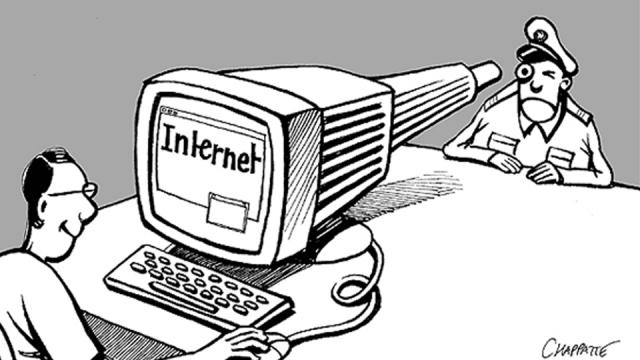
When a Manhattan court ruled last month that Twitter must hand over tweets from Occupy activist Malcolm Harris following a protest on Brooklyn Bridge, it set a precedent that on-line communications are no longer our own property and can easily be used against us by law enforcement.
Perhaps Malcolm and others should have taken some elementary precautions.
Obviously, you don’t have to sign up with Twitter using your real name or with an email address that links back to you. There are plenty of free email options out there from companies that won’t sell on your data. You can also muddy things further by conjuring up an entirely new persona for yourself with a fake identity generator.
If you do want to stand on a public landmark and tweet, you had best mask your smartphone first. Luckily, there are apps for both Android and Apple devices that divert all communications through a hidden network, masking both identity and location, and providing anonymous access to Twitter and Facebook as well as instant messaging and secure email.
If things turn nasty and local ISPs deny access, these apps still connect to social networks and websites blocked by the State even when law enforcement cannot.
But don’t stop there. When it comes to communicating with fellow activists, you might as well go all James Bond; and there are a lot of free spy tools on the Internet.
With PrivNote, you can send messages that self-destruct once read. Or you could hide a secret message inside something so fundamentally boring that no one will bother to look deeper.
At SpamMimic, you can enter a short message and have it regurgitated as mind-numbing spamtext that you send out to your friends. They just paste the spam back into a box on the site and out comes the message.
To be extra smart, send out your spam via a re-mailer such as AnonyMouse, where you can compose an email and have all the delivery codes stripped away and new ones added along the journey. When the email arrives at its destination, there is no way that it can traced back to you.
If you want to send a longer message, you will need to encrypt it and a PGP Key is the best way to do that. There are various ways of setting up a PGP Key for smartphones and other devices; some free, like iGolder.
Basically, you need to generate two keys – a public key which you give to anyone wanting to send you encrypted data and a private key that you keep to yourself. The sender uses your public key to encrypt the data and then sends it to you. When you receive the data, you unscramble it with your private key. Top mathematicians guarantee the system 100 percent secure; just don’t lose your key.
To really make things really difficult for even the most determined adversary, you can hide your encrypted message inside an innocuous-looking digital photo or music track. This is cryptography’s dark cousin, steganography from the Greek meaning secret writing. Think invisible ink.
These days you can hide almost any kind of digital file by embedding it inside another digital file, such as a .jpg, .bmp or mp3. You can use it for all manner of covert communication. WikiLeaks-type documents can be embedded inside a photo, short videos can be transmitted secretly inside a music file, and messages can be passed on by a digital ‘drop box’ held on a photo within a webpage.
Counter-technology isn’t very good and there is little to give the game away unless the file is unexpectedly large. Just looking at the image or trying to open it with a steganalysis program will not show that the image contains any hidden data.
But perhaps the simplest way to communicate secretly is to open a free email account and then give the address and log-in details to the other members of your group. Messages are then written but saved as drafts and never sent. The draft messages are then accessed by those with the password. This way the emails are never actually transmitted so cannot be intercepted. You can even use the account as a personal bulletin board with all members posting on different topics.
The case of Malcolm Harris shows us how we need to tighten security. There is no reason to play ball and allow our human rights to be infringed. We can easily slip from the grasp of those who would monitor and control us. We might even claim the liberty that the Internet originally promised.
But, if it seems that Internet freedom is at a low ebb right now, just wait until the Utah Data Center comes on-stream next year when absolutely everything you say or do on-line will be logged and analyzed and used to profile you the way they did in the movie "Minority Report."
Scary times ahead. You are going to need some serious security.
Conrad Jaeger is the author of "Deep Web Secrecy and Security" published by Deep Web Guides and available as an interactive e-book for $10.37 on Amazon.
3 WAYS TO SHOW YOUR SUPPORT



- Log in to post comments


