
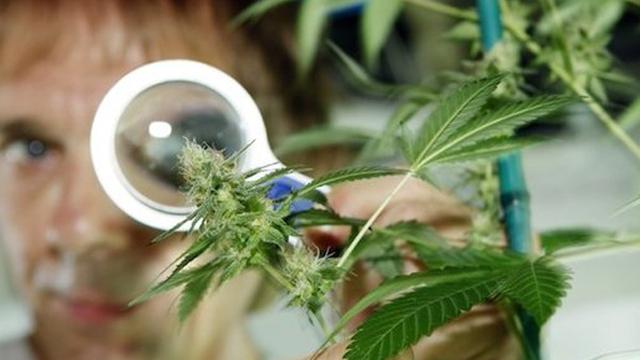
In an unprecedented popular vote, Colorado and Washington have approved ballot initiatives to legalize the sale of marijuana under regulations somewhat stricter than those for alcohol.
“These are not just the first two states to do this,” exulted Ethan Nadelmann of the Drug Policy Alliance. “They’re the first two political jurisdictions in the world to do this.”
In Colorado, Amendment 64, which would “regulate marijuana like alcohol,” had 54 percent of the vote with more than 85 percent counted. (It was outpolling President Obama, who carried the state, by almost 50,000 votes.) The measure will let people 21 or older possess up to an ounce or grow six plants, and the state will license growers and retailers.
“We’re glad to be the first state to set it off,” said Art Way of the Drug Policy Alliance of Colorado. “We hope we’re the tipping point for the nation.”
He credits the state’s experience with regulating medical-marijuana dispensaries for the initiative’s success. “The conversation has been going on in Colorado for the past seven or eight years, so we’ve laid the groundwork,” he said.
In Washington, Initiative 502 had 55 percent of the vote with more than half the ballots counted, buoyed by a 150,000-vote margin in Seattle. It will have the state Liquor Control Board license growers, processors, and stores. Buyers will pay a 25 percent sales tax, and stores can’t be within 1,000 feet of a school. It was somewhat controversial among marijuana users because it defines 5 nanograms per milliliter of THC in the blood as evidence of drugged driving.
“We’re ecstatic,” said Tonia Winchester, outreach director for the campaign. “Washingtonians are ready to try a new approach to marijuana. They realize that 75 years of the failed policy of prohibition have not worked.” She credits a “well-crafted initiative” that took into account public-safety concerns for its success.
The law allowing possession of up to an ounce—and larger quantities of cannabis food or drink products—goes into effect Dec. 6. There will be a one-year period to develop rules for a legal supply, during which, Winchester says, “we hope to have a dialogue with the federal government to implement the will of Washington voters.”
But Oregon voters rejected Measure 80, the Oregon Cannabis Tax Act, which won about 45 percent with about half reported. It would have set up a state cannabis commission to administer pot stores, paralleling Oregon’s state-run liquor stores. That campaign began later and had less funding and professional organization than the Colorado and Washington initiatives.
Three states also had medical-marijuana initiatives on the ballot, but only one won.
Massachusetts voters solidly approved Question 3, which would eliminate criminal and civil penalties for people using marijuana for a “debilitating medical condition,” and allow “nonprofit medical marijuana treatment centers.” The initiative won about 63 percent of the vote and carried every county in the state. It means that 18 states and Washington, DC, have now legalized medical marijuana,
But in Arkansas, the first medical-marijuana initiative to make the ballot in the South lost narrowly. Issue 5, which would have permitted it for people with a wide variety of serious ailments and allowed nonprofit medical-marijuana dispensaries, fell short, receiving about 48 percent of the vote.
Montana voters endorsed IR 124, which upheld the state’s 2011 law restricting medical marijuana. Montana had legalized it in a 2004 initiative, but the legislature enacted a measure that lets local governments ban dispensaries and limits the numbers of patients a caregiver can grow for and the number of patients a doctor can recommend it to without being investigated. The measure was confusing, as a “no” vote was for repeal. Repeal was behind by about a 57-43 margin with about 65 percent of the vote in.
Washington vs. DC, Colorado vs. Congress?
The Washington and Colorado votes are a political milestone, the strongest challenge ever to U.S. marijuana prohibition. However, they will provoke a direct conflict with federal drug laws. It is a well-established legal principle that federal law supersedes state law, and neither the courts nor the Obama administration have bent on this.
In 2005, the Supreme Court ruled that the federal government’s power to regulate interstate commerce authorized it to ban even donated homegrown medical marijuana, which the plaintiffs argued was neither interstate nor commerce.
In 2011, federal prosecutors sent letters to the governors of Arizona, Colorado, Montana, Rhode Island, Vermont and Washington, threatening that if they set up a system to license and regulate medical-marijuana cultivation and distribution, state employees working in it might face federal drug-trafficking charges. Washington Gov. Christine Gregoire vetoed one such proposal after the state’s two U.S. Attorneys told her they would “vigorously” prosecute “individuals and organizations that participate in unlawful manufacturing and distribution activity involving marijuana, even if such activities are permitted under state law.”
As the Colorado and Washington laws would permit both growing and selling marijuana without the justification of medical use, state employees involved in regulating them would face similar risks—as, obviously, would anyone running a cannabis farm or ganja store.
“We hope the federal government will let Colorado and Washington be the laboratories of marijuana policy,” responds Art Way.
President Obama, says Allen St. Pierre of the National Organization for the Reform of Marijuana Laws, “has an opportunity to do nothing. He can help these states legalize by doing nothing.”
St. Pierre finds it encouraging that the Obama administration did not speak out against the initiatives—unlike the Clinton and Bush administrations, which campaigned against medical-marijuana initiatives, or even Obama’s in 2010, when Attorney General Eric Holder spoke out against California’s Proposition 19 legalization initiative.
Ethan Nadelmann makes the same point. As the Colorado law won’t permit sales until mid-2013, and Washington will take a year to develop its regulations, he hopes the administration will take a wait-and-see approach.
Will the victory of these two initiatives set off a major political change, a spurting leak in the dike of prohibition? Or would the prohibitionists in power become more intransigent? Public support for marijuana legalization has been steadily growing. It has reached 50 percent in recent polls; in 1969, when Gallup first asked about it, it was 12 percent. On the other hand, there are currently more members of Congress who question the circumstances of President Obama’s birth than who have openly endorsed legalizing marijuana.
St. Pierre has long bemoaned the “huge disconnect” between popular sentiment and legislative action on pot issues. But “unless our system is totally dysfunctional”—a possibility he doesn’t rule out—he hopes that everything from “the amount of cannabis tourism that’s about to happen” (and the tax revenues it will bring states) to demographic changes will intensify the pressure to change the laws. Baby boomers and younger people are far more likely to support legalization than the shrinking number of older people who came of age before weed was widespread, he notes. Colorado and Washington could help by becoming exemplars of well-regulated reefer sales.
“The prohibition days are done,” he says. “I don’t say that in a cocky way, I say it analytically.”
Both he and Nadelmann see a parallel with gay marriage, a once-taboo issue that gradually gained public support and eventually won legal recognition. The federal prohibition is a clear obstacle, says Nadelmann, but “the momentum and the trend lines are on our side. We have public opinion, the notion of deference to responsible state and local laws, and the fiscal, public-safety, public-health, and moral arguments. We have all the arguments on our side, with the exception of the supremacy clause of the Constitution.”
The victory of Proposition 215 in California in 1996, the nation’s first successful medical-marijuana initiative, showed that a “fringe” movement could win an election in a major state, he says. “What we showed tonight was that we could win even bigger.”
The other five states that passed medical-marijuana initiatives before 2001—California, Oregon, Alaska, Maine, and Nevada—are possible next targets, he says. California would be the biggest prize, but it’s also the most expensive place to mount a campaign.
Steven Wishnia is a New York-based journalist and musician. He is the author of the novel "When the Drumming Stops" (Manic D Press), "Exit 25 Utopia," and "The Cannabis Companion."
3 WAYS TO SHOW YOUR SUPPORT



- Log in to post comments


