
It's a familiar pattern: those on top of the economic ladder enjoy massive profits while expecting workers to sacrifice even more for the "greater good."
This storyline weaves itself into every justification for anti-worker policies. From Washington's potential Grand Bargain that would cut trillions from needed social programs, to the workplaces with their stagnating wages and declining benefits, those on top plead poverty to workers while stuffing their pockets beyond belief.
The argument is also currently being repeated by the giant multinational corporations that control the nation's shipping ports.
Fortunately, the longshore workers are organized into powerful unions that have the ability to fight back against big business greed - something that was recently demonstrated at the port strikes in Los Angles and Long Beach, and which is now underway in the union negotiations happening at ports along the East Coast and at the ports in the Northwest.
Victory in Southern California
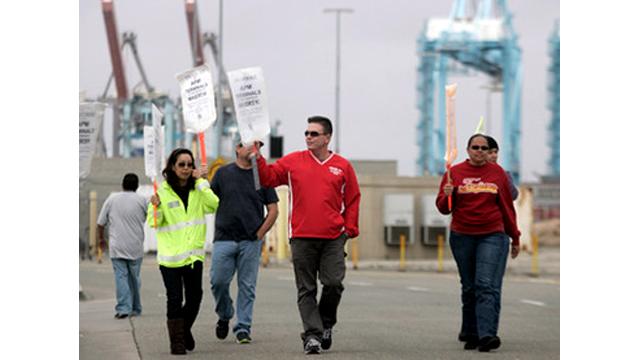
An impressive victory was achieved in Los Angeles last month as a result of an eight-day strike by the 800 members of the Office Clerical Unit of the International Longshore and Warehouse Union (ILWU) Local 63.
For two years the workers had been without a contract as a result of stalling by the Harbor Employer Association. The main issue on the table was job security: the employers were hiring more nonunion superintendents through attrition, outsourcing work to nonunion contractors elsewhere in the U.S. and overseas, and finding ways to get fewer employees to perform more work. The members of ILWU Local 63 wanted to put a halt to this not only to preserve their own jobs, but to have these jobs available for future generations.
After two years at the bargaining table, it became clear that the Harbor Employer Association was unwilling to move on the union's issues. The membership was left with no choice but to strike. And it was Longshore solidarity that won the day.
Ten thousand dockworkers refused to cross Local 63's picket line, leaving 10 of the 14 ports at Los Angeles and Long Beach at a standstill and $760 million a day of merchandise untouched.
The strike made the impact it needed to; suddenly, the Harbor Employer Association discovered that they were able to make more movement on the union's demands in a few days than they had for the previous two years.
After eight days on strike, a tentative agreement was reached and later ratified by membership vote. The Harbor Employer Association's attempts to outsource, at the cost of future working class jobs, hit an unmovable obstacle, resulting in a victory that demonstrates how taking collective action to shut down production can win.
Developments on the East Coast
On the East Coast, a different Longshore union is facing its own difficulties. The International Longshoremen’s Association (ILA) represents 15,000 union dockworkers at 14 ports from Maine to Texas. These ports handle 40 percent of all U.S. container cargo. The ILA is in negotiations with the United States Maritime Alliance Ltd. (USMX), an alliance of container carriers, direct employers, and port associates.
It has been 35 years since the ILA went out on strike. And at the end of December, it looked likely that this stretch was up. Dec. 29 was the final day of extended contract negotiations and the membership was ready to grab their picket signs.
The main point of contention was container royalties, a decades-old fee of $4.85 per ton of container cargo paid to the ILA membership. This is a significant amount of income that the workers take in. USMX insisted on reinstating a cap on this fee that the ILA had successfully fought to remove in the last two-year contract.
In an e-mail an ILA spokesman said the following:
"We let USMX defer $42 million of container royalty money to help pay for the $1.00 an hour increase that was due longshore workers — we, in essence, paid for our own raise —and now USMX wants the CAP back on. They got the benefit and now they want us to go backwards."
On Dec. 28, ILA President Harold J. Daggett sent out a public announcement stating:
"I am pleased to announce that the ILA made major gains on the Container Royalty issue that will protect our ILA members. Consequently, we agreed to extend the ILA Master Contract by 30 days, beyond the December 29th deadline (because of the year-end holidays, the deadline of the new extension will be February 6, 2013)."
What these major gains are remains unclear, and George Cohen, director of the Federal Mediation and Conciliation Service is demanding that all parties keep their lips tight for now. Consequently, there is no telling how the next few weeks of negotiations will go.
The ILA membership does not have any reason to stand down from strike preparations. The moment for decision will come when the membership has a tentative agreement in their hands and has a chance to read the fine print, collectively discuss it and vote.
The only certainty is that they are more likely to get a good contract and avoid a strike if they are prepared to go on a strike that will choke USMX's profit flow off.
3 WAYS TO SHOW YOUR SUPPORT



- Log in to post comments


