
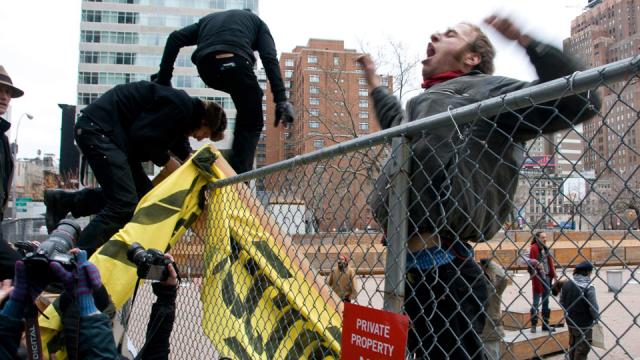
Photo: AF-Photographer. Occupiers attempt to set up an new encampment at Duarte Park on December 17, 2011
I’ve lately been getting the feeling that Occupy Wall Street’s past successes are starting to go to the heads of some people in the movement. There were, of course, the glory days of Liberty Plaza, and now also the spurt of momentum during and following the brief March 17 six-month-anniversary reoccupation there. But as the NYPD and police departments across the country make it quite clear that occupations of any kind will not be tolerated, the mood has gotten sour. The good old days, it seems, are not coming back.
For lots of organizers, I’ve noticed, the operating presumption is that occupation — something comparable to last fall but somehow surely better — constitutes a prerequisite to further political action. Consequently, a considerable amount of the energy of the most talented organizers in New York (as well as, evidently, in Oakland and San Francisco) has been directed toward failed reoccupation attempts. Or else the movement is celebrating its own anniversaries, not making occasions for new ones. The more conversations I have with listless, frustrated organizers, though, the more I start to feel that right now this occupation-first logic is exactly backwards.
This is a new time; the movement and people’s perspectives on it are in a totally different place than they were last fall. Potential allies expect more from the movement, I’d say, and so they should. People I know who were wholeheartedly behind it a few months ago seem to think it’s over, or it should be. The encampments, which Occupiers know as well as anyone sometimes turned into rather unsafe spaces, lost much public support. YouTube clips and statistics of Occupiers behaving badly in them have become fodder for a right-wing smear campaign that is gearing up for any possible resurgence. This matters; in some sense, an occupation must always be earned with public support, support which makes the cost in legitimacy too high for the state to mount an eviction.
Remember the early morning that so many remember as the climax of OWS’s whole story? It was October 14, when thousands of people turned out before dawn to keep the paws of Mayor Bloomberg’s cleaning crews off of the park. The moment those crews were routed, when the announcement came to everyone through the people’s mic — that was amazing. But it took a lot of committed allies to make it happen, beyond the usual characters you’d see around all the time. And right now, apparently, that support simply isn’t there, because evictions keep happening and there isn’t much of an outcry.
So how can the movement recapture that support? How can it, even more than before, light up people’s imaginations and make them want it to stick around? Here’s a modest proposal (modest because this is not a movement that tends to take or need advice): Challenge the power that affects lots and lots of people’s lives.
Right now, there are a bunch of smart projects starting up in the movement, each addressing core issues directly related to why so many thousands of people began Occupying Wall Street to begin with. There’s Fight BAC, a project with the (not at all modest) goal of taking down Bank of America. There’s the effort to fight foreclosures and evictions through occupations, auction blockades or eviction defense. There are groups like Disrupt Dirty Power aimed at finally halting the corporate machine that’s driving climate change. How about a massive student debt strike?
All of these are already in the works in the Occupy movement, but they tend to attract relatively small numbers of people compared to re-occupation attempts and rowdy marches. What if these, for a while, were the main business of the movement and the main outlet of its huge creativity? What if the first thing people thought of when they heard the word “Occupy” was, “Oh, those are the kids trying to take down the most dangerous bank in America and who saved my friend’s home from foreclosure”? Do stuff like this, and you’re creating a dilemma for the whole society. You’re asking everyone to choose sides — not about a little occupation, but about major features of everyday economic life. Do I want Bank of America to foreclose on my neighbor or not? Do I want my kids to spend their post-college lives enslaved by debt or not? These are serious political questions, which will easily eviscerate the nonsense the presidential candidates keep spouting on the news. Suddenly the question of letting the movement have an occupation somewhere seems comparatively small.
In the meantime, and in the process, it’s hugely important to keep the spirit of occupation alive — though not necessarily in tents. Union Square in New York is serving that purpose right now (especially when Occupiers there sleep on sidewalks in front of banks), as are the occasional afternoon Occupy Town Square events. May Day might be a great moment for rallying along these lines. This sort of thing is really important, because it’s constructive rather than just disruptive, and it points the way toward a new, revolutionary society. Lots of people in the movement talk about wanting to see these occupations eventually evolve into sustainable worker cooperatives and serious, large-scale mutual aid networks. But what if it were all in the context of making unmistakable the most egregious, fundamental crises in the fabric of our society — in the banks, in the schools, in politics, in how we treat our planet?
Compared to those sorts of things, I bet, encampments in parks will seem like no big deal. Maybe the movement might even start getting them again without really trying. At the very least, there will be a whole lot more people standing up against the forces of repression for the right to occupy. Hey, they’ll say, we’re changing the world with this movement — why not let it have a park or a building somewhere if we can do some good with it?
3 WAYS TO SHOW YOUR SUPPORT



- Log in to post comments


