
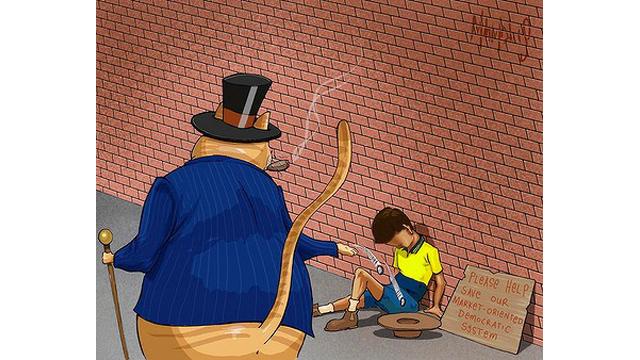
America is currently engaged in the most expensive presidential contest in world history. In the United States, money doesn't just talk – it dictates. How can we hope to make progress on the path to sustainability when the road is blocked by barricades of bullion backed by battalions of billionaires? How do we break through the political gridlock?
Dave Brower's wife, Anne, once put a wise spin on this dilemma. "What we need," she said, is "a cure for greedlock."
Earth's richest 1,000 individuals now control as much wealth as the poorest 2.5 billion people on the planet. This super elite uses its vast wealth to control the media, influence politicians, and bend laws to their favor. In the US, the wealthy dominate our government: 47 percent of US representatives are millionaires, as are 67 percent of US senators. The Center for Responsive Politics reports Congressional wealth has increased 11 percent between 2009 and 2011.
Not only is our economy out of balance with nature, our economy is also out of balance with the practical limits of physical and fiscal reality. As the Occupy movement has indelibly framed it, we are now a society divided not only by haves and have-nots, but we are a nation – and a world – divided into the 99 percent and the 1 percent.
Imagine if a tree were engineered like the US economy – with half of its mass centered in the top 10 percent of its height and 40 percent of its mass concentrated in the very topmost branches. Whether redwood or oak, such a tree would not be stable in a windstorm. It would be destined to topple. Of course, nature has better sense.
In 2011, the International Forum on Globalization (IFG) published a report called Outing the Oligarchy designed to focus public attention on "the ultra-rich individuals who benefit most from – and are most responsible for – the growing climate chaos that is destabilizing global ecosystems." It defined them as "a small elite of powerful billionaires who profit from polluting the atmosphere by promoting government policies that support an unsustainable reliance on fossil fuels."
The IFG report illustrated the growing rich-poor gap by visualizing a parade in which all the residents of Canada ambled down a city street on a single day. Let's translate that vision to the US.
Imagine if everyone in America was invited to parade down Pennsylvania Avenue in Washington, DC. Imagine if the parade took just one hour. Imagine if the march began with the poorest people in the lead. Imagine if all the marchers' income levels were indicated by their height. Here's what such a parade would look like:
For the first 10 minutes, the lead marchers (those who survive on only a few thousands dollars a year) look like toddlers, barely a foot tall. Around 15 minutes into the parade, the marchers are not quite so poor: They now stand about three feet tall. This tide of half-sized adults continues for the next 25 minutes. Only after more than two-thirds of the population has surged down the parade route do we begin to see normal-sized marchers (those making an average income). For the next 10 minutes or so, the spectacle resembles a normal parade. Then things start to get really strange.
In the final 10 minutes, we start to see marchers who are wealthier than average: people who are seven, even eight feet tall. In the last six minutes, the marchers loom more than 14 feet tall. With 25 seconds left, the minority of super-rich marchers looks down from a height of more than 30 feet – nearly six times the size of the average marcher; 30 times the size of those who made up the first quarter of the parade.
In the closing seconds of this parade of wealth, the shoulders of some marchers extend thousands of feet into the sky – these are the plutocrats. Finally, bringing up the rear, in the very last second of the march, are the most powerful and dominant members of the power elite – a select band of Godzilla-like oligarchs who look down upon everyone else from an astonishing altitude of 8,000-plus-feet. No wonder the superrich seem so removed and aloof.
Just like the banking system, when something is "too big to fail" it becomes a danger to itself and others. Nature would never tolerate such a system. Nor should we.
Gar Smith is Editor Emeritus of Earth Island Journal.
3 WAYS TO SHOW YOUR SUPPORT



- Log in to post comments


