
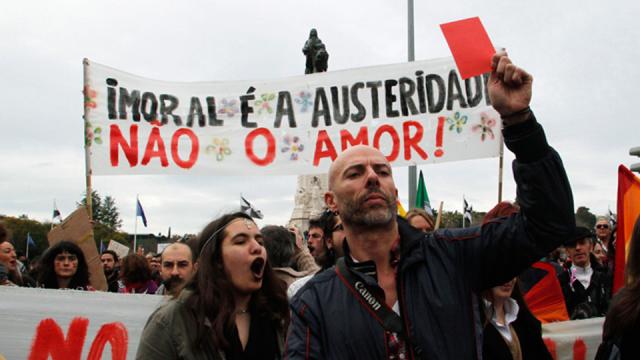
Hundreds of thousands of people flooded the streets of Portuguese cities protesting austerity measures that the government hopes will help to avoid the bailout and lift the country out of recession.
Protests, coordinated through social media by nonpartisan groups, have swept across the country with the biggest mass demonstration taking place in the capital Lisbon.
According to rally coordinators, some 500,000 protesters filled a Lisbon boulevard leading to the Finance Ministry. Many of them were carrying placards and chanting "It's time for the government to go!" and "Screw the Troika, we want our lives back," referring to the lenders from the European Commission, European Central Bank and International Monetary Fund.
People in the crowd sang "Grandola," a protest song from the 1974 Carnation Revolution that ousted the dictatorship established by Antonio Salazar, and brought an end to military rule in the country. During the past few week activists have sung the song to heckle government ministers making public speeches.
What the protesters are demanding is a complete change of the government’s policies aimed at reviving Portugal’s economy as the country faces its worst recession since the 1970s.
The main reasons of mass protests are an increase in taxes and cuts in public wages imposed by the “Troika” of lenders in exchange for the 78 billion euro bailout, agreed in mid-2011. The measure pushed unemployment to record levels of 17 per cent.
"People are desperate, seeing their incomes fall sharply, their families and friends without jobs," the WSJ quoted a 49-year-old journalist and one of the protest organizers, Nuno Almeida.
On Thursday, Portugal's Prime Minister Pedro Passos Coelho promised more spending cuts as a part of a deep reform of the state, which, he said, is necessary to make lower taxes possible in the future.
"This government has left the people on bread and water, selling off state assets for peanuts to pay back debts that were contracted by corrupt politicians to benefit bankers," Reuters quotes one of the protesters said a movie-maker, Fabio Carvalho. "If not today, things have to change tomorrow and we need to remain in the streets for the government to fall."
The rallies were organized in Lisbon, Porto and several dozen other cities via the Internet by a group of activists known as Que Se Lixe a Troika, or Screw the Troika, Reuters reports.
These demonstrations coincide with a quarterly review by the EU/IMF bailout inspectors.
Marina Watson Peláez of the Portugal Daily View reports:
“There are no jobs in country, and that’s all down to bad management and capitalism”, says 30 year old Renato Santos, an architect, who has been earning €650 per month for the last 6 years and will be forced to leave his profession later this year. “The Portuguese have to stick together and ask this government to step down”, he told Portugal Daily View.
Renato Santo was among the several thousands of peaceful demonstrators who marched through Lisbon on Saturday to step up their opposition to the country’s €78bn bailout, ahead of hefty €4bn spending cuts.
The mass rally occurred just a week after Portugal’s international lenders started the seventh evaluation of the country’s bailout implementation on Monday in the finance ministry building which overlooks the square by the river Tagus and where the protest’s highlight took place: people started chanting the”Grandola Vila Morena” song, which set off the 25 April Revolution in 1974 and has been haunting the Prime Minister and other government officials in recent weeks.
Protestors marched through the city centre shouting “resign” and carried banners reading “Troika, government, go out.”
The movement “Screw the Troika” (que se lixe a troika), one of the organisers of the protest, told Portugal Daily View that around 1.500.000 people attended the protest and that it was a clear message to the government that it was “illegitimate.”
This protest sent out a clear message: that the government should step down and the country should hold new elections”, said Nuno Ramos de Almeida, one of the organisers.
The protest took place in 40 cities in Portugal and abroad, including at Portuguese consulates in Paris and Barcelona and at Boston’s public library in the United States, according to news agency Lusa, and came a week after similar anti-austerity protests in Spain – as southern europeans struggle with increasingly tough austerity measures to bring down their debts.
The country’s largest trade union, CGTP, says the protests are intended to slam “brutal” austerity and the “tremendous” sacrifices made by the Portuguese.
The social welfare cuts in the troika memorandum are throwing the country into a economic and social disaster without precedents”, says Arménio Carlos, head of trade Union CGTP.
But President Cavaco Silva has insisted that “indignation is not a policy of response to the crisis.”
Portugal has been told to increase cuts to public spending by the institutions that granted it a €78bn bailout in May 2011 and is struggling with the highest tax rates and deepest recession in recent history and the unemployment has grown to a record 17.6%.
Portuguese protests get creative
Even though the Portuguese are chafing under an austerity-focused government and have seen their living standards fall, they haven’t hurled petrol bombs outside parliament like their neighbours Greece and protests are generally peaceful.
But the financial crisis is giving way to new social changes, with a new wave of creative, satiric protests taking place in the shadows.
A Portuguese political group recently got hold of the prime minister’s tax number – which went viral and was used on people’s store receipts – a silent way of protesting a policy which forces consumers to put down their national insurance number on restaurant bills and shopping receipts.
The Portuguese also don’t lack humour. Last week the prime minister was greeted by a group of students holding a dead hanged rabbit – a play on his surname Coelho, meaning rabbit – on Wednesday at Lisbon’s Faculty of Law.
And the nostalgic ”Grandola Vila Morena” is likely to continue to reverberate unless the government gives up and steps down.
3 WAYS TO SHOW YOUR SUPPORT



- Log in to post comments


