The Riskiest Banks are Still Those We Bailed Out

Search form

The Riskiest Banks are Still Those We Bailed Out

The Riskiest Banks are Still Those We Bailed Out

Mon, 9/24/2012 - by Pat Garofalo
This article originally appeared on Think Progress

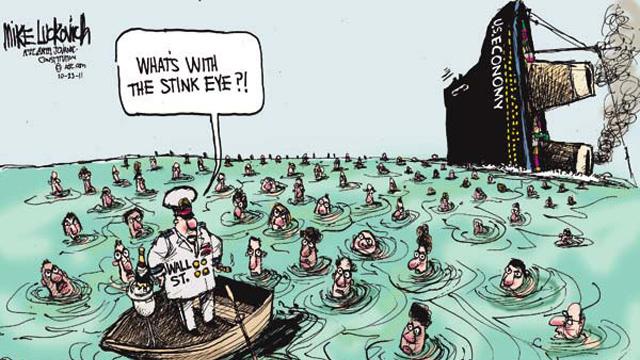
According to a new report from the Bank of International Settlements — which provides research to the world’s central bankers — bailed out banks in both the U.S. and around the world continued to be riskier than non-bailed out banks, even after they received taxpayer dollars during the financial crisis of 2008:

We find no evidence that rescued banks reduced the riskiness of their new lending more than non-rescued banks in response to the crisis and the public rescues. Even as lending volumes decreased across the board in 2009, rescued banks continued to write riskier syndicated loans, as reflected by their involvement in the leveraged loan segment and in the spreads charged on the facilities that they originated. We also find, unsurprisingly, that the syndicated lending of banks that later received a bailout was riskier before the crisis than that of non-rescued institutions. [...] During the crisis, rescued banks did not reduce the riskiness of their new syndicated lending compared to their non-rescued peers. In fact, our results suggest that the relative riskiness of their lending increased.

As Reuters columnist James Saft noted, “This is both astounding and totally predictable. Astounding because it was so clear that those risks were not just foolish but destructive. Predictable because of course the banks realized that they had not been just lucky but had been given a special exemption from death which will be very hard to revoke.”

Despite this and other clear evidence that the banks are totally uninterested in learning any lessons from the financial crisis, Republicans are attempting to bog down or repeal the Dodd-Frank financial reform law.

But several prominent banking executives have said that the size and complexity of today’s mega-banks makes them unmanageable. A recent report found that the financial crisis cost the U.S. economy $12.8 trillion.

Sign Up

Article Tabs

Corporate media just got nailed with a crackdown on whistleblowing, the kind activists have experienced in heavy doses. Lo and behold, mainstream journalists don't like what they're being told to swallow.

In this Chapter Five excerpt from his new book, "What Then Must We Do? Straight Talk About the Next Revolution," Alperovitz talks about what's wrong with our political and economic systems and how we can transform them.

Morally twisted right-wing orthodoxy has taken the “conserve” out of conservatism, as GOP honchos' knee jerk slavishness to petroleum interests have infected America.

Farmers must pay Monsanto each time they plant the company’s genetically modified soybeans, the Supreme Court ruled this week, rejecting an Indiana farmer’s argument that his un­or­tho­dox techniques did not violate the company’s patent.

While drone usage on college campuses has not received much attention, there are at least 25 universities in the U.S. that have been approved by the Federal Aviation Administration to fly drones in U.S. airspace.

Monsanto snuck a "rider" last week into the latest Senate agricultural legislation, giving the biotech giant blanket immunity from USDA action to halt potentially harmful GMO crops.

There's a big difference between our perception of wealth inequality in America, and how the real numbers add up.

Last weekend, 4,000 supporters of Binz, Zurich’s longest-established squat, were met with tear gas, rubber bullets and water cannons when a party turned into a march to protest their imminent eviction.

Tens of thousands from across the world called for new measures of liberty and dignity as they descended on Tunis to open the weeklong World Social Forum.

On Monday, the County Commission of Mora County in northeastern New Mexico became the first in the U.S. to pass an ordinance banning all oil and gas extraction.

In Albuquerque, Occupy and Immigrant Groups Unite

If anything captured the essence of the 2012 May Day celebrations, it was the convergence of issues popularized by Occupy Wall Street-influenced movements with the demands for justice long pushed by immigrant community organizations.

Why Curbing the Climate Crisis Will Take More Than Summits and Divestment

Targeting the fossil fuel industry is essential, but divestment as the target for action raises the same question as global summitry does: Is it enough?

ALEC Companies Leads Attack on North Carolina's Clean Energy

Corporate polluters are taking aim this year at states with renewable energy laws, starting with ALEC's assault on North Carolina’s clean energy economy, with support from Duke Energy, ExxonMobil and Koch Industries.

Legalize It! Voters in Colorado and Washington Make History

In an unprecedented popular vote, Colorado and Washington become the first two political jurisdictions in the world to legalize the sale of marijuana.