
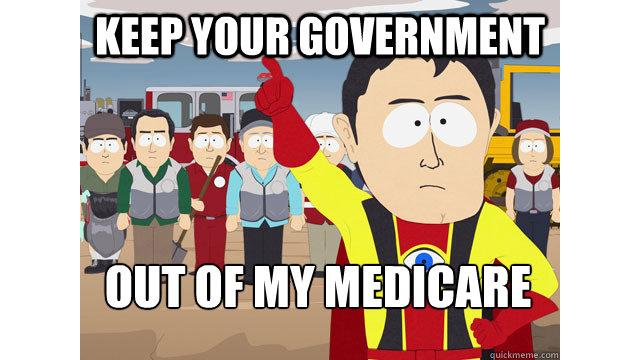
“Government, keep your hands off my Medicare!”
Commentators and comedians alike had fun with the cognitive dissonance represented by the statement above, found on more than one hand-scrawled sign at Tea Party rallies. But while opposition to government is more at home on the political right, ignorance about the role of government is a bipartisan malady.
Liberals may shake their heads at the “ignorance” of the Right, but we’ve seen focus groups in San Francisco comprised of liberal Democrats argue about whether or not the Bay Area Rapid Transit system is public transportation. Years of research and polling have shown that there is a broad lack of understanding about the role of government in our everyday lives. Many Americans are unaware of just what’s public and what’s private. Why is that?
Government programs may be victims of their own success. When a public system works well, it becomes less visible. During and following the New Deal, the federal government took responsibility for protecting working people. Within a generation or less, this became the “new normal.” As a result, until very recently, most Americans took collective bargaining rights, wage and hour laws, Social Security, and unemployment insurance for granted. These protections strengthen our economy by building a strong middle-class and minimizing poverty.
During World War II, the Defense Department mobilized America’s scientific and creative talent to defend the nation. The public – and most of the business community – came to understand that public investments in basic scientific research and technological advances were in the national interest. American businesses from GE to Apple have reaped the rewards of innovations produced by government-funded research labs.
But we don’t have to go back decades to see the crucial role government plays: Until the financial crisis of 2008, most individuals and businesses assumed their bank deposits were safe. Yet without the Federal Deposit Insurance Corporation, created by the Glass-Steagall Act of 1933, millions could have lost their life savings or seen their businesses go under. This invisible government service has become another taken-for-granted yet critical component of modern life.
In other words, when public systems work effectively, they immediately get embedded in individual and collective expectations about “the American quality of life,” and taken for granted. Government, when it works, is just an invisible part of everyday life.
People don’t recognize what government does until it fails to do something they expect it to do – like regulate the mortgage market and credit card practices, protect against deep-sea oil spills, respond to hurricanes or keep contaminated drugs off the market. When breakdowns do occur, the cultural meme that gets triggered (with a lot of assistance from pundits and self-serving public relations shops) is: “Government always screws up,” not “low-road corporations cut corners without government oversight.”
Until we Americans truly recognize the myriad ways in which government protects the quality of life in America and provides the foundation for economic growth, we’re likely to continue to have a shallow and partisan debate about the size of government or trust in government. To this end, the Nathan Cummings Foundation supported the production of a video intended to draw attention to the innumerable ways in which America’s private sector is supported by public investment in our future: From federal insurance for individual savings accounts, to roads that allow the transfer of goods; from the National Weather Service, to local police forces – without government involvement, we would not be able to grow together as a nation.
What we need is not more sound bite-driven argument, but an honest, well-grounded conversation about the role government already plays in the economy today, and the role we need it to fill to create a competitive, successful, inclusive economy for the 21st century.
3 WAYS TO SHOW YOUR SUPPORT



- Log in to post comments


