
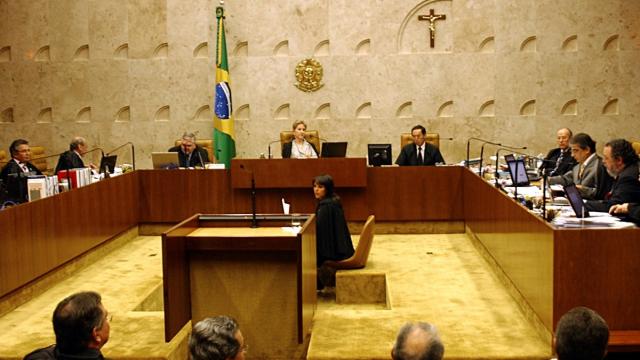
Amid a massive corruption scandal which has tarnished Brazil’s political class and driven the country’s president to the brink of impeachment, the Brazilian supreme court has banned corporate donations to candidates and parties in future elections.
With eight votes in favor and three against, the court declared late on Thursday that the rules allowing companies to donate to election campaigns were unconstitutional.
Around 76% of the over R$3 billion ($760 million) donated during last year’s election campaigns for the presidency, senate and congress came from corporate entities. Both the ruling leftwing Partido dos Trabalhadores (PT) and the main opposition Partido da Social Democracia Brasileira (PSDB) received over R$1bn each.
Rosa Weber, one of the judges who ruled in favor of the ban, argued that undue economic influence comprised the legitimacy of the country’s elections.
“The influence of economic power has ended up transforming the electoral process into a rigged political game, a despicable pantomime which makes the voter a puppet, simultaneously undermining citizenship, democracy and popular sovereignty.”
According to “The Spoils of Victory,” a US academic study into campaign donations and government contracts in Brazil, corporate donors to the PT in the 2006 elections received between 14 to 39 times the value of their donations in government contracts.
Almost all of the major corruption scandals in Brazil in recent years have involved campaign finance contributions, from the “mensalão” cash-for-votes scheme that rocked the administration of Lula da Silva to the current Operation Car Wash investigation into Petrobras, the state-run oil company.
Of the top 10 corporate donors in the 2014 elections, five currently have senior executives in preventative detention, accused of involvement in the Petrobras scandal.
The case was brought to the supreme court around one and a half years ago by the Order of Brazilian Attorneys (OAB). On Thursday the organization’s secretary general, Cláudio Pereira de Souza Neto, celebrated the decision. “It is what Brazilian society has been hoping for, even more so in these times of crisis,” he said, adding that the court order should make future elections cheaper.
Despite being the major beneficiary of corporate donations last year, the PT, along with several other, smaller leftwing parties, supported the ban. But in a defeat for the government, congress recently voted to allow companies to donate up to a maximum of R$20 million (US$5.1 million). Following the supreme court’s ruling, President Dilma Rousseff is now expected to veto that bill.
In a dissenting opinion, judge Gilmar Mendes lambasted the PT. “The party that took most advantage of corporate donations is now, like Mother Teresa of Calcutta, calling for their prohibition. It’s a conversion worthy of sainthood,” he said, claiming the party now had enough money from its 12 years in power to finance its election campaigns until 2038.
Another judge who voted against, Celso de Mello, argued that it would be preferable to have control over donations. “If some donation is made from now on all we can be sure of is that we won’t know about it, but we can never be sure that it doesn’t exist.”
Others pointed out the practical difficulties of enforcing the new legislation. Helio Gurovitz, a commentator for the G1 website, pointed out that the rules would not stop secret donations to “caixa dois” accounts – the name for the off-the-books slush funds set up by many political parties.
Similarly, the court ruling still allows for donations by individuals, of up to 10% of their annual income, a loophole that could be exploited by companies channelling their donations through bundles of individual voters.
So far, opposition parties have been muted in their response, promising only to respect the decision. Eduardo Cunha, the speaker of the lower house and an opponent of the government despite belonging to the allied Partido do Movimento Democrático Brasileiro (PMDB), said the ruling put the 2016 municipal elections in an “unnecessary limbo."
According to a study of 180 countries by the International Institute for Democracy and Electoral Assistance (Idea), 39 ban corporate donations, including Mexico, France and Costa Rica; 126 allow them with certain limitations, including the U.K., Germany and Argentina.
3 WAYS TO SHOW YOUR SUPPORT


- Log in to post comments


