
As demonstrations continued in Brazil for another night, President Dilma Rousseff attempted to co-ordinate a government response among senior officials who have been stunned by the scale of protests.
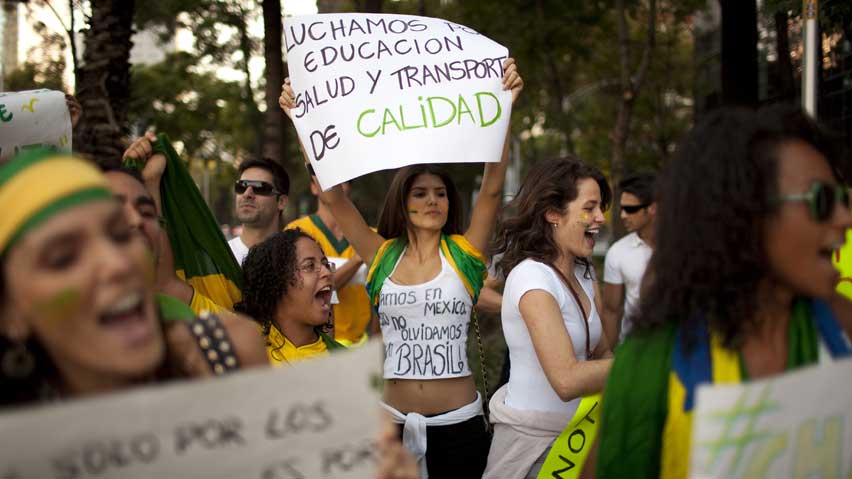
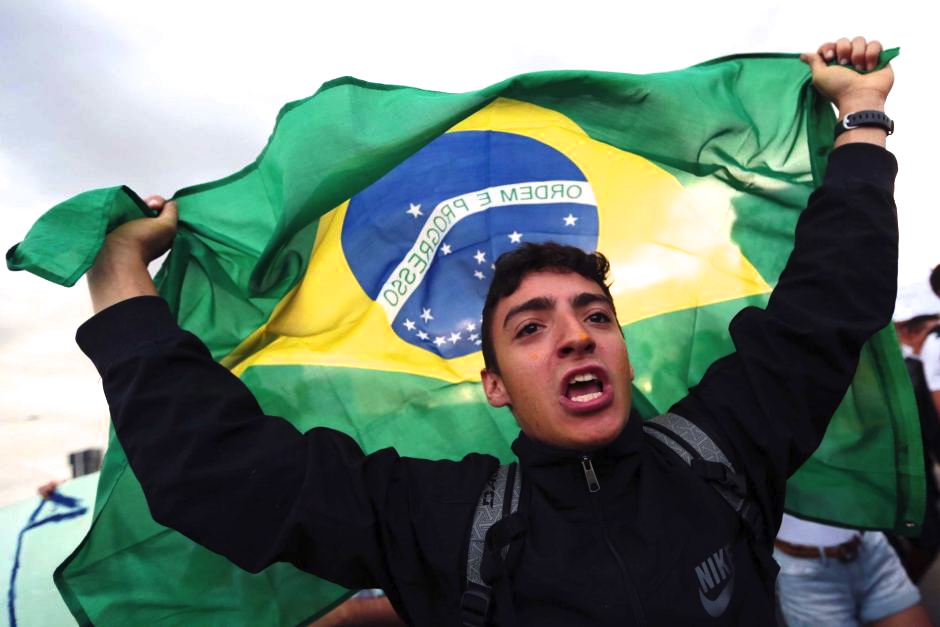
Keeping the pressure on the authorities, an estimated 50,000 people flooded Cathedral Square and other main streets in São Paulo for the second night running and rallies were reported in two other cities.
This followed Monday night's demonstrations in at least a dozen cities, which drew a quarter of a million people on to the streets.
Initially driven by opposition to a bus price hike, the marches have rapidly swollen to incorporate a range of grievances, including police brutality, inequality, corruption, dire public services and the extravagent preparations for next year's World Cup.
Faced by the biggest show of public frustration in more than 20 years, officials are struggling to grasp what is happening.
"It would be pretentious to say we understand what's going on," Gilberto Carvalho, Rousseff's secretary general, told a congressional hearing. "If we are not sensitive we'll be caught on the wrong side of history."
After bloody clashes on the streets last week, when police fired rubber bullets at demonstrators and journalists, Rousseff moved on Tuesday to placate the protestors.
"The voices of the street want more citizenship, health, transport, opportunities," said the president, who cut her political teeth in the 1960s as a Marxist guerrilla opposed to the military dictatorship. "My government wants to broaden access to education and health, understands that the demands of the people change."
Rousseff – who faces re-election next year – also convened a series of high-level meetings on Tuesday with her predecessor, Luiz Inácio Lula da Silva, and regional governors from São Paulo, Rio de Janeiro and Rio Grade de Sul.
According to the domestic media, she particularly praised the restraint of the police in São Paulo during Monday night's demonstrations – which was in marked contrast to the violence of their response the previous week. She is also reportedly pushing for a reduction of bus fares.
But with more protests planned in the coming days regional leaders are nervous. The governor of Minas Gerais, Antonio Anastasia, has asked the state to provide personnel from the National Force to strengthen public security in the face of the unrest. The government has agreed to dispatch 150 personnel, according to the Folha de São Paulo website.
Lucio Flavio Rodrigues de Almeida, a sociology professor at the Catholic University of São Paulo, said the authorities had so far responded only with repressive actions against protests that had morphed in character and size and were being organised by an amorphous social network rather than political parties.
"The strong repression, especially in São Paulo, increased the strength and sympathy for a protest movement that has successfully compared the spending on infrastructure for the Confederations Cup and the World Cup with small investments in public transportation," he said.
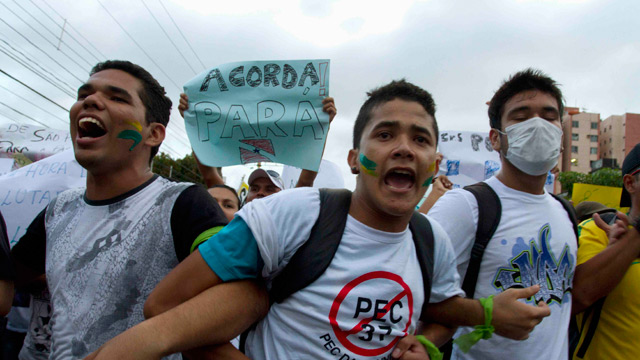
The vast majority of the protesters have been peaceful and many reported feeling elated at the mass and spontaneous movement to shake the government into action. On Tuesday marchers bore banners that called for reform, exclaimed "Dilma Out" and demanded an end of corruption.
One group attempted to break into the city hall, prompting police to use pepper spray to block their passage. Other demonstrators formed a human chain to hold back the attackers, chanting: "No violence!"
Television coverage of the protests – the sixth in São Paulo – showed a shop being looted and fires burning in the city centre. A TV van was overturned and set on fire and public transport was temporarily disrupted when protesters occupied and damaged a station control room and threw stones at a train.
Police said four people had been arrested in connection to the thefts of merchandise. It stressed that these were "isolated incidents caused by a small minority".
Crowds also gathered on Tuesday in Florianópolis, the Rio de Janeiro suburb of Sao Goncalo, and in Maringá, in northern Paraná state. Solidarity protests have been staged in several European countries including Britain, Portugal, Spain and Denmark.
Brazilian football players taking part in the Confederations Cup expressed support for the demonstrations. The Chelsea defender David Luiz said it was natural for people to express their opinion, while the midfielder Givanildo Vieira de Souza, known as Hulk, said the protesters were trying to improve things in the country.
"I come from the bottom of the social ladder and now I have a good life. I see these demonstrators and I know that they are right," Hulk told a press conference in Fortaleza. "We know that Brazil needs to improve in many areas and must let the demonstrators express themselves."
Bigger demonstrations are planned for Thursday in Rio de Janeiro, São Paulo and a wider number of municipalities than anything seen so far.
3 WAYS TO SHOW YOUR SUPPORT



- Log in to post comments


