
Read

User menu

Search form

CIA's Drone Program in Pakistan Began with Assassination Deal

CIA's Drone Program in Pakistan Began with Assassination Deal
Mon, 4/8/2013 - by Caroline Bankoff
This article originally appeared on New York Magazine

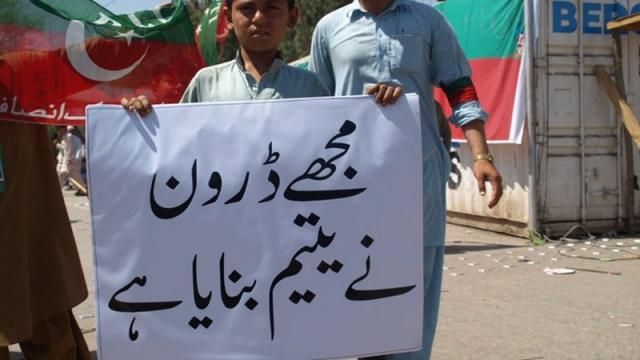
A book excerpt that appears on the front page of Sunday's New York Times reveals that the United States' drone program in Pakistan was allowed to begin because the CIA agreed to take out a man the Pakistani government considered an enemy of the state. In The Way of the Knife: The C.I.A., a Secret Army, and a War at the Ends of the Earth (out on Tuesday), journalist Mark Mazzetti describes the details of the deal: In 2004, Pakistani officials were growing increasingly frustrated by Nek Muhammad, a Taliban-affiliated militant who led a string of successful attacks against Pakistan's military in the country's tribal areas over the years. Their attempts to kill Muhammad on their own had failed, as had a brief truce with him.

"Pakistani officials had, for several years, balked at the idea of allowing armed C.I.A. Predators to roam their skies. They considered drone flights a violation of sovereignty, and worried that they would invite further criticism of [then President Pervez Musharraf] as being Washington’s lackey," writes Mazzetti. However, the military's intelligence officials finally agreed to allow the American drones into their airspace after then CIA director George Tenet offered to murder Muhammad in exchange. When a missile blew up Muhammad's South Waziristan compound — killing him and several others — the Pakistani military took credit for the deaths. The CIA was never mentioned in any official accounts of the incident, which was targeted killing conducted by an American drone in Pakistan. As we now know, the attack preceded hundreds of similar strikes, though the targets are at least supposed to be people who pose a direct threat to American interests.

Mazzetti goes on to note that CIA's shift toward the drone program was prompted by a desire to get rid of its network of secret prisons, which, as an internal report had recently revealed, were rife with prisoner abuse, leaving the agency vulnerable to charges of war crimes, among other things. "[The Muhammad] deal paved the way for the C.I.A. to change its focus from capturing terrorists to killing them, and helped transform an agency that began as a cold war espionage service into a paramilitary organization." While increased public awareness of drone killings has put some pressure on President Obama and current CIA head John Brennan to be more transparent about the program, scaling it back will be even more difficult than a 13-hour filibuster. As Mazzetti writes, "With a generation of C.I.A. officers now fully engaged in a new mission, it is an effort that could take years."

Originally published in New York Magazine.


3 WAYS TO SHOW YOUR SUPPORT

ONE-TIME DONATION

Just use the simple form below to make a single direct donation.

DONATE NOW

MONTHLY DONATION

Be a sustaining sponsor. Give a reacurring monthly donation at any level.

GET SOME MERCH!

Now you can wear your support too! From T-Shirts to tote bags.

SHOP TODAY

Sign Up

Article Tabs

From a pro-democratic perspective, civil society and new media organisations are surging in the aftermath of the Orban regime.

The country’s new prime minister, Andy Burnham, has promised a break from the politics of the last 40 years—realizing more broadly that Labour must stand up for the 99% against big business, or the party will become irrelevant.

The tragic shooting of Lorenzo Salgado Araujo is just the latest example of ICE having a fundamental disrespect for human life — further proving why the agency should be stripped of funding and shut down, and its rank-and-file agents and leadership prosecuted.

While the U.S., EU and their allies are enabling Rojava—the strongest force against Islamic State— to fall, it is vital for internationalists to continue to support this beacon of democracy and liberation.

June 23, 2026 may be remembered as the beginning of the end of the Democratic Party establishment.

The current wave of food recalls is a direct byproduct of President Donald Trump’s administration deliberately removing the safeguards put in place aimed at protecting American consumers more than a century ago.

From a pro-democratic perspective, civil society and new media organisations are surging in the aftermath of the Orban regime.

We can still celebrate success while simultaneously putting a cap on net worth.

The country’s new prime minister, Andy Burnham, has promised a break from the politics of the last 40 years—realizing more broadly that Labour must stand up for the 99% against big business, or the party will become irrelevant.

Much like the resistance to AI data centers, the opposition to Flock surveillance cameras has brought the left and the right together against billionaires who are trying to force America into becoming even more of a police state.

Much like the resistance to AI data centers, the opposition to Flock surveillance cameras has brought the left and the right together against billionaires who are trying to force America into becoming even more of a police state.

Posted 1 month 3 weeks ago

The country’s new prime minister, Andy Burnham, has promised a break from the politics of the last 40 years—realizing more broadly that Labour must stand up for the 99% against big business, or the party will become irrelevant.

Posted 1 month 3 weeks ago

We can still celebrate success while simultaneously putting a cap on net worth.

Posted 1 month 1 week ago

The current wave of food recalls is a direct byproduct of President Donald Trump’s administration deliberately removing the safeguards put in place aimed at protecting American consumers more than a century ago.

Posted 2 weeks 1 day ago

From a pro-democratic perspective, civil society and new media organisations are surging in the aftermath of the Orban regime.

Posted 2 weeks 3 days ago

The current wave of food recalls is a direct byproduct of President Donald Trump’s administration deliberately removing the safeguards put in place aimed at protecting American consumers more than a century ago.

From a pro-democratic perspective, civil society and new media organisations are surging in the aftermath of the Orban regime.