
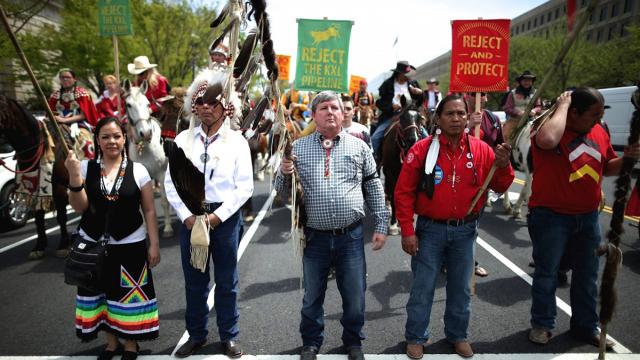
WASHINGTON — For a few days, tepees erected by Native Americans and their cowboy allies will frame the view of the Washington Monument from the National Mall.
A group of roughly 60 ranchers, farmers, and tribal leaders and members whose land falls near or on the proposed pathway of the contested Keystone XL pipeline, calling themselves the Cowboy and Indian Alliance, rode into the nation’s capital on horseback Tuesday to set up camp and begin four days of demonstrations to register their protest of the project.
The yet-to-be-approved 1,179-mile pipeline, which would carry crude oil from the tar sands of Canada’s Alberta province to Gulf Coast refineries in Texas, has been mired in controversy, legal challenges and delays for five years.
Critics, many of them environmentalists, say the Keystone XL will only deepen the United States’ dependence on fossil fuels, hasten the effects of climate change and violate landowners' rights.
Proponents, on the other hand, say its construction will boost the economy, lead to the creation of American jobs and move the country toward energy independence.
Many see the issue as the defining test of President Barack Obama’s commitment to the environment. As a candidate in 2007, he vowed to end “the tyranny of oil.”
In the latest twist, the Obama administration on Friday announced another delay in the approval process, with the State Department giving regulatory agencies a few more months to weigh in on the pipeline. The move delays the final decision until after November’s midterm elections — viewed by most as a purely political decision to avoid fallout that could negatively affect Democrats’ chances in the elections.
The ranchers and Native Americans — about 40 of whom led a procession on horseback before coming to the Mall to set up a camp of tepees — said they wanted to ensure that lawmakers and the Obama administration were hearing them loud and clear about their qualms.
Matthew Black Eagle Man, a 45-year-old member of the Sioux Long Plain First Nation tribe in Manitoba, Canada, said the government’s attempt to build a pipeline on Native American lands continues a long-standing pattern of abuse inflicted on indigenous people.
“For 500 years, our people have been suffering,” he said. “The government gave us the most desolate places in the country for our reservations. Now they want to build a pipeline on our land.”
Black Eagle Man said, too, that Native Americans were committed to being good stewards of the earth’s resources.
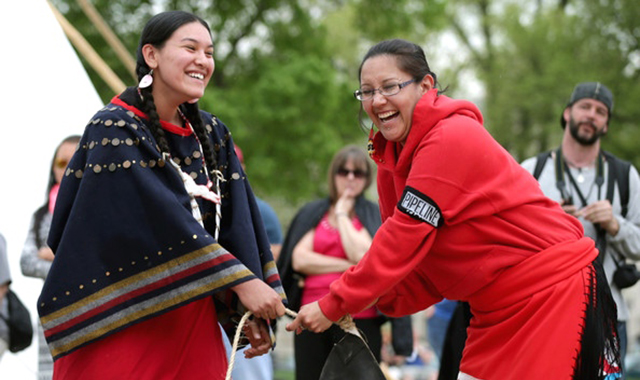
“We’re here to help protect the water, our first medicine,” he said. “Our most abundant resource is being destroyed by man.”
Michaelynn Hawk, 53, director of the advocacy organization Indian Peoples Action in Butte, Mont., said she saw a malicious design in the way the Keystone path is plotted.
“Why did they pick the reservations to lay down their pipeline?” she said. “They were probably thinking the indigenous people were not going to stand up.”
Many pointed out the dangers the pipeline posed to the water supply. Keystone, if approved, would cross the Ogallala Aquifer, one of the United States’ largest underground water reserves, carrying corrosive, unrefined tar sand deposits that environmental groups say is more prone to causing leaks.
“I raise horses on a small ranch, and they can’t drink oil. Sooner or later, that thing’s going to leak,” said Mike Blocker, 62, whose ranch is in Antelope County, Neb., directly in the path of the pipeline. “How can you sleep at night knowing that 830,000 pounds of this crap is flowing underground where you live?”
Donna Roller, 62, who owns a farm in York County, Neb., was appalled that more of the public was not up in arms that a foreign oil company — TransCanada, the owner of the pipeline — was marching into the United States and trampling on American land rights.
“What the hell? What is wrong with the American public that they are complacent in this?” she said. “This is a foreign corporation that’s going to make billions off our backs. We won’t allow them to go — we will lay our bodies on the line with the Native Americans.
“We need water, we need food,” she added. “We don’t need tar sands.”
The Cowboy and Indian Alliance has four days of events planned, including documentary screenings, meetings with environmental groups and elected leaders, traditional Native American ceremonies and delivering a tepee painted by the activists to the Museum of the American Indian in honor of Obama, as a sign of respect. The week will culminate in a rally on Saturday that organizers are expecting to attract 5,000 protesters.
Activists Tuesday seemed to acknowledge that they were fighting a perilous and uphill battle against moneyed interests — particularly oil and gas companies.
“They're going to continue to win their battles most of the time,” said Gary Rossi, 60, a protester from Washington who came to show his support. “Every day it doesn't get approved is another little victory.”
Nonetheless, the oil and gas companies say Keystone XL opponents are slowly losing the argument and that the environmental concerns are exaggerated.
“Today's opening ceremony for this week's Keystone XL D.C. protests has to be disappointing for activists given the small turnout — especially since it’s Earth Day,” Matt Dempsey, a spokesman for a coalition of oil industry trade groups and business associations that support the pipeline, said in a statement. “Despite the media hype, Keystone XL opponents are clearly losing momentum.”
3 WAYS TO SHOW YOUR SUPPORT



- Log in to post comments


