
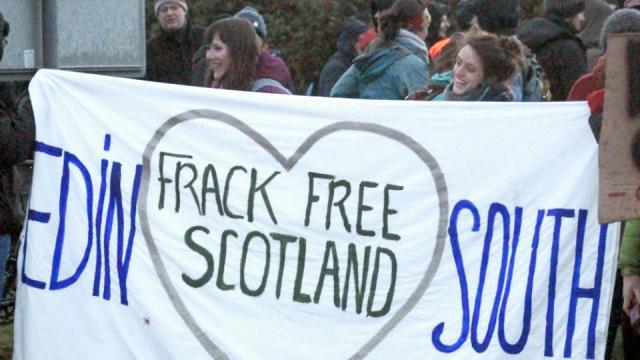
Scotland’s government under the Scottish National Party recently announced a moratorium on fracking. The Radical Independence Campaign responded by repeating its call for an outright ban on all forms of unconventional fuel extraction. Using new powers devolved to Scotland since the independence referendum last fall, the moratorium is just one example of the political transformation currently underway here.
The SNP is predicted to win 42 of Scotland’s 59 seat at the 2015 U.K. general election – an eight-fold increase that would make it Britain’s third largest party. Pollsters give the party a 42% chance of joining a U.K. coalition government. Combined with the #GreenSurge, it's safe to say that the era of British two-party rule appears to be ending.
The SNP is moving progressively in other ways as well, for instance in its call for a U.K.-wide end to austerity measures. If it joins a U.K. coalition government this spring, large-scale changes could be afoot regarding the party's anti-nuclear stance and its staunch support for Scottish independence. But the SNP is still a broad church, with reports saying some of its top voices still favor fracking.
Nonetheless, the rise in SNP polling, and its moratorium decision, is inextricably linked to Scotland’s people-led movements. Organizations like the Radical Independence Campaign (RIC), Women for Independence and Green Yes have continued to gain support post-referendum; the progressive movements are selling out conferences and continuing to hold Yes-stalls on street corners, public meetings and mass events.
A recent RIC anti-fracking conference welcomed the January moratorium cautiously, with a proviso that citizens must hold the Scottish National Party to its promise for a full and inclusive public discussion. A serious concern was raised that the moratorium didn't include the relatively unknown practices of Underground Coal Gasification (UCG), Coal-bed Methane, and fracking under the sea. The conference called for a ban on all these industries and shared direct action strategies to combat them – including lessons learned by the "Lock the Gate" movement in Australia.
Currently there are plans for UCG to take place in Kincardine, southeast Scotland. The process involves converting coal into gas while it's under the ground and inaccessible for mining. Oxygen, steam and other chemicals are pumped through boreholes under high pressure to make the coal seam explode, releasing methane and other gases that industry attempts to capture.
UCG, which remains less common than fracking, was conducted in the former USSR and more recently experimented in Queensland, Australia on three sites. Two of the tests have been shut down, including at Cougar Energy plant in Kingaroy, where there's been extensive ecological contamination.
On the other hand, with the Coal-bed Methane process, water is pumped out of the coal seam to make fractures and cavities so gas can be released. The vast amount of water drawn out has high levels of toxins, from its close proximity to the coal face. Other risks include its high emissions of methane, a potent greenhouse gas.
The anti-frack conference also highlighted New York State’s recent decision to ban hydraulic fracturing. The move in December by New York Gov. Andrew Cuomo happened as a result of wide ranging public consultation in combination with a massive, sustained protest movement, said Professor Andrew Watterson. An internationally acclaimed expert on public health, Watterson concluded that “as a health professional, we need to push for a ban.”
Scotland's governing party will soon announce a timeframe for the consultation. In the meantime, people are being encouraged to write submissions about the dangers of tapping unconventional fuels, to pressure the consultation to adopt the precautionary principle on the issue, and to visit local political representatives with petitions at all levels to ban fracking as part of a Broad Alliance of Scottish anti-fracking groups.
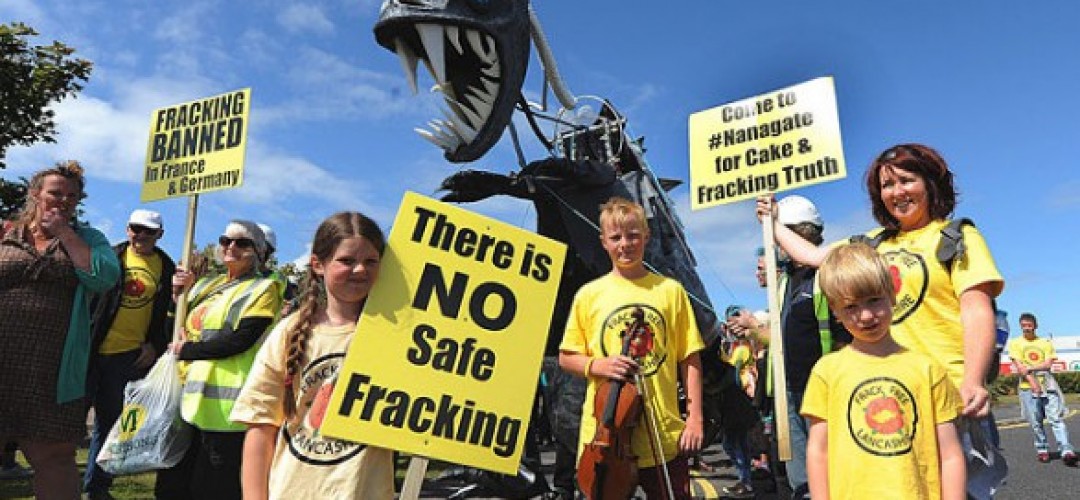
To counter the industry's efforts to prevent a ban, Radical Independence Campaign and others are reaching out to ally movements that joined them in the referendum push, as they attempt to galvanize public opposition to fracking through street stalls, meetings, protests and educational events like anti-fracking film nights.
The conference also focused on the crucial role played by community campaigns in fighting unconventional fossil fuel extraction. The opening session heard about Falkirk, where Dart Energy plans to commence work on Coal-bed Methane. In opposition, local residents defined a Community Charter to assert what they feel should be protected as community assets. Features the group chose to preserve include a clean environment, future generations, food security and trustworthy elected representatives.
The charter has already been adopted by four communities, and is gaining momentum. Maria Montinaro from Concerned Citizens of Falkirk explained that the charter was easy to replicate: all a place needs to do is define its own assets, and it can adopt the charter.
Mary Church from Scottish Friends of the Earth told the audience that Scotland already has world-leading legislation to tackle climate change and is a global leader in renewables. “Opening up a new frontier of fossil fuels is completely irresponsible," she said. And with a Green Surge sweeping the U.K. ahead of May elections, her opinion appears to reflect the majority.

3 WAYS TO SHOW YOUR SUPPORT


- Log in to post comments


