
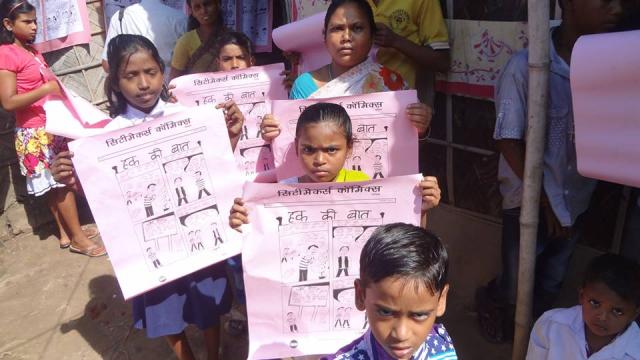
In the Jaduguda hamlet of eastern India's Jharkhand state, villagers knew that uranium was being mined but they had little idea about the enormous harm the uranium dust was causing. Surendra Mohan Murmu, a resident, realized that trying to explain the dangers to the villagers would have to be done carefully. He wanted them to understand the issue so that protests against the indiscriminate mining practices would be well informed and aware of the facts.
So Murmu drew a series of comics that he mounted on walls where passersby could see them. At first they made people laugh. But gradually the issues highlighted in his drawings caught their eye. "People gathered around in groups to discuss them,” he says. “Every day we watched the numbers grow.”
Murmu and others like him in India now go by the emerging title of "comic activists," a term used to describe those whose talent at creating comics is helping ensure that poor and under educated people understand laws and their basic human rights. Murmu creates a regular wall poster titled “Aibhen Marshaal,” written in the santhali language, which focuses on the many violations occurring in this largely backward and under-reported region. Murmu’s recent protests have been against the planting of Monsanto's genetically modified Bt Brinjal, or eggplant, being grown in Orissa.
Sharad Sharma, the founder of the comics journalism movement in India, says that protests like Murmu's highlight his belief in the power of comics to inform people and change their minds about important issues. Sharma teaches some of India’s poorest populations to literally draw their concerns in the form of funny cartoon characters, which are displayed as wall posters that not only educate citizens — but make officials aware of the real wants and needs of the people.
The art of the movement is this: comic wall posters get across information quickly, easily and cheaply.
“It’s not as if no one cares about the poor or the powerless in the country,” says Sharma. “But those that formulate polices are so far removed from the lives they are trying to improve that often their plans aren’t very successful. In the whole process of development we forget who it’s actually aimed at.”
Articulating Complex Issues
A popular political cartoonist associated with different India news media, Sharma in the early 1990s began to realize he could use cartoons to highlight the issues of the common man with great impact. “Together we have managed to create a grassroots movement where comics have become a legitimate symbol of protest,” he says.
Sharma trains others from the villages he works in. Anyone can join and become a "comic activist," where no subject is taboo and no subject is above being made into a cartoon. As a result, comic activists have helped ensure that social movements across India gain visibility and direction. “Their importance,” says Sharma, “cannot be over emphasized.” He cites as an example the Barmer Comics Manch, a local initiative that has successfully run “Aapni Dikri Ro Haq” (The Rights of Our Girl Child), launched in Rajasthan with the aim of raising awareness about female feticide.
Comic Activism
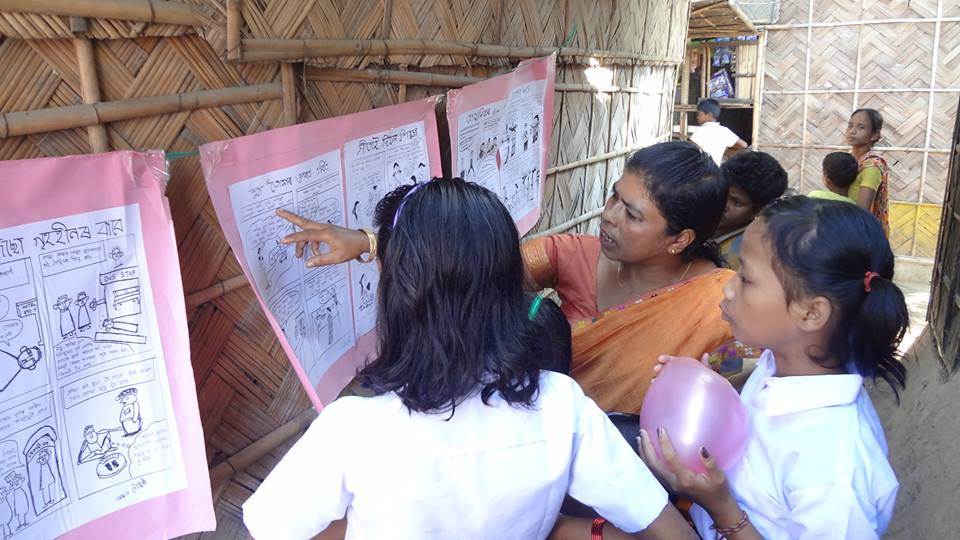
Rashmi Rekha Das is an activist based in Bhubhneswar, Orissa. She learned the art of creating comics in a workshop held by Sharma, and was inspired to stay on. Das conducts different workshops and has already trained several children. Because she herself is from the community, people are comfortable coming to her, articulating ideas and discussing solutions.
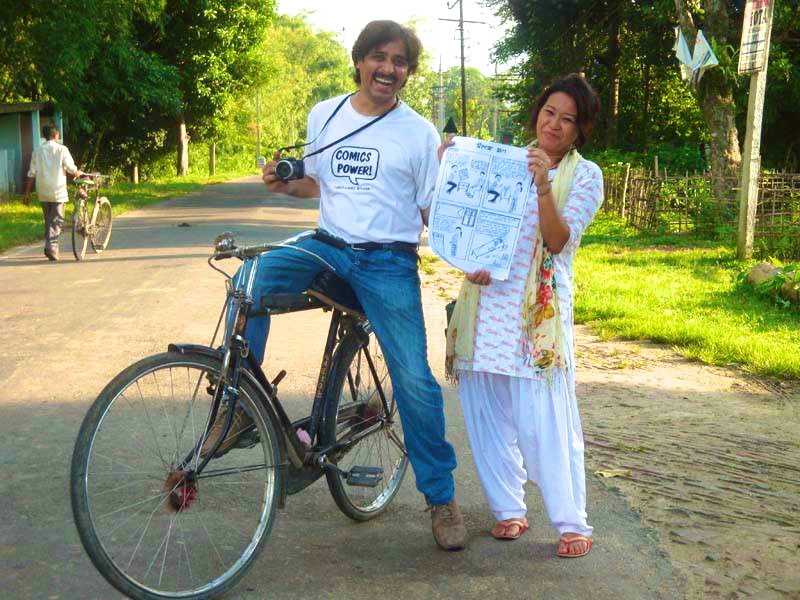
The movement started small. Traveling on his scooter, Sharma would cover remote hamlets, holding workshops and teaching people to draw about what concerned them and to articulate issues they had never raised openly. “At first children were my most enthusiastic participants,” he says. “Once adults realized that this was one medium that didn’t require reading or writing, they joined in as well. Young people remain my favorite students.”
One example is the small town of Muzaffarpur in the northern state of Bihar. There, children didn’t have proper drinking water facilities at school. Girls were discriminated against because of their gender, and child marriage was rampant. The children wanted better schools, more access to books and they were against early marriages, but they had no outlet and no one who would listen.
After a workshop with Sharma, in association with the NGO Adithi-Plan, the children drew as a way of voicing their concerns. The comics drew the attention of the village headman, and they managed to get a hand pump for their school. One of the girls, whose parents were worrying about her marital prospects, managed to convince them that it was school she needed and not a wedding.
“Comics are so non-threatening in nature that the officers who see our posters first smile and once everyone is in a better mood, discussions about thorny issue proceed more smoothly,” he says.
Suresh Jaipal, from the remote hamlet of Anti in Barmer, of Rajasthan state, attests to this. The village had been promised better water facilities for years. In a recent meeting, talks with officials weren’t going well. That’s when Jaipal stepped forward with a series of drawing showing a fat man melting in the heat of bureaucratic wrangling. The irate crowd was amused and finally concrete plans about the water facilities were decided on.
Sharma works with NGOs and other organizations who help bring people together. “We don’t need much,” he says. “Comics are simple line drawings. All we need are ideas, paper and pencils.”
Usually drawn on large news sheets, the comics they are posted on walls where the entire village can see them and discuss the matters they raise. Many are stuck on vehicles to be displayed as mobile exhibitions. Some of the workshops often develop into intensive campaigns.
The “Goenkar Changemaker Campaign, Goa” was started in 2006 to alert children to the dangers of tourists seeking sex. Students from local colleges produced cartoons that were displayed in more than 60 villages by the Child and Women Welfare Board.
By 2003, Sharma couldn’t handle the vast number of calls asking for training, so he formed the World Comics Organization to add size and structure to the movement. Today, World Comics India is a collective of grassroots activists, cartoonists, artists, journalists and students using comics as a communication tool as well as medium of self-expression, with networks extending to Pakistan, Nepal, Sri Lanka, Brazil and the U.K.
Sharma is candid about the impact of his work. “I won’t say that we have felled governments or changed the way society operates,” he says. “But the whole comics journalism movement has shown even the very poor can have a means of putting their voice forward. It might not be easy but it’s effective.”
Follow the author Paromita Pain on the Commons or on twitter at @ParoP
3 WAYS TO SHOW YOUR SUPPORT



- Log in to post comments


