
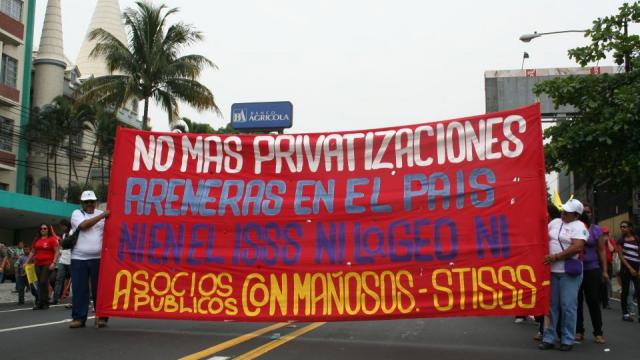
Unions in El Salvador are on high alert, fighting a privatization scheme that has the full weight of the U.S. government behind it. Led by the Salvadoran Union Front, a militant coalition of public- and private-sector unions, workers are mobilizing against a proposed Public-Private Partnership (P3) Law, drafted by Salvadoran President Mauricio Funes’s office with U.S. Treasury Department assistance.
The law is an initiative of the bilateral development agreement called the Partnership for Growth, which the U.S. Embassy in El Salvador calls a “signature effort of President Obama’s development policy.” With everything from ports, airports, and roads to municipal services and higher education on the auction block, the P3 law threatens public-sector workers with layoffs, wage cuts, and union busting. In the face of aggressive U.S. pressure for the law’s passage, Salvadoran workers are counting on international solidarity to protect their jobs and defend state services.
“For us,” says José Alberto Cartagena Tobias of the SITEAIES airport workers union, “a public-private partnership is nothing more than privatization.” Workers like him know firsthand the cost of privatization. After state banks, telecommunications, electricity, and pensions were sold off under the right-wing Nationalist Republican Alliance (ARENA) administrations of the 1990s, labor conditions plummeted.
Five thousand workers were laid off at the telecommunications company, and those remaining saw salary reductions, the loss of seniority, and their union dissolved. Nearly 1,000 workers were laid off at the Acajutla port following privatizations in 2001; dock workers’ daily wages dropped by 90% and their union was dismantled. At the airport, security, cargo, and cleaning services were privatized that year; these workers now earn $240/month, while the unionized airport workers earn a minimum of $552 a month.
Soaring utility rates and rising unemployment soon turned public opinion against privatization. In 2003, 150,000 Salvadorans took to the streets to shut down ARENA President Francisco Flores’ attempt to privatize the health-care system; little has been privatized since.
Today, the U.S. government and Salvadoran economic elite are trying a different tack. The new strategy, explains Gilberto García of the Center for Labor Study and Support (CEAL), “appears more ‘lite’.” The P3 Law is designed to shield new contracts from the controversies that damned past concessions.
Currently, all privatizations and concessions require legislative approval. The proposed law, however, would create a body in the executive office to approve concessions, with many contracts bypassing the legislature entirely. And the bill is more generous to corporate bidders than it is to state budgets; for larger concessions requiring legislative approval, a bidding corporation would be guaranteed a 1% return on bid value if debate extends past 45 days, or if the bid is rejected.
Furthermore, equal-treatment stipulations ensure a major bidding advantage for transnational corporations, which generally have more capital than local companies. Workers like Cartagena fear that with concessions funneling former sources of state funding into foreign bank accounts, vital social programs will inevitably suffer: “The few resources that remain with the State will be in private hands—people who come from other countries to exploit [us] and then take our money who-know-where.”
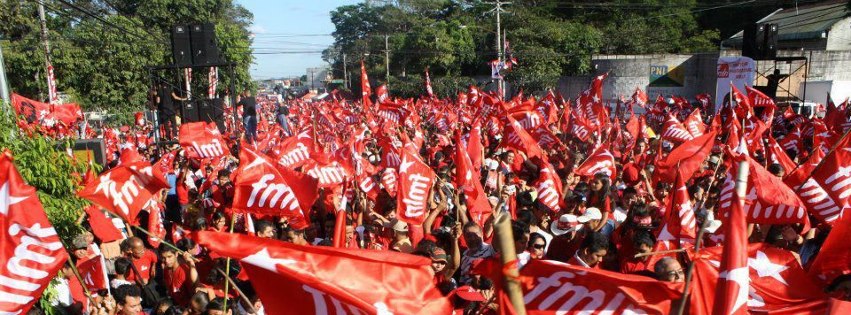
Through constant lobbying and mobilizations over the past year, the Salvadoran labor movement has made its position clear. These efforts have won the support of the Farabundo Martí National Liberation Front (FMLN), the leftist governing party that allied with Mauricio Funes, a non-FMLN member and progressive journalist, to win the Presidency in 2009.
But while the FMLN opposes the President’s bill, it alone does not hold enough legislative seats to block the law’s passage. “We are rejecting public-private partnerships,” shouted Mari Carmen Molina of the Union Confederation of Salvadoran Workers to the cheers of 70,000 amassed in a San Salvador plaza on May Day 2012, “because even though the government sells it as a concession, we know that these are privatizations!”
But the U.S. is hitting back. In recent months, U.S. Ambassador to El Salvador Mari Carmen Aponte has launched a pressure campaign for the passage of the P3 Law, warning in national media that the law is a “prerequisite” for a disbursement of over $350 million in development aid, and stating that $50 million of those funds must be reserved for P3 projects.
Salvadoran public-sector unions are calling on U.S. allies to denounce this intervention. In February, Salvadoran labor leaders met with union members and officials in cities across the United States during a tour organized by the Committee in Solidarity with the People of El Salvador (CISPES).
In Washington, D.C., Jaime Rivera of the Electrical Sector Workers’ Union (STSEL) emphasized the stakes of the struggle: “This matter goes far beyond what will happen to us as workers. This is a matter of defending our national assets, of not allowing them to be turned over to private hands, who will profit off of our infrastructure and national resources at the expense of our people.”
U.S. unions and labor councils, recognizing similar privatization threats to U.S. workers, are heeding the call. Labor groups including the San Francisco and Washington State labor councils, SEIU local 6, ILWU local 5, UNITE HERE local 2, the Labor Council for Latin American Advancement NYC, DC 37 and many others have passed resolutions condemning the US pressure for the P3 Law, and have sent letters to President Funes’ office and party leaders in the legislature to support the Salvadoran unions’ opposition to the bill.
In addition, over 1,000 US residents have added their signatures to a petition to Ambassador Aponte, demanding an end to US pressure for the law.
Early debate around the P3 law has already begun in the Salvadoran Legislative Assembly. The right-wing parties have the majority votes necessary for the bill’s approval; only massive popular opposition can stall its passage. Addressing U.S. workers, SITEAIES’ José Alberto Cartagena Tobias calls for solidarity: “What we need, definitely, are allies. We need a lot of allies. ... And as soon as possible, because we know that this is practically already on top of us.”
Originally published by Dollars and Sense.
3 WAYS TO SHOW YOUR SUPPORT



- Log in to post comments


