
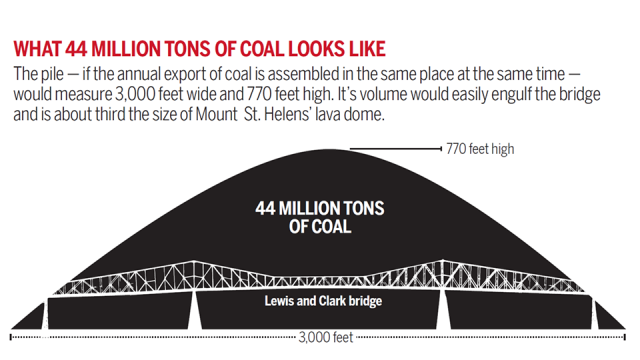
A final “scoping” hearing was held October 17 in Tacoma, Washington, regarding a massive coal export terminal proposed for Longview, along the Columbia River. The hearing was an opportunity for public input on issues for the Washington State Department of Ecology to study while writing the project’s Environmental Impact Statement. It was attended by Millennium Bulk Terminals Longview, which was formed by coal industry partners to build and operate the terminal. On the other side, Power Past Coal represented the grassroots opposition to the project. While it was the last public hearing, comments on the proposal can still be submitted online until November 18.
Times are turbulent for the coal industry. Between 2008 and 2012, Big Coal lost a big chunk of its share of total U.S. electricity generation, falling from 48% to 37%. This was due in large part to coal being displaced by cheaper and ever more abundant natural gas. Coal’s popularity has slipped at just the moment that 350.org and its environmental allies have succeeded in underscoring the urgency of curbing CO2 emissions.
Meanwhile, and not coincidentally, U.S. interest in wind and solar energy has exploded, setting further limits on coal’s domestic prospects. The coal industry is increasingly hesitant to bid on new mining permits, and a recent analysis by Goldman Sachs took a dim view of the future of coal investments.
With U.S. coal mining corporations looking overseas, notably to China as the growth market for their product, the stage is set for a clash over access to the Pacific Coast in the northwestern United States, where coal could be transferred from freight trains crossing country to coal barges crossing the sea.
And as China begins to take major steps to address its own CO2 and smog problems — for example, restricting new coal plant construction, at the popular demand of its citizens — the time is ripe to engage in conversation about whether coal has a future as a major fuel source at all.
A piece of that conversation took place in Tacoma on October 17. The Cascades region finds itself at the crossroads of the U.S. coal industry's wants and Asia’s coal energy needs. Whether or not coal port terminals such as the one in Longview get built may determine whether coal mining expands or contracts in the U.S., along with its impact on worldwide CO2 emissions. Millennium Bulk plans to ship 44 million tons of coal per year through the region.
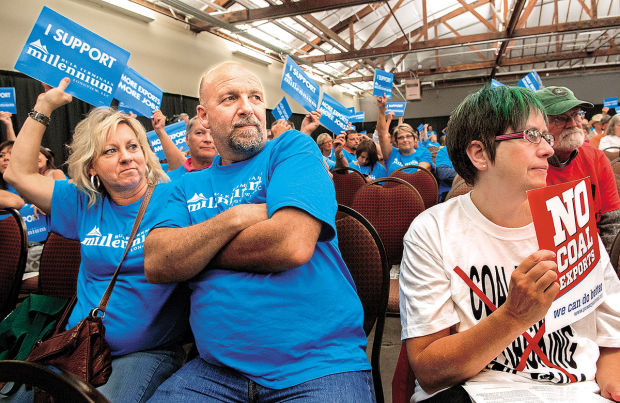
In contrast to the 100 or so attendees who were there two weeks ago to support the Millennium project, some 700 opponents aligned with Power Past Coal showed up to say that human-driven climate change is a pressing reality that must be factored into any impact statements on the project. Millennium’s prime contention was that impact statements had never been done this way in the past, and thus it would not be fair to consider climate change or any other factor that was not strictly “local.”
Interestingly, before the hearing had even begun, representatives of Millennium appeared somewhat demoralized. Virtually no one from that camp made eye contact with members of Power Past Coal, and there was body language to match. The 7-to-1 crowd opposing the terminal reflected previous Washington coal export terminal hearings.
A core perception, however, was that Millennium's testimony itself revealed a shaky trust in the strength of their own case. The best points made by Millennium supporters focused on the more limited nature of scoping in the past — and, of course, on jobs as well. They reiterated time and again that new coal terminal jobs were something that Washington State needed as soon as possible, even though most of the jobs would be related to the terminal's construction, and therefore temporary.
Some testifying with Power Past Coal pointed out that loading coal from rail to ship is a highly-automated process which requires relatively few people. The question quickly became whether the value of a few permanent jobs outweighed the health, safety and environmental costs to the community.
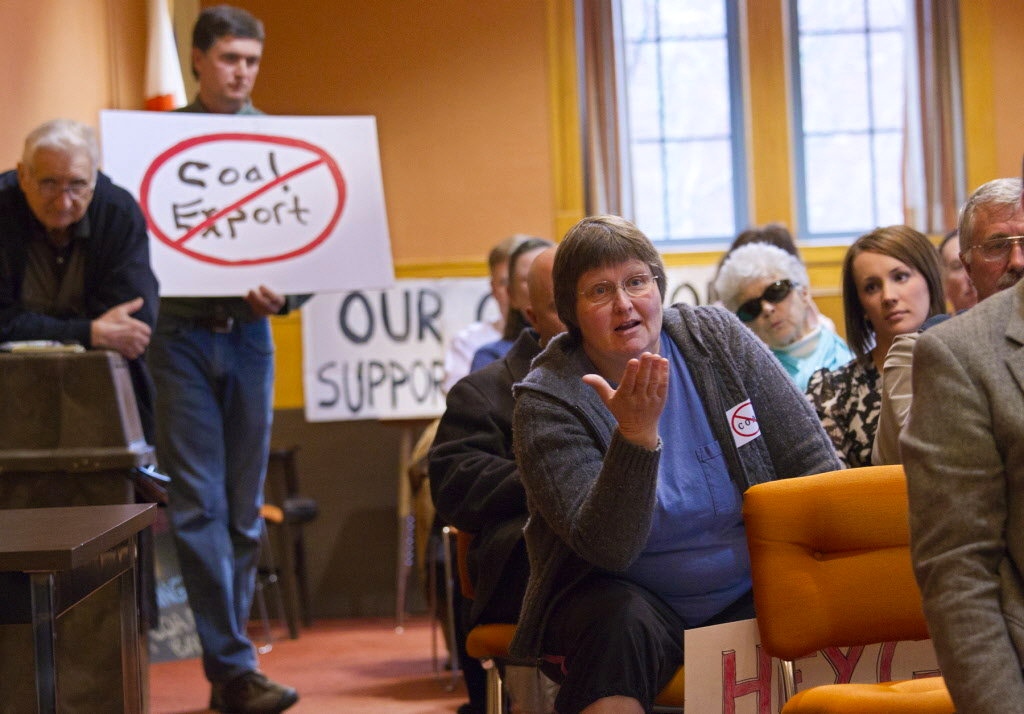
Power Past Coal also had something to say about the issue of the EIS scope. While Millennium argued that the scope shouldn’t extend to include impact on world carbon levels, PPC recognized that it was wrong for the scoping of past projects not to have included worldwide impacts, especially since these impacts would also be suffered at home. Making an EIS local-only scope is a useful way for fossil fuel companies to externalize the cost of the impact, and fail to account for the true cost of negative externalities that have long been an important concern for environmentalists.
Millennium’s comments grew increasingly thin. One participant ranted for two minutes without managing to arrive at a point. Another argued that the only alternative to expanded U.S. coal ports was for China to import its coal from countries such as Turkey with its “dirty lignite.” A fact-check confirmed that the U.S. does indeed have much larger reserves and already exports more lignite every year.
While the issue at the hearing was strictly whether to allow coal to be exported through Washington State, Millennium boosters extolled the cheap cost and environmental friendliness of “clean coal” technology. They discounted wind and solar energy as too costly to compete, a “hippie fantasy" as they called it. According to the U.S. Energy Information Administration, wind power is already almost universally cheaper than any form of coal technology, “clean” or conventional. And solar is not far behind. The Millennium argument against the reliability of renewable power seemed to be merely that we would never come up with solutions.
On PPC's side of the aisle, major questions were raised about how, and how many, 1.5-mile-long coal trains would impact local traffic and emergency response — and alternatively, how costly new overpasses would be for affected communities. We asked how dust and emissions from the coal would affect asthma, cancer rates, water quality and wildlife habitat.
One individual directed the public's attention to past coal barge disasters and demanded to know what a once-in-100-years accident could cost if that severity occurred on the Columbia River. Others said that if the Longview terminal were allowed to be built, everything environmentally achieved in our state would be undone.
Keep in mind the science and the math on climate change: the confirmation that if we burn even 20% more of our existing carbon stockpiles, life on earth will become difficult to a critical degree. We are already beginning to see such losses as the weather grows more extreme, and no amount of profits from coal that we export can pay those costs. The more our public policy picks the fossil fuel industry for winners, the more it picks the rest of us for losers.
The hearing on October 17, however, didn't strike a depressing note. “I sense a lot of angst in the room,” said the moderator at one point. "Why don’t we do this: If you feel the need to express yourselves, now’s your time to get it all out.” The cheering that erupted in the room seemed impossibly loud for only 800 people.
3 WAYS TO SHOW YOUR SUPPORT



- Log in to post comments


