Read

User menu

Search form

Financial Transaction Tax Gets the Green Light in Europe

Financial Transaction Tax Gets the Green Light in Europe
Mon, 10/15/2012 - by Sarah Anderson
This article originally appeared on Institute for Public Policy Studies

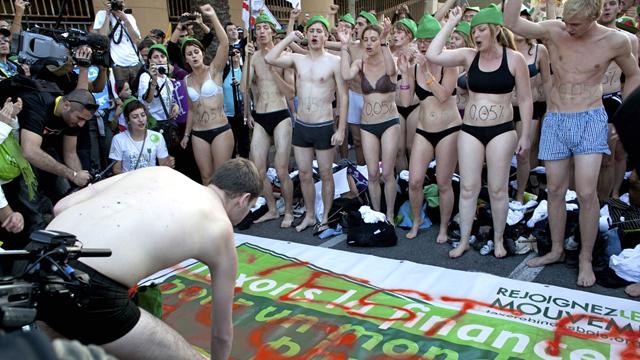
Photo: Oxfam France

European campaigners for a financial transaction tax have done some awfully goofy things over the past three years.

At one French demonstration, they stripped down to their skivvies to emphasize the small size of the tax (0.1% on trade of stocks and bonds and 0.02% on derivatives under the European Commission's proposal). In Germany, they rented a limo and crashed the Berlinale film festival, dressed as Robin Hood characters. In many countries, they've gotten elected officials to pose with silly hats and fake bows and arrows.

But after last week, the opponents of the financial transaction tax (aka Robin Hood Tax) will no longer snicker at such antics. At a meeting of European finance ministers on October 9, 11 governments committed to implementing the tax. This is two more than the minimum number needed for an official EU agreement. And it is a huge victory for those of us -- not just in Europe but also in the United States and around the world -- who've been pushing for such taxes as a way to curb short-term speculation and generate massive revenue for job creation, global health, climate, and other pressing needs.

Of course the goofy stunts weren't the only game-changers. Campaigners have also built up strong technical arguments about the feasibility of such taxes. And a growing number of financial professionals have come out in support, blunting the industry backlash.

The broader European crisis has also been a major factor. In fact, there are rumors that Italy and Spain may have sold their support in exchange for some debt concessions from Germany. The additional eight governments in the new coalition of the willing are France, Austria, Belgium, Estonia, Greece, Portugal, Slovakia, and Slovenia. More may join in the coming months.

There are still a few hurdles ahead. There will be a round of negotiations that could result in the European Commission's proposal being watered down by lowering the rates or narrowing the base to only cover securities. There will be a fight to make sure revenues help people and the planet instead of the big banks. And EU heads of state will have to vote by a qualified majority to give the initiative the green light. This means some countries that don't plan to implement the tax themselves will still need to sign off on it. The biggest opponent, UK Prime Minister David Cameron, may have some obstructionist tricks up his sleeve.

But according to Peter Wahl of WEED, one of the key forces behind the German campaign, "there is now quite a strong political will behind the project, so that we can expect definitive implementation rather soon, perhaps already during 2013."

Europe's dramatic step forward can only boost the growing U.S. grassroots efforts for a Robin Hood Tax. Our current Treasury Secretary, Timothy Geithner, has been a naysayer, sometimes even chastising European leaders for considering the idea. But with Geithner heading out the door after the election and Europe moving towards raising revenue off the tax, we may get a blast of fresh thinking.

3 WAYS TO SHOW YOUR SUPPORT

ONE-TIME DONATION

Just use the simple form below to make a single direct donation.

DONATE NOW

MONTHLY DONATION

Be a sustaining sponsor. Give a reacurring monthly donation at any level.

GET SOME MERCH!

Now you can wear your support too! From T-Shirts to tote bags.

SHOP TODAY

Sign Up

Article Tabs

From a pro-democratic perspective, civil society and new media organisations are surging in the aftermath of the Orban regime.

The country’s new prime minister, Andy Burnham, has promised a break from the politics of the last 40 years—realizing more broadly that Labour must stand up for the 99% against big business, or the party will become irrelevant.

The tragic shooting of Lorenzo Salgado Araujo is just the latest example of ICE having a fundamental disrespect for human life — further proving why the agency should be stripped of funding and shut down, and its rank-and-file agents and leadership prosecuted.

While the U.S., EU and their allies are enabling Rojava—the strongest force against Islamic State— to fall, it is vital for internationalists to continue to support this beacon of democracy and liberation.

June 23, 2026 may be remembered as the beginning of the end of the Democratic Party establishment.

The current wave of food recalls is a direct byproduct of President Donald Trump’s administration deliberately removing the safeguards put in place aimed at protecting American consumers more than a century ago.

From a pro-democratic perspective, civil society and new media organisations are surging in the aftermath of the Orban regime.

We can still celebrate success while simultaneously putting a cap on net worth.

The country’s new prime minister, Andy Burnham, has promised a break from the politics of the last 40 years—realizing more broadly that Labour must stand up for the 99% against big business, or the party will become irrelevant.

Much like the resistance to AI data centers, the opposition to Flock surveillance cameras has brought the left and the right together against billionaires who are trying to force America into becoming even more of a police state.

Much like the resistance to AI data centers, the opposition to Flock surveillance cameras has brought the left and the right together against billionaires who are trying to force America into becoming even more of a police state.

Posted 2 months 1 day ago

The country’s new prime minister, Andy Burnham, has promised a break from the politics of the last 40 years—realizing more broadly that Labour must stand up for the 99% against big business, or the party will become irrelevant.

Posted 2 months 1 day ago

We can still celebrate success while simultaneously putting a cap on net worth.

Posted 1 month 2 weeks ago

The current wave of food recalls is a direct byproduct of President Donald Trump’s administration deliberately removing the safeguards put in place aimed at protecting American consumers more than a century ago.

Posted 3 weeks 2 days ago

From a pro-democratic perspective, civil society and new media organisations are surging in the aftermath of the Orban regime.

Posted 3 weeks 4 days ago

The current wave of food recalls is a direct byproduct of President Donald Trump’s administration deliberately removing the safeguards put in place aimed at protecting American consumers more than a century ago.

From a pro-democratic perspective, civil society and new media organisations are surging in the aftermath of the Orban regime.