
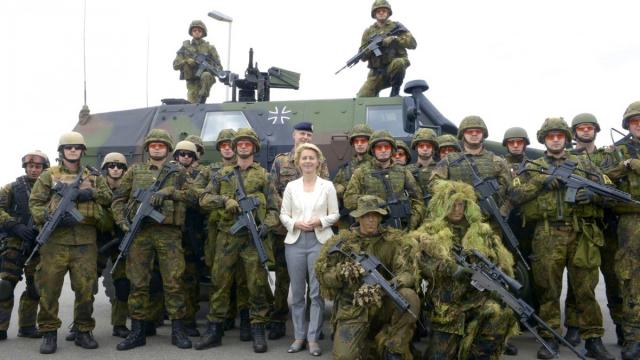
The recent rise of terrorist attacks in Germany and the subsequent escalation of defense measures by German authorities have put the country back in the international spotlight. Now, the Ministry of Interior's announcement to deploy federal Bundeswehr forces along with police to begin intensive anti-terror drills never before seen in Germany, combined with a recent civil defense plan urging German citizens to stockpile food and water in case of a national emergency, has made the country appear as though it's teetering on the edge of chaos.
Despite constant reassurances that Germany was not facing an imminent attack in its interior, the recent reports went to great lengths to speak of the possibility of a "future" disaster which would, in turn, cause the government to bring back a nationwide conscription program.
In particular, the government's recently published "White Paper: On German Security Policy and the Future of the Bundeswehr," proposed future legislation regarding the reformation of the country's Federal army. According to the document, the Bundeswehr's duties will include conducting "defense tasks" within German and allied territories, defending against hybrid threats and working alongside UN and NATO forces to secure embargoes and sanctions. The document explains:
"The White Paper will lay the foundation for one of these instruments in particular, namely the Bundeswehr, to meet the challenges of the future."
In the document, Germany admits its role as a key player in Europe but also recognizes its importance toward shaping the future international scene. "Our ambition is also to improve the conditions of human coexistence in a sustainable manner and to protect and strengthen international human rights norms," it reads.
However, the German federal administration is aware that its current economic sovereignty in Europe may not be maintained indefinitely, and part of the suggested legislation appears intended to acclimate the country to future shifts, stating:
"In the long run, however, it is unlikely that Germany will retain its position as the world’s fourth-largest economy. The economies of the emerging powers in Asia and Latin America will likely overtake the German – although not the European – gross domestic product in the coming years."
With this in mind, Germany remains open to a controlled influx of new immigrant populations, ensuring that the country is more than willing to factor in future demographic changes. Specifically, the document reads, "In the future, strong population growth in African and Asian countries as well as our own demographic changes will place Germany under increased pressure. This trend can be mitigated through qualified immigration, but it cannot be stopped."
The document also elaborates on Germany's current strategic standing and the possibility of future forays into large-scale international undertakings. The issues discussed in the proposed legislation tie in with previous German policies, which served to increase public defense spending, leading to the biggest overhaul of the country's armed forces in the last decade.
From a foreign policy standpoint, the White Paper initially appears to present an alarming development in regards to Germany's new foreign policy. The financial and political turmoil in Europe following the Brexit, the slew of recent terrorist attacks and the possibility of a future conflict with Russia creates an impression that Germany is well on its way toward rearming itself. However, closer examination of recent events prove that this is not the case.
If anything, Germany has maintained a presence in international peacekeeping efforts since a 1994 court ruling, while its forces have also participated in a non-combat capacity within the international alliance against the Islamic State. Instead, Germany seems prepared to assume a new role as a leading power helping to establish a unified European Army, with the intent of protecting the European Union's interests, and allowing for the creation of a non-fragmented military force that would be able to compete on an international level at severely reduced cost.
This, according to the document, will be achieved by supplementing the presence of NATO forces in the region, rather than by outright displacing them as had been the case with the establishment of the Western European Union, a defensive alliance of 10 E.U. countries (including Belgium, France, Germany, Greece, Italy, Luxembourg, the Netherlands, Portugal, Spain, and the United Kingdom) whose intent was to provide military support in case of Soviet aggression.
According to an article in Newsweek written by the U.K.'s former Prime Minister Tony Blair, Germany's current initiative “would not supplant NATO but would have the independent ability to take military action at times when Europe’s security interests are threatened when the U.S. may decide not to be involved.”
The White Paper's proposed legislation came under fire when it was leaked to the press in May by the U.K.'s then-Prime Minister David Cameron, who warned that Germany's intent to establish a unified E.U. army would only serve to weaken the existing deterrents toward external aggression by crippling the GDP of the Union's member states. Furthermore, the presence of a unified E.U. army would serve only to drive NATO forces away from the Union, he argued, which would in turn drive U.S. military presence away as well.
On the other end of the spectrum, France appears to welcome the proposed German White Paper, treating the possibility of a unified European Army as a positive proposal. With the uptick of recent terrorist attacks on French soil, and with its army dangerously close to being overstretched, it makes sense that France would pursue a strategy to ensure stability within the broader region, while leaving the U.K. to focus its efforts toward strengthening its ties with NATO forces.
Whether or not the proposed legislation would put Germany at the head of the new European Defense Force, the E.U.'s most prominent member states are already intrigued by the possibility of establishing a military deterrent to handle continental crises in the future. Germany has made its intentions clear, showing that the country is capable of bearing the economic and political costs of organizing such an ambitious endeavor. However, it should be remembered that whichever country takes the reins to enact such a plan will not do so without its own explicit interests in mind.
3 WAYS TO SHOW YOUR SUPPORT



- Log in to post comments


