
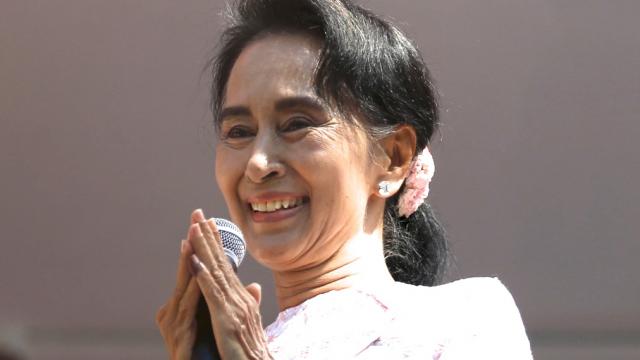
Myanmar's ruling party conceded defeat on Monday in a general election as the opposition led by democracy figurehead Aung San Suu Kyi appeared on course for a landslide victory that could ensure it forms the next government.
"We lost," Union Solidarity and Development Party (USDP) acting chairman Htay Oo told Reuters a day after the Southeast Asian country's first free nationwide election in a quarter of a century.
By late afternoon on Monday, vendors outside the headquarters of the National League for Democracy (NLD) in Yangon were selling red T-shirts with Suu Kyi's face and the words "We won."
The election commission was announcing the results of Sunday's election as they trickled in, constituency by constituency. Suu Kyi's party won 49 of the first 54 seats declared for the lower house, where 330 seats were contested.
The keenly watched vote was Myanmar's first general election since its long-ruling military ceded power to President Thein Sein's quasi-civilian government in 2011, ushering in a period of reform and opening up to foreign investment.
The NLD said its own tally of results posted at polling stations around the country showed it was on track to win more than 70 percent of the seats being contested in parliament, above the two-thirds threshold it needs to form Myanmar's first democratically elected government since the early 1960s.
"They must accept the results, even though they don't want to," NLD spokesman Win Htein told Reuters, adding that in the populous central region, the Nobel peace laureate's party looked set to take more than 90 percent of seats.
Reuters was not able to independently verify the party's own estimates of its performance.
Jubilation
Traffic squeezed at a walking pace through the jubilant crowd outside the NLD headquarters. Hundreds of people, many sporting the party's color of red and a peacock logo, waved flags and cheered as results were announced and projected onto a screen hung from the building.
"I'm very happy about the result," said Hnin Si, 60, a trader in Yangon. "The people have suffered for 50 years. I believe Aung San Suu Kyi will make the country a better place."
The election was a landmark in Myanmar's unsteady journey to democracy from the military dictatorship that made the former Burma a pariah state for so long.
It is also a moment that Suu Kyi will relish after spending years under house arrest following Myanmar's 1990 election, when the NLD won a landslide victory that was ignored by the junta.
This time, the ruling party, which was created by the former junta and is led by retired military officers, as well as the chief of the armed forces have pledged to respect the result.
But although the election appears to have dealt a decisive defeat to the USDP, a period of uncertainty still looms because it is not clear how Suu Kyi will share power easily with the still-dominant military.
The junta-drafted constitution guarantees one-quarter of parliament's seats to unelected members of the military and allows the commander-in-chief to nominate the head of three powerful ministries: interior, defense and border security.
The charter also gives the armed forces the right to take over the government under certain circumstances, and the military maintains a grip on the economy through holding companies.
Barred from Presidency
Even if the NLD gets the majority it needs, Suu Kyi is barred from taking the presidency herself under the constitution, written by the junta to preserve its power. Suu Kyi has said she will be the power behind the new president, regardless of a charter she has derided as "very silly".
Incomplete vote counts showed some of the most powerful politicians of the USDP trailing in their bids for parliamentary seats.
Among the losers was USDP chief Htay Oo, who told Reuters from the rural Irrawaddy delta heartlands that are a bastion of support for his party that he was "surprised" by his own defeat.
Voting in the historic election was for the most part trouble-free, despite religious tensions fanned by Buddhist nationalists whose actions intimidated Myanmar's Muslim minority in the run-up to the poll.
But the NLD cried foul on Monday over advance votes that could boost the chances of a senior member of the ruling party.
In an official complaint, it said it was "illogical" that the USDP could win 90 percent of advance votes – made by those unable to vote on election day – in Lashio, a township in the east of the country with a large military presence.
Its complaint followed concerns that some observers had not been given permission to monitor voting in military installations.
The issue over advance votes taps painful memories of a previous election in 2010, which the NLD boycotted and the USDP won by what the Brussels-based think tank International Crisis Group called "massive manipulation" of the count, particularly of advance votes.
3 WAYS TO SHOW YOUR SUPPORT



- Log in to post comments


