
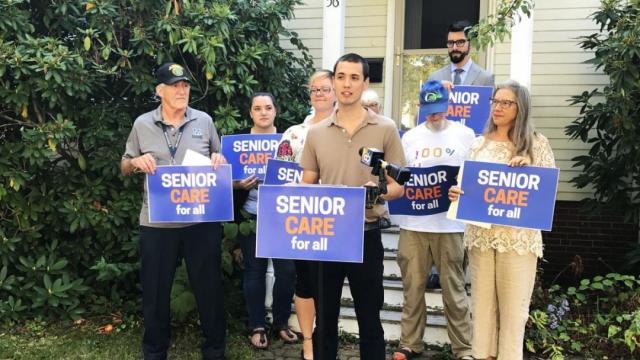
A group of progressives in Maine has proposed a radical new solution to providing medical care for an aging, rural population. Question 1, a measure on the ballot in November, proposes universal home health care for all Maine residents, to be paid for by a tax on people making more than $128,400 a year. Opponents of the proposal say that the program would be too costly; supporters say it could radically change the lives of people living with disability or serious illness.
Eligibility for the program would depend on daily needs, rather than on a medical diagnosis. Maine residents who cannot complete at least one “daily living” activity, such as bathing, cooking or walking, would be able to receive help in a variety of forms.
More than 27,000 people may be eligible for the program, with seniors making up less than half, at 13,100, according to an analysis by the University of Southern Maine. According to another study by the university, half of Maine residents older than 75 have a disability.
“I’ve never had people cry signing a petition and tell me how much something like this would have changed their lives,” Kevin Simowitz, political director for Caring Across Generations, told Kaiser Health News. The Maine People’s Alliance, a grassroots organization that works on a variety of progressive issues, collected 67,000 signatures to get the measure on the ballot. The group has spent $343,166 in support of Question 1, according to the most recent state campaign finance data.
“In our rapidly aging state, too many seniors are being forced from their homes, and too many people with disabilities can’t get the care they need,” said Miri Lyons, a Maine resident and former home care worker and family caregiver for a child with a disability. “Home care for all will fix that. It’s a guarantee that if you need help staying in your home, you can get it.”
Two ballot question committees—Mainers for Homecare and Caring Majority—have spent $233,567 and $61,158 respectively in supporting the measure. It has been endorsed by the Maine AFL-CIO, the Maine Small Business Coalition and Justice in Aging.
Maine industry groups largely oppose the measure, saying it would adversely affect the state’s overall economy. Opponents say the measure is too expensive and take issue with the proposed income tax, which would affect the top 3 percent of people living in Maine, according to the Maine Center for Economic Policy.
“This bill is not about caring for our seniors. It’s about selling a scheme to our seniors and people with disabilities, funneling money to union bosses and driving highly paid professionals, like doctors and engineers, out of Maine,” No on Question 1, a political action committee (PAC), says on its website. The PAC receives the majority of its funding from the Maine State Chamber of Commerce, the Maine Bankers Association PAC and the Maine Association of Realtors.
The Maine Bankers Association PAC has spent $50,000 opposing the ballot measure. The Retail Lumber Dealers Association of Maine PAC has spent $5,000 and Restaurateurs for a Strong Economy has spent $500 in opposition, according to state campaign finance data. The National Federation of Independent Business Maine PAC has spent $4,000 against the measure.
No on Question 1 has spent $58,791 against the ballot measure. The group’s treasurer, Diane Johanson, formerly was a lobbyist for the Maine Tourism Association, which opposes the measure as well.
Mike Tipping, communications director for the Maine People’s Alliance, said that large donors such as the Maine Association of Realtors and the Maine Bankers Association PAC profit when the elderly have to move out of their homes and into nursing homes. He called the spending against the measure “absolutely disgusting.”
Critics say that Question 1’s emphasis on pay for caregivers, as well as a stipend for family caregivers, is too costly, but supporters say a raise for caregivers is crucial.
“I work full time and make eleven dollars and fifty cents an hour. Starting pay at my company is minimum wage. I rely on food stamps and Section Eight to keep my son fed and housed,” said Maddie Hart, a home care worker in Maine quoted on the Maine People’s Alliance website. “My work is challenging, dangerous, and skilled. Home care workers deserve to be paid enough to support our families. This referendum will help get us there.”
“I think it makes common sense to make sure that elders, veterans and disabled folks can stay in their homes,” Peter Vondell, a disabled Marine veteran, wrote in the Sun Journal. “No one wants to live in a dismal, sterile medical facility, I know I don’t.”
Originally published by Truthdig