
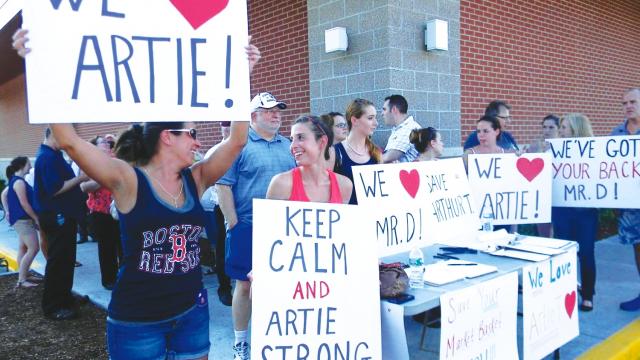
Empty shelves and protesters are what you’ll find at your local Market Basket these days.
The desolate aisles and shelves here make you feel like you just walked into a ghost town. After former CEO Arthur T. Demoulas, affectionately referred to as “Artie T,” was fired by a board headed by his cousin Arthur S. Demoulas in June, Market Basket employees decided they had a choice to make: Either accept the corporate greed that had crept into their harmonious work system, or band together to get Artie back.
A Family Affair
Artie is famous within the chain for his warm treatment of Market Basket employees and customers. Kellie Casey, a manager at the Salem, Mass., branch, says, “Artie comes in and he’s like, ‘Kellie, how are the kids, how old are they now?’”
A common outing for Artie is visiting his stores for hours at a time, talking with workers and meeting customers. Not many of the employees expect this from Felicia Thornton and James Gooch, the new co-CEOs of Market Basket.
“They say that they’ve gone to nearly every store – not one of us [here] have ever seen them. They don’t know us, they don’t know our family, they don’t know anything about us," Casey says.
And it's not just his personal relationships with employees. Artie also offers good benefits and fair pay – cashiers can make $12 an hour, and the company shares its billions in profits with workers across its 71 stores by providing multiple yearly bonuses. Veteran cashiers make as much as $40,000 a year. And all workers who are enrolled in college get an annual $1000-per-year scholarship.

Voices of the Movement
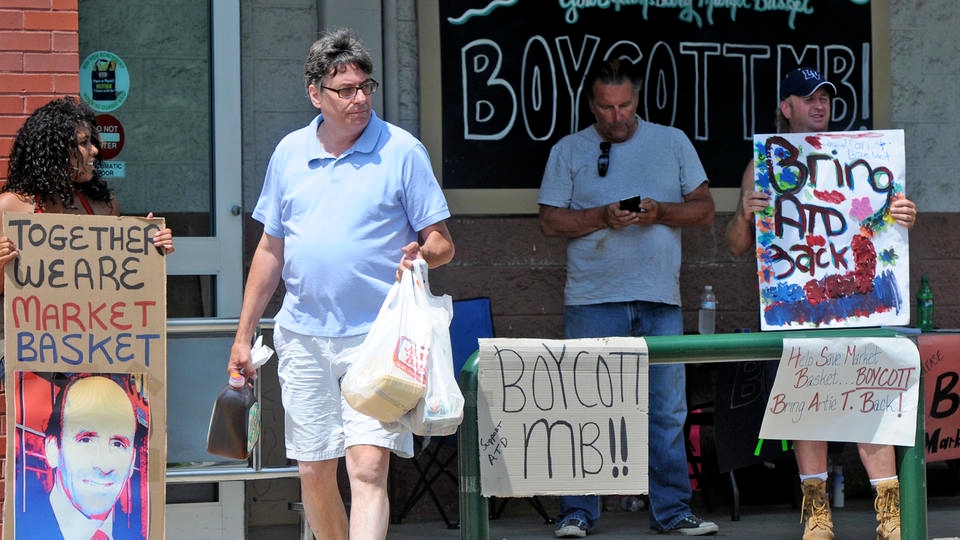
It’s a picture-perfect sunny day as I drive into the parking lot of Salem’s Market Basket. Dozens of young market employees populate the parking lot and driveway. They’re holding signs, chanting and interacting with customers and people driving by – all of this on a summer Saturday, when they could be relaxing at home.
Sarah Barnard, 18, says she’s been working at Market Basket for two years. She just graduated high school in the spring and is trying to save up to go to college. “Artie S. doesn’t want to do anything for us, to benefit us as a whole,” Barnard says. “We’re a family – I have nothing bad at all to say about Market Basket.”
Since the debacle began last week, thousands of employees, customers and supporters have publicly protested Artie’s dismissal. Most if not all of the protesting employees are risking their jobs.
“I wake up in the middle of the night, and it’s all I can think about," continues Casey, a mother of two who receives no child support and is fully dependent on her management income.
"I have teenagers that work here, I have people with families. They’re all looking at me for answers,” she says, and "we just don’t have any answers for them.”
Many of the market's employees are teenagers who work only part-time. So why do they care so passionately about saving one man's job?
“Because that’s the kind of environment we make for them. We make it a positive experience, we make them want to come to work. I know we keep saying this, but it’s like a big family – it's like I have 300 children," adds Casey.
It’s no coincidence that the faces of today's movements for economic justice have been young people. From US Uncut to Occupy Wall Street, thousands of people from a slew of ages and backgrounds flooded the streets – but exceptionally notable attendants were youth. At a pivotal moment for workers in America, those who are the future of the country are more and more often the ones who are standing up for justice.
The Future of Market Basket
Having never felt the sting of economic injustice personally like this before, 18-year-old Barnard takes an important lesson away from the Market Basket employee uprising: how to make an impact on corporate America.
“When you bring everyone together and you say something and you speak your mind, you can definitely reach corporate in a way you didn’t think you could,” Barnard says.
Across the northeast this week, workers continue to risk their jobs to keep what they see as a fair and functioning labor system intact. And the market's non-union employees aren’t the only ones up and about in Artie T's name. Casey says customers have been showing support by boycotting the stores and bringing water and food to the protesters.
As a result, revenue at Market Basket stores is down 70 to 90 percent in recent days. Meanwhile, signs placed throughout empty shelves in the stores speak volumes: “Due to corporate greed," they read, "we are unable to receive most deliveries at this time.”
Update: Artie T. has made a large, undisclosed offer to buy back the corporation in his name. At this time, nothing has been officially confirmed.
3 WAYS TO SHOW YOUR SUPPORT



- Log in to post comments


