
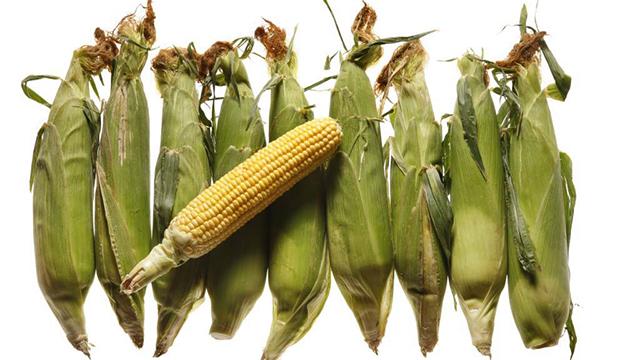
Monsanto’s near-monopoly gives the company the right to control access to a staple food item that is found in a wide range of consumer products.
Monsanto has yet another case pending in the court system, this time before the U.S. Supreme Court on the exclusivity of its genetically modified seed patents. Narrowly at issue is whether Monsanto retains patent rights on soybeans that have been replanted after showing up in generic stocks rather than being sold specifically as seeds, or whether those patent rights are “exhausted” after the initial planting. But more broadly the case also raises implications regarding control of the food supply and the patenting of life—questions that current patent laws are ill-equipped to meaningfully address.
On the specific legal issues, Monsanto is likely to win the case (they almost always do). The extant facts make this a relatively poor platform to serve as a test case of Monsanto’s right to exert such expansive powers. The farmer in this situation had previously purchased Monsanto soybeans for planting (back in 1999), and in this instance bought previously harvested soybeans with the intention of planting them – even spraying Monsanto’s Roundup herbicide on them in the hopes that at least some of the generic stock would be of the so-called “Roundup Ready” variety.
Despite this unfortunate posture, the case does provide another opportunity for critical inquiry regarding the unprecedented and perverse level of control Monsanto is asserting over the food supply. It is estimated that 90 percent of the soybeans in the U.S. are genetically modified and thus subject to potential patents. A random handful of soybeans procured anywhere is likely to contain at least some Monsanto-altered beans. Such a near-monopoly effectively gives Monsanto the right to control access to a staple food item that is found in a wide range of consumer products.
Other variations on this theme include pollen from Monsanto corn (similarly dominant in the U.S. market) pollinating a farmer’s crop, or seeds from Monsanto-engineered grains being distributed by animals, winds, or waterways and commingling with non-GMO plantings. In each case, Monsanto could have a cause of action against an unwitting farmer by claiming patent infringement.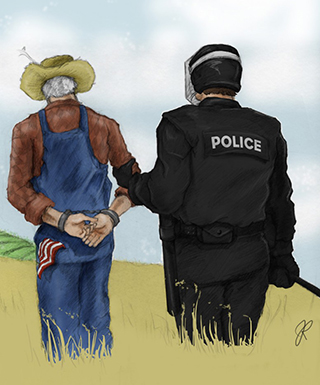
More broadly, and unlikely to be addressed in the instant case, is whether Monsanto (or any other company) should be able to patent seeds – the core of global food supplies, and thus of sustenance for billions of people—in the first place. Activists will decry the fact that Monsanto is patenting life, and this is indeed an Orwellian (or perhaps a Huxleyan) prospect, to be sure. Yet I would submit that Monsanto is actually patenting death, which is potentially even more disconcerting.
Consider that by exerting this level of control over the food supply, Monsanto is rapidly creating a world in which people have to pay fealty to the corporation in order to grow food and/or consume it. In this sense, Monsanto gains enormous power to determine who is allowed to eat – and thus who lives or dies. Consider further that Monsanto’s patents also include technologies in which seeds are sold that cannot propagate themselves, resulting in plants terminating rather than perpetuating, requiring farmers to have to go back to the “company store” in order to replant their fields.
In the case currently before the Court, shades of the latter issue are present, with the question being whether the seeds of the seeds of Monsanto creations retain their exclusive patent rights—possibly in perpetuity. This sort of argument might give us cause to wonder whether an animal (or even a human being, someday?) who consumes these proprietary foods could be implicated in such assertions if they are somehow genetically altered in the process. Perverse slippery slopes aside, the permeation of patentable materials throughout the food chain is by now a clear and present danger.
These are troubling trends indeed. Monsanto wants the right to exert perpetual control, and with it the power to make decisions about who/what lives or dies. In addition to seed patents, their corporate creations include herbicides, pesticides, and biocides that toxify soils and poison waters. Genetically modified foods increasingly dominate the U.S. food supply (and supplies elsewhere, at least where they haven’t been explicitly banned) despite insufficient testing and concerns about their health impacts. The ability of corporations like Monsanto to continue plying such products with little oversight constitutes a de facto consumer beta test on a mass level, the full effects of which may not be known for decades, if ever.
Taking all of this together, it increasingly appears that Monsanto is patenting death, perhaps even more so than life. Their patent rights should not trump the rights of people to procure safe, healthy, living foods. Whatever the result in the Supreme Court case, we should roundly deem Monsanto a loser in the court of public opinion, and strive to loosen their death grip on our food supply.
3 WAYS TO SHOW YOUR SUPPORT



- Log in to post comments


