
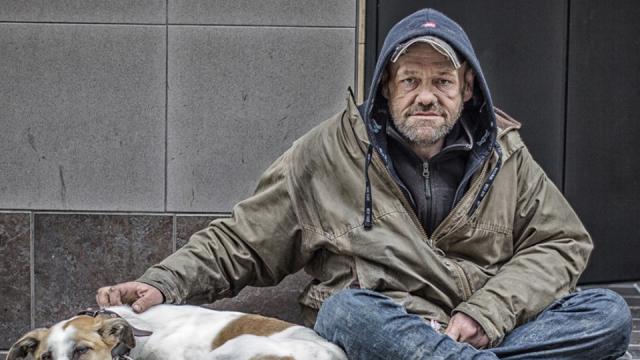
Anger mounted in London as the borough of Hackney announced a series of fines intended to tackle anti-social behavior, including sleeping rough and begging. And in the wake of the widespread opposition to the new law, the local authority caved into pressure by making a dramatic amendment to the policy fining homelessness.
Under a new Public Space Protection Order (PSPO), homeless people in the London borough were threatened with on-the-spot fines of £100 and a potential court charge of £1,000. The local Hackney authority said the fines had been put in place to combat persistent “anti-social behavior” such as sleeping rough in “hot spots,” begging and drinking on the streets.
But the new PSPO law attracted intense criticism from homelessness charities and local campaigners, who warned the fines risked criminalizing vulnerable people.
Over 80,000 Sign Anti-PSPO petition
Notably, the announcement also generated a petition opposing what has been referred to as the “absurd public spaces protection order.” In its first week, the petition spawned more than 80,000 signatures; the campaign also received support from the celebrity community, with pop star Ellie Goulding expressing her “disgust” at the crackdown.
The organization Digs, which supports and empowers renters in Hackney, arranged for a protest to take place against the so-called "criminalization of homelessness" at the Hackney town Hall on June 22.
Heather Kennedy, a spokesperson for Digs, told the Hackney Times that the council “had failed to support residents in housing need… in the middle of a housing crisis.”
“We will not rest until the criminalization of homelessness in our borough is overturned,” Kennedy added.
Other local organizations spoke out about the Public Space Protection Order. The Hackney Community Law Centre released a statement requesting Hackney council to reconsider the new law.
“The order will not stop people sleeping rough. It will simply force them to sleep rough elsewhere, or else render them liable to prosecution,” said the Community Law Centre’s chair, Ian Rathbone.
Rathbone added that if the borough’s deputy mayor had bothered to carry out a consultation prior to putting the law in place, she would have found a large number of people planning to come together to protest the new law.
In response to the outcry, Hackney council issued an amendment to the PSPO that dropped the threat of fining rough sleepers – a policy U-turn that was effective almost immediately.
Zahira Patel, a paralegal working on issues of civil liberties, who had initiated the petition and had grown up near Hackney, spoke ofher excitement at the council’s decision to amend the PSPO.
“It’s great news. I do believe that other parts of the PSPO remain problematic – such as the fact that begging remains in it – but I’m very pleased that rough sleeping will no longer be included.”
Social Cleansing in London
The story highlights not only the intensity of the anger mounting in the U.K. in the wake of tough new policies aimed at the poor, but also the power and influence of those uniting in protest.
Homelessness in the U.K. has been in the spotlight in recent years, as has the lack of social housing. So it's hardly surprising that a policy targeting the homeless while exploiting the shortfall in housing was considered “perverse.”
As one local Hackney resident said in response to the PSPO, “This looks very much like a case of social cleansing by Hackney Council: an attempt to ‘clean up’ the borough for its more affluent residents and visitors.”
Earlier this year, official figures showed that the number of homeless people in London had increased by 79% since 2010, and jumped by over a third during the past year alone.
According to the homelessness charity Crisis, the rise can be pinned on the chronic housing shortage, harsh welfare reforms and the fact that people sleeping on the streets are not a priority to lawmakers.
Ample criticism has been leveled at the government, which keeps insisting the economy is on the mend and GPD is on the rise, while society’s most vulnerable continue to suffer; inadequate housing and cuts to housing benefit are poignant examples of the poorest continuing to bear the brunt.
As Leslie Morphy, chief executive of Crisis, told The Independent: “We need the Government to address the chronic lack of affordable housing, take real steps to improve the private rented sector and to urgently consider the impact its cuts to housing benefit are having, particularly in the capital.”
Yet despite relentless government cuts, the fact a local London authority was forced to make an immediate policy reversal due to public pressure is being viewed as a victory for protestors and anti-austerity groups. And the sudden change of heart about homelessness in Hackney isn't the only U-turn the government has made in recent months due to popular campaigning.
Earlier this year, as anti-fracking protesters gathered at a rally outside parliament in London to hear Green MP Caroline Lucas speak out about the dangers of hydraulic fracturing, digging for shale gas throughout the U.K. was abandoned.
In what was described as a “spectacular last minute U-turn,” the U.K. government jettisoned attempts to push through a fracking bill – a decision influenced not only by the protests but by the well organized grassroots campaign that publicized the issue nationally.
With Britain's new Conservative government threatening to introduce tough new measures that further curtail the welfare state as they target the poorest in the nation, national restlessness and frustration is growing. And as the decision in Hackney to reverse the policy criminalizing homelessness reveals, the power of protestors can no longer be taken lightly.
3 WAYS TO SHOW YOUR SUPPORT



- Log in to post comments


