
Read

User menu

Search form

Researchers Warn Arctic Has Entered 'Unprecedented State' That Threatens Global Climate Stability

Researchers Warn Arctic Has Entered 'Unprecedented State' That Threatens Global Climate Stability
Tue, 4/9/2019 - by Jon Queally
This article originally appeared on Common Dreams

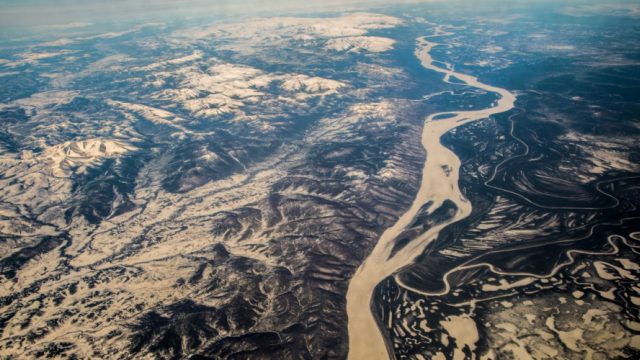
The Yukon River winds through western interior Alaska in early April. (Photo: UAF/Todd Paris)

A new research paper by American and European climate scientists focused on Arctic warming published Monday reveals that the "smoking gun" when it comes to changes in the world's northern polar region is rapidly warming air temperatures that are having—and will continue to have—massive and negative impacts across the globe.

The new paper—titled "Key Indicators of Arctic Climate Change: 1971–2017"—is the work of scientists at the International Arctic Research Center at the University of Alaska Fairbanks and the Geological Survey of Denmark and Greenland in Copenhagen (GUES).

"The Arctic system is trending away from its 20th century state and into an unprecedented state, with implications not only within but beyond the Arctic," said Jason Box of the GUES, lead author of the study. "Because the Arctic atmosphere is warming faster than the rest of the world, weather patterns across Europe, North America and Asia are becoming more persistent, leading to extreme weather conditions. Another example is the disruption of the ocean circulation that can further destabilize climate: for example, cooling across northwestern Europe and strengthening of storms."

John Walsh, chief scientist at AUF's research center, was the one who called arctic air tempertures the "smoking gun" discovered during the research—a finding the team did not necessarily anticipate.

"I didn't expect the tie-in with temperature to be as strong as it was," Walsh said. "All the variables are connected with temperature. All components of the Arctic system are involved in this change."

The study, published Monday as the flagship piece in a special issue on Arctic climate change indicators published by the journal Environmental Research Letters, is the first of its kind to combine observations of physical climate indicators—such as snow cover, rainfall, and seasonal measurements of sea ice extent—with biological impacts, such as a mismatch in the timing of flowers blooming and pollinators working. According to Walsh, "Never have so many Arctic indicators been brought together in a single paper."

This three-and-a-half minute video put together by the research team, explains its methodology and findings in detail

The new study comes as temperature records in the polar regions continue to break record after record. Last week, climatologists said Alaska experienced the highest March temperatures ever recorded.

Statewide temperatures averaged 27°F degrees last month, a full 4 degrees higher than the record set in 1965. Brian Brettschneider, a climatologist with the International Arctic Research Center at University of Alaska Fairbanks, told the Anchorage Daily News, "We're not just eking past records. This is obliterating records."

Also last month, as Common Dreams reported, the UN Environment Programme (ENUP) warned in a far-reaching report that winter temperatures in the Arctic are already "locked in" in such a way that significant sea level increases are now inevitable this century.

Rising temperatures, along with ocean acidification, pollution, and thawing permafrost threaten the Arctic and the more than four million people who inhabit it, including 10 percent who are Indigenous. But, as UNEP acting executive director Joyce Msuya noted at the time, "What happens in the Arctic does not stay in the Arctic."

That warning was echoed by the researchers behind the new study out Monday. Their hope, they said, is that the findings about air temperatures and the delicate interconnections between the climate and other natural systems in the Artic will "provide a foundation for a more integrated understanding of the Arctic and its role in the dynamics of the Earth's biogeophysical systems."

Originally published by Common Dreams

3 WAYS TO SHOW YOUR SUPPORT

ONE-TIME DONATION

Just use the simple form below to make a single direct donation.

DONATE NOW

MONTHLY DONATION

Be a sustaining sponsor. Give a reacurring monthly donation at any level.

GET SOME MERCH!

Now you can wear your support too! From T-Shirts to tote bags.

SHOP TODAY

Sign Up

Article Tabs

From a pro-democratic perspective, civil society and new media organisations are surging in the aftermath of the Orban regime.

The country’s new prime minister, Andy Burnham, has promised a break from the politics of the last 40 years—realizing more broadly that Labour must stand up for the 99% against big business, or the party will become irrelevant.

The tragic shooting of Lorenzo Salgado Araujo is just the latest example of ICE having a fundamental disrespect for human life — further proving why the agency should be stripped of funding and shut down, and its rank-and-file agents and leadership prosecuted.

While the U.S., EU and their allies are enabling Rojava—the strongest force against Islamic State— to fall, it is vital for internationalists to continue to support this beacon of democracy and liberation.

June 23, 2026 may be remembered as the beginning of the end of the Democratic Party establishment.

The current wave of food recalls is a direct byproduct of President Donald Trump’s administration deliberately removing the safeguards put in place aimed at protecting American consumers more than a century ago.

From a pro-democratic perspective, civil society and new media organisations are surging in the aftermath of the Orban regime.

We can still celebrate success while simultaneously putting a cap on net worth.

The country’s new prime minister, Andy Burnham, has promised a break from the politics of the last 40 years—realizing more broadly that Labour must stand up for the 99% against big business, or the party will become irrelevant.

Much like the resistance to AI data centers, the opposition to Flock surveillance cameras has brought the left and the right together against billionaires who are trying to force America into becoming even more of a police state.

Much like the resistance to AI data centers, the opposition to Flock surveillance cameras has brought the left and the right together against billionaires who are trying to force America into becoming even more of a police state.

Posted 1 month 4 weeks ago

The country’s new prime minister, Andy Burnham, has promised a break from the politics of the last 40 years—realizing more broadly that Labour must stand up for the 99% against big business, or the party will become irrelevant.

Posted 1 month 4 weeks ago

We can still celebrate success while simultaneously putting a cap on net worth.

Posted 1 month 2 weeks ago

The current wave of food recalls is a direct byproduct of President Donald Trump’s administration deliberately removing the safeguards put in place aimed at protecting American consumers more than a century ago.

Posted 3 weeks 7 hours ago

From a pro-democratic perspective, civil society and new media organisations are surging in the aftermath of the Orban regime.

Posted 3 weeks 2 days ago

The current wave of food recalls is a direct byproduct of President Donald Trump’s administration deliberately removing the safeguards put in place aimed at protecting American consumers more than a century ago.

From a pro-democratic perspective, civil society and new media organisations are surging in the aftermath of the Orban regime.