
After the Watergate scandal taught Richard Nixon the consequences of recording White House conversations none of his successors has dared to do it. But Nixon wasn't the first.
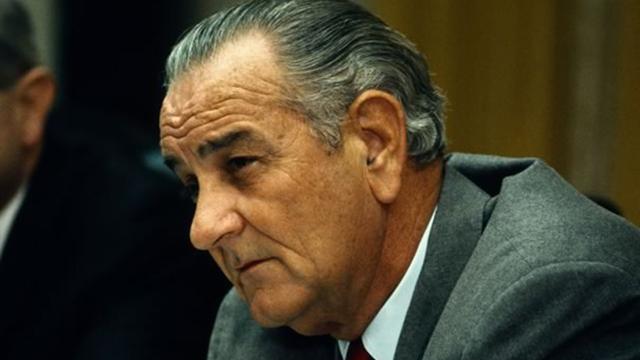
He got the idea from his predecessor Lyndon Johnson, who felt there was an obligation to allow historians to eventually eavesdrop on his presidency.
"They will provide history with the bark off," Johnson told his wife, Lady Bird.
The final batch of tapes released by the LBJ library covers 1968, and allows us to hear Johnson's private conversations as his Democratic Party tore itself apart over the question of Vietnam.
The 1968 convention, held in Chicago, was a complete shambles.
Tens of thousands of anti-war protesters clashed with Mayor Richard Daley's police, determined to force the party to reject Johnson's Vietnam war strategy.
As they taunted the police with cries of "The whole world is watching!" one man in particular was watching very closely.
Lyndon Baines Johnson was at his ranch in Texas, having announced five months earlier that he wouldn't seek a second term.
The president was appalled at the violence and although many of his staff sided with the students, and told the president the police were responsible for "disgusting abuse of police power," Johnson picked up the phone, ordered the dictabelt machine to start recording and congratulated Mayor Daley for his handling of the protest.
The president feared the convention delegates were about to reject his war policy and his chosen successor, Hubert Humphrey.
So he placed a series of calls to his staff at the convention to outline an astonishing plan. He planned to leave Texas and fly into Chicago.
He would then enter the convention and announce he was putting his name forward as a candidate for a second term.
It would have transformed the 1968 election. His advisers were sworn to secrecy and even Lady Bird did not know what her husband was considering.
On the White House tapes we learn that Johnson wanted to know from Daley how many delegates would support his candidacy. LBJ only wanted to get back into the race if Daley could guarantee the party would fall in line behind him.
They also discussed whether the president's helicopter, Marine One, could land on top of the Hilton Hotel to avoid the anti-war protesters.
Daley assured him enough delegates would support his nomination but the plan was shelved after the Secret Service warned the president they could not guarantee his safety.
The idea that Johnson might have been the candidate, and not Hubert Humphrey, is just one of the many secrets contained on the White House tapes.
They also shed light on a scandal that, if it had been known at the time, would have sunk the candidacy of Republican presidential nominee, Richard Nixon.
By the time of the election in November 1968, LBJ had evidence Nixon had sabotaged the Vietnam war peace talks - or, as he put it, that Nixon was guilty of treason and had "blood on his hands".
The BBC's former Washington correspondent Charles Wheeler learned of this in 1994 and conducted a series of interviews with key Johnson staff, such as defense secretary Clark Clifford, and national security adviser Walt Rostow.
But by the time the tapes were declassified in 2008 all the main protagonists had died, including Wheeler.
Now, for the first time, the whole story can be told.
It begins in the summer of 1968. Nixon feared a breakthrough at the Paris Peace talks designed to find a negotiated settlement to the Vietnam war, and he knew this would derail his campaign.
He therefore set up a clandestine back-channel involving Anna Chennault, a senior campaign adviser.
At a July meeting in Nixon's New York apartment, the South Vietnamese ambassador was told Chennault represented Nixon and spoke for the campaign. If any message needed to be passed to the South Vietnamese president, Nguyen Van Thieu, it would come via Chennault.
In late October 1968 there were major concessions from Hanoi which promised to allow meaningful talks to get underway in Paris - concessions that would justify Johnson calling for a complete bombing halt of North Vietnam. This was exactly what Nixon feared.
Chennault was dispatched to the South Vietnamese embassy with a clear message: the South Vietnamese government should withdraw from the talks, refuse to deal with Johnson, and if Nixon was elected, they would get a much better deal.
So on the eve of his planned announcement of a halt to the bombing, Johnson learned the South Vietnamese were pulling out.
He was also told why. The FBI had bugged the ambassador's phone and a transcripts of Anna Chennault's calls were sent to the White House. In one conversation she tells the ambassador to "just hang on through election".
Johnson was told by Defense Secretary Clifford that the interference was illegal and threatened the chance for peace.
In a series of remarkable White House recordings we can hear Johnson's reaction to the news.
In one call to Senator Richard Russell he says: "We have found that our friend, the Republican nominee, our California friend, has been playing on the outskirts with our enemies and our friends both, he has been doing it through rather subterranean sources. Mrs Chennault is warning the South Vietnamese not to get pulled into this Johnson move."
He orders the Nixon campaign to be placed under FBI surveillance and demands to know if Nixon is personally involved.
When he became convinced it was being orchestrated by the Republican candidate, the president called Senator Everett Dirksen, the Republican leader in the Senate to get a message to Nixon.
The president knew what was going on, Nixon should back off and the subterfuge amounted to treason.
Publicly Nixon was suggesting he had no idea why the South Vietnamese withdrew from the talks. He even offered to travel to Saigon to get them back to the negotiating table.
Johnson felt it was the ultimate expression of political hypocrisy but in calls recorded with Clifford they express the fear that going public would require revealing the FBI were bugging the ambassador's phone and the National Security Agency (NSA) was intercepting his communications with Saigon.
So they decided to say nothing.
The president did let Humphrey know and gave him enough information to sink his opponent. But by then, a few days from the election, Humphrey had been told he had closed the gap with Nixon and would win the presidency. So Humphrey decided it would be too disruptive to the country to accuse the Republicans of treason, if the Democrats were going to win anyway.
Nixon ended his campaign by suggesting the administration war policy was in shambles. They couldn't even get the South Vietnamese to the negotiating table.
He won by less than 1% of the popular vote.
Once in office he escalated the war into Laos and Cambodia, with the loss of an additional 22,000 American lives, before finally settling for a peace agreement in 1973 that was within grasp in 1968.
The White House tapes, combined with Wheeler's interviews with key White House personnel, provide an unprecedented insight into how Johnson handled a series of crises that rocked his presidency. Sadly, we will never have that sort of insight again.
3 WAYS TO SHOW YOUR SUPPORT



- Log in to post comments


