Read

User menu

Search form

Struggling to Serve at the Nation’s Richest University

Struggling to Serve at the Nation’s Richest University
Tue, 10/25/2016 - by Rosa Ines Rivera
This article originally appeared on The New York Times

Cambridge, Mass. — I’ve been at Harvard University for 17 years, but I’ve never been in a classroom here. I’m a cook in the dining halls. I work in the cafeteria at the T.H. Chan School of Public Health, where every day I serve amazing students studying medicine, nutrition and child welfare, as well as the doctors and researchers who train them.

While I’ve earned no college credits here, I’ve had a lesson in hypocrisy.

On my way to work each morning, I pass a building with the inscription: “The highest attainable standard of health is one of the fundamental rights of every human being.” If Harvard believes this, why is the administration asking dining hall workers to pay even more for our health care even though some of us pay as much as $4,000 a year in premiums alone?

I serve the people who created Obamacare, people who treat epidemics and devise ways to make the world healthier and more humane. But I can’t afford the health care plan Harvard wants us to accept.

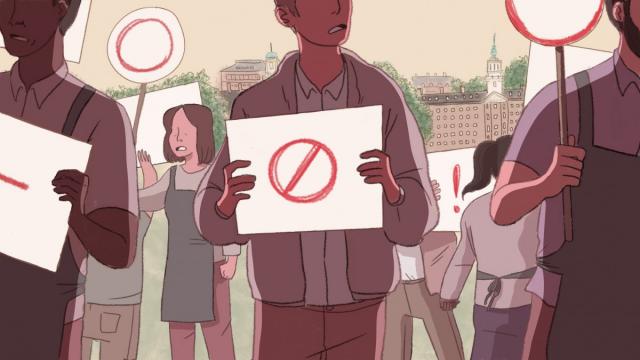
That’s why I have been on strike with 750 co-workers for more than two weeks. That’s why the other day, co-workers and I were arrested after we sat down in Harvard Square, blocking traffic, in an act of civil disobedience. And that’s why the medical school students, in their white coats, have been walking the picket line with us in solidarity.

The co-pays alone can be a problem. When a doctor told me my daughter had failed a hearing test and might need surgery, I thought about what care I could do without. I recently skipped an appointment to have a spot on my lung checked for cancer to save on the co-pays.

Medical students analyzed Harvard’s proposal and found that the cost of premiums alone could eat up almost 10 percent of my income. And Harvard wants to increase our co-pays for every single doctor visit to $25, from $15, for primary care and to $100, from zero, for outpatient hospital care and some tests. Some costs would be reimbursed for lower-income workers, but out-of-pocket expenses would still be hard to meet.

The students say that Harvard’s proposal is unaffordable for nearly all of us according to state government guidelines. If it goes through, I will keep avoiding the doctor to save that money for my kids’ co-pays. Any increase puts me at the breaking point.

Harvard is the richest university in the nation, with a $35 billion endowment. But I can’t live on what Harvard pays me. I take home between $430 and $480 a week, and this August, I fell behind on my $1,150 rent and lost my apartment. Now my two kids and I are staying with my mother in public housing, with all four of us sharing a single bedroom. I grew up in the projects and on welfare. I want my 8-year-old daughter and 2-year-old son to climb out of the cycle of poverty. But for most of my time at Harvard it’s been hard.

The average dining hall worker makes $31,193 a year, higher than other cafeterias in the area, but it still doesn’t go far around Boston. That’s why we’re asking for an annual salary of $35,000 for some financial stability, particularly since most dining halls are open only during the school year. Right now I’m lucky to work in one of the few cafeterias that’s open all year.

I know that health care costs are going up everywhere, and I don’t have all the answers. But there must be some way not to shift costs onto Harvard’s poorest workers.

If good health is truly “one of the fundamental rights of every human being,” then shouldn’t that also apply to the human beings working in Harvard’s cafeterias?

Originally published by The New York Times

3 WAYS TO SHOW YOUR SUPPORT

ONE-TIME DONATION

Just use the simple form below to make a single direct donation.

DONATE NOW

MONTHLY DONATION

Be a sustaining sponsor. Give a reacurring monthly donation at any level.

GET SOME MERCH!

Now you can wear your support too! From T-Shirts to tote bags.

SHOP TODAY

Sign Up

Article Tabs

From a pro-democratic perspective, civil society and new media organisations are surging in the aftermath of the Orban regime.

The country’s new prime minister, Andy Burnham, has promised a break from the politics of the last 40 years—realizing more broadly that Labour must stand up for the 99% against big business, or the party will become irrelevant.

The tragic shooting of Lorenzo Salgado Araujo is just the latest example of ICE having a fundamental disrespect for human life — further proving why the agency should be stripped of funding and shut down, and its rank-and-file agents and leadership prosecuted.

While the U.S., EU and their allies are enabling Rojava—the strongest force against Islamic State— to fall, it is vital for internationalists to continue to support this beacon of democracy and liberation.

June 23, 2026 may be remembered as the beginning of the end of the Democratic Party establishment.

The current wave of food recalls is a direct byproduct of President Donald Trump’s administration deliberately removing the safeguards put in place aimed at protecting American consumers more than a century ago.

From a pro-democratic perspective, civil society and new media organisations are surging in the aftermath of the Orban regime.

We can still celebrate success while simultaneously putting a cap on net worth.

The country’s new prime minister, Andy Burnham, has promised a break from the politics of the last 40 years—realizing more broadly that Labour must stand up for the 99% against big business, or the party will become irrelevant.

Much like the resistance to AI data centers, the opposition to Flock surveillance cameras has brought the left and the right together against billionaires who are trying to force America into becoming even more of a police state.

Much like the resistance to AI data centers, the opposition to Flock surveillance cameras has brought the left and the right together against billionaires who are trying to force America into becoming even more of a police state.

Posted 1 month 3 weeks ago

The country’s new prime minister, Andy Burnham, has promised a break from the politics of the last 40 years—realizing more broadly that Labour must stand up for the 99% against big business, or the party will become irrelevant.

Posted 1 month 3 weeks ago

We can still celebrate success while simultaneously putting a cap on net worth.

Posted 1 month 1 week ago

The current wave of food recalls is a direct byproduct of President Donald Trump’s administration deliberately removing the safeguards put in place aimed at protecting American consumers more than a century ago.

Posted 2 weeks 3 days ago

From a pro-democratic perspective, civil society and new media organisations are surging in the aftermath of the Orban regime.

Posted 2 weeks 6 days ago

The current wave of food recalls is a direct byproduct of President Donald Trump’s administration deliberately removing the safeguards put in place aimed at protecting American consumers more than a century ago.

From a pro-democratic perspective, civil society and new media organisations are surging in the aftermath of the Orban regime.