
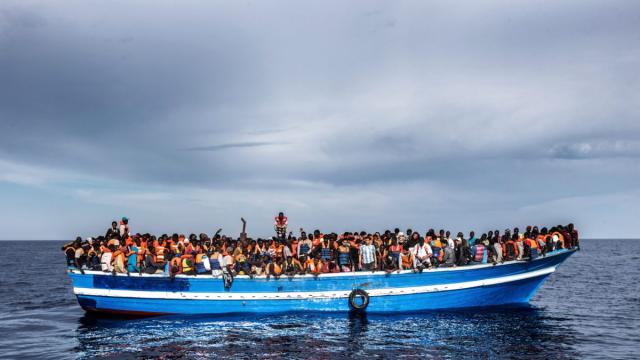
In 2016, every major media outlet focused on the influx of refugees into the European Union as a humanitarian crisis of unprecedented proportion. During that year, the media coverage alternatively painted the issue as either a boon or a blight on the E.U. – both exalting, and exposing, the Old Continent’s capability to deal with the crisis.
Exactly one year later, the issue has been mostly left to the sidelines with only sparse reporting. There has been little mention of the ongoing unwillingness by France or Germany to make good on their commitment to accept the promised number of refugees, nor further debate on Hungary’s and Poland’s outright refusal to admit any refugees within their borders.
Earlier in August, Germany along with other Scandinavian countries resumed the process of returning asylum seekers to Greecewhom they had turned down for entry. The measure was intended to go into effect last year, but the influx of nearly 1 million refugees into Greece, which is suffering from an ailing economy with few resources to properly handle the emergency, led to a brief reconsideration.
Currently, Germany will begin by deporting 400 individuals back to Greece, which has been deemed their "country of entry" into the E.U., with other countries set to follow suit. This is despite the riot that took place in July inside a refugee camp on the island of Lesbos, where groups of Syrian, African and other Middle Eastern refugees were forced into a small living space with limited access to food and water.
Now, many fear the crisis could take a turn for the worse since a number of the NGOs that have provided aid for the refugees have had their funding cut by the E.U.. According to a joint statement issued by Doctors Without Borders, Save the Children and other aid groups:
“To date, no national response plan has been released, and information about how the transition will be implemented is severely lacking.”
The fact that Germany and the European Commission appear eager to wash their hands clean from the crisis appears to be having an impact beyond E.U. borders. According to recent reports, German NGOs have recently halted their attempts to rescue Libyan immigrants attempting to cross the Mediterranean, abandoning Italian and Spanish authorities to deal with the humanitarian crisis on their own.
It is important to note that this is taking place only six years after Germany officially altered its Constitution in accordance with the Dublin Convention, allowing for the deportation of any immigrants or failed asylum seekers to their country of entry within the Union. This amendment, of course, took place the same year that Chancellor Angela Merkel officially announced what she called the "failure of multiculturalism," adopting the measure right after a slew of riots exploded across the country in 2016.
According to William Mallinson, a former British Diplomat: “Of course, elections are coming. [Merkel] is trying to present a harder image…these refugees are treated as cannon fodder.”
The UN seems to agree, having only recently declared the situation in Greek refugee camps "dire," in a recent briefing made by UNICEF spokeswoman Sara Crowe. Clement Perin, head of the Doctors Wiithout Borders chapter in Greece, said: "These families are paying the price of European cynicism and the reprehensible deal with Turkey… It is outrageous to see that despite all European promises and announcements, men, women and children are living in tents.”
Despite the ranging criticism, German Interior Minister Thomas De Maiziere went ahead and gave the green light to begin the process of deportation, citing that Greece had sent "positive signals" that it could handle the additional influx of refugees. This announcement elicited a horrified response by the asylum-seeking organization Pro Asyl, whose spokesman, Karl Kopp, declared: "Even having this idea is completely unacceptable."
Greece's Syriza government isn’t blameless; in fact, according to to Dimitris Christopoulos, head of the International Federation of Human Rights, the Greek administration shares a good portion of the fault. With refugee aides abandoning their posts in droves after being informed that their compensation had been placed indefinitely on hold, and with considerable sums of aid money lost in a sea of red tape, it has become clear to many that the government is using the refugee chaos as a trump card. “The Greek administrative chaos is the best deterrence… it sends the message that Greece is a mess, so don’t come this way,” said Christopoulos.
In the end, what is painfully obvious is that the E.U.’s failure to handle the refugee crisis is not so much due to a lack of resources or options, but a result of chronic mismanagement compounded by an unwillingness to establish a clear policy across the member-states. It’s a failure that has cost the lives of hundreds and could doom thousands of others, forcing them to spend their lives in horrific living conditions, all in the interest of maintaining a pointless political façade.
3 WAYS TO SHOW YOUR SUPPORT



- Log in to post comments


