
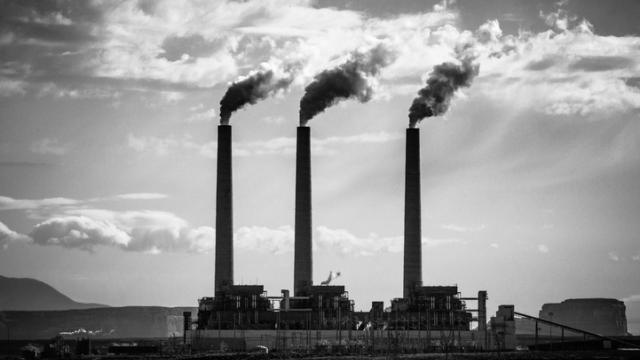
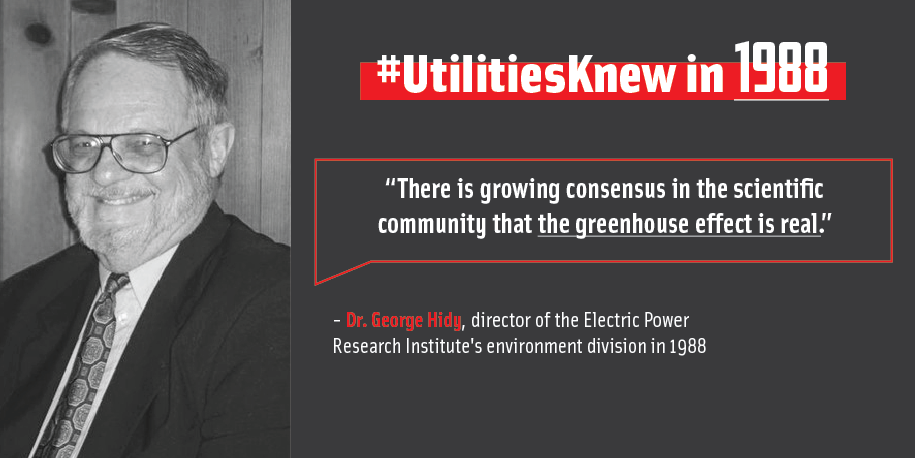
Scientists had begun to warn electric utilities about climate change by 1968, and by 1988 the industry’s official research and development organization had acknowledged that, “There is growing consensus in the scientific community that the greenhouse effect is real.”
Despite this early knowledge about climate change, electric utilities have continued to invest heavily in fossil fuel power generation over the past half a century, and since 1988 some have engaged in ongoing efforts to sow doubt about climate science and block legal limits on carbon dioxide emissions from power plants.
The Energy and Policy Institute’s new report provides a first look into the electric utility industry’s nearly 50-year long relationship with climate science, based largely on original research that reviewed scores of industry documents.
Below are just a few of the key findings from the report.
The Electric Utility Industry was Warned about Climate Change in 1968
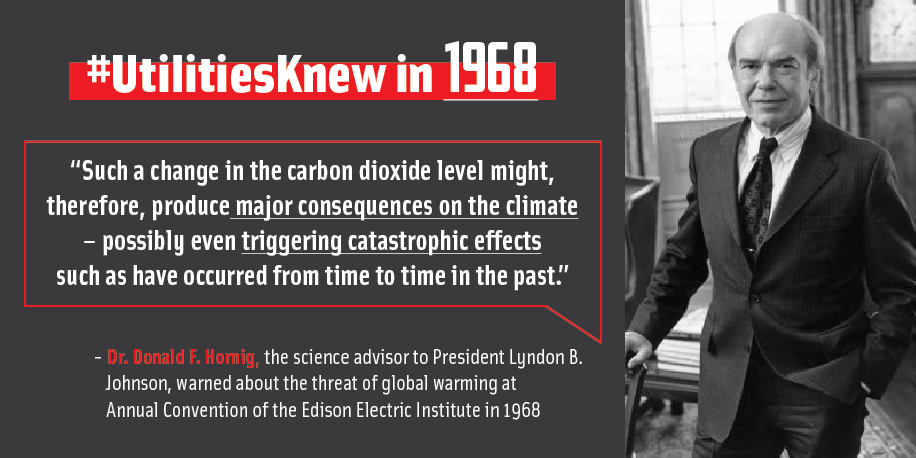
Dr. Donald F. Hornig, a science advisor to President Lyndon B. Johnson, warned the 1968 Annual Convention of the Edison Electric Institute about the threat that allowing CO2 emissions from burning fossil fuels to build up in the atmosphere could one day pose to the climate.
“Such a change in the carbon dioxide level might, therefore, produce major consequences on the climate – possibly even triggering catastrophic effects such as have occurred from time to time in the past,” Hornig said.
Utilities Sponsored Climate Change Research During the 1970s and 1980s
While the science on climate change was limited compared to what we know today, by 1971 electric utilities knew enough to include research into the “effects of CO2” in the industry’s long-term research and development goals for through the year 2000. More than 50 electric utilities contributed to the development of these goals, as did industry associations like EEI.
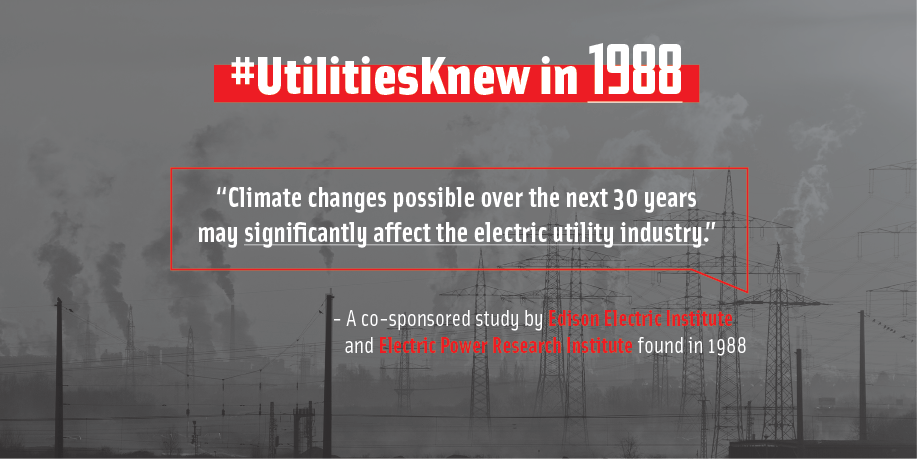
Utilities, through the largely customer funded Edison Electric Institute and Electric Power Research Institute, sponsored cutting edge climate research during the 1970s and 1980s. During the 1980s, EPRI funded research by influential scientist Charles Keeling and the Scripps Institution of Oceanography that documented “virtually all that we knew at the time from measurements of atmospheric CO2.” Between 1985 and 1988, EEI and EPRI co-sponsored another study which found that “climate changes possible over the next 30 years may significantly affect the electric utility industry.”
Utilities Knew Long Ago that Climate Change Concerns Could Warrant a Shift Away from Fossil Fuels
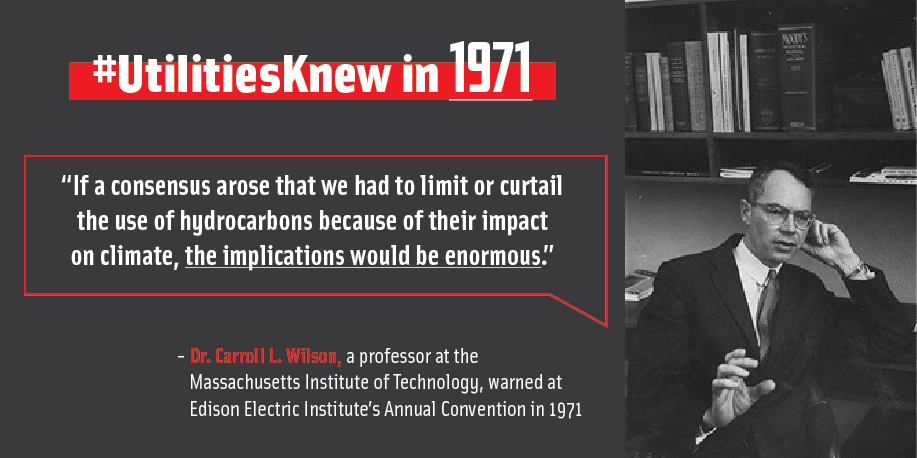
“If a consensus arose that we had to limit or curtail the use of hydrocarbons because of their impact on climate, the implications would be enormous,” Dr. Carroll L. Wilson, a professor at the Massachusetts Institute of Technology, warned at EEI’s Annual Convention in 1971.
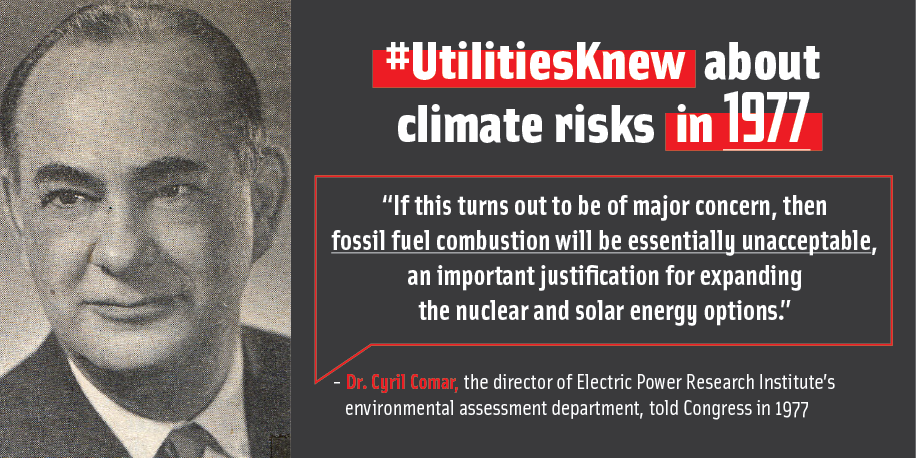
“If this turns out to be of major concern, then fossil fuel combustion will be essentially unacceptable, an important justification for expanding the nuclear and solar energy options,” Dr. Cyril Comar, director of EPRI’s environmental assessment department, told Congress in 1977.
“As consensus builds that man is changing the earth’s climate, policymakers are turning their attention to the issue and exploring potential responses,” the EPRI Journal reported that same year.
By 1988, electric utilities were at a critical juncture. They could either be a part of the solution to climate change, or a part of the problem.
Some Utility Interests Responded to the “Growing Consensus” on Climate Change with Disinformation
“It is possible that an increase in concentration of atmospheric gases which absorb the outgoing infrared radiation could result in a rise in average global temperature,” William McCollam, Jr., then president of EEI, admitted to Congress in 1989. McCollam also acknowledged that climate change “could have significant effects on agriculture, rainfall, sea level, storm events, demography, and human health.”
However, McCollam claimed that “our knowledge is currently so limited that we cannot yet judge with any accuracy what might be the results of continued increases in greenhouse gases.”
“… we believe that any plan calling for urgent and extreme action to reduce CO2 emissions is premature at best,” McCollum told Congress.
“The electric utility industry is aggressively pursuing several paths which are designed to meet the nation’s energy needs while reducing atmospheric emissions,” McCollum nonetheless pledged.
Instead, that same year, EEI and some major electric utilities chose to “aggressively” work to sow doubt about climate science. American Electric Power, Consumers Power Company, EEI, Pacific Gas & Electric Company, and Southern Company joined the Global Climate Coalition, which for years worked to deny the causes and risks of climate change. In 1991, EEI and Southern Company spearheaded the Information Council on the Environment ad campaign, which listed as its top strategy an effort to “reposition global warming as theory (not fact).”
Some Utilities Continue to Mislead on Climate Change in 2017
Despite EEI’s 1989 pledge to reduce atmospheric emissions, annual CO2 emissions from the electricity sector remained higher in 2016 than they were when McCollum testified in 1989, due in large part to ongoing efforts by some in the industry to sow doubt about climate science and block legal limits on CO2 emissions from power plants.
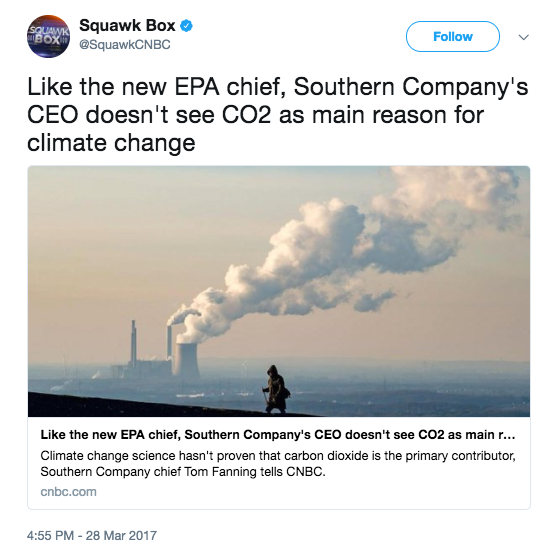
Thomas Fanning, the CEO of Southern Company, continued to deny that CO2 emissions are the primary contributor to climate change during an interview with CNBC in 2017. At the time, Fanning was also the chairman of EEI and the face of the investor-owned electric utility industry. Yet no effort was made by EEI, Southern Company, or other utilities to set the record straight.
Some electric utilities continue to back special interest groups – including the American Coalition for Clean Coal Electricity, American Legislative Exchange Council, U.S. Chamber of Commerce, and Utility Air Regulatory Group – that mislead on climate science and/or oppose legal limits on CO2 emissions from power plants.
Nearly 50 years after scientists began to warn the electric utility industry about climate change, some utilities continue to stand in the way of real progress in addressing the problem. It is a story with striking parallels to the investigations into ExxonMobil’s early knowledge and ongoing deception on climate change. Research has shown that electric utilities could face serious financial repercussions if ever held liable for the climate change damages incurred by their power plant emissions.
Originally published by Energy and Policy Institute
3 WAYS TO SHOW YOUR SUPPORT



- Log in to post comments


