

I went to D.C.’s Smithsonian Museum of Natural History expecting to learn about the history of our planet. Instead, I stumbled upon a Koch-funded climate denial disaster.
“With the planet in peril, arts groups can no longer afford the Koch brothers money.”
That’s what Washington Post art and culture critic Philip Kennicott wrote in a recent opinion piece about prolific climate denial funders Charles and David Koch. Having recently seen Koch money in action at one of the world’s most prestigious science museums, I couldn’t agree more.
On July 4, 2017, after watching the Independence Day Parade, I went to Smithsonian Natural History Museum feeling joyful.
I’ve visited the museum before, and every time I visit I’m attracted to all different types of exhibitions — from wildlife specimens to the beautiful gem collection. As a graduate student from China, I’ve always looked at the Smithsonian Natural History Museum as one of the best museums in the world.
But this visit was different. As I wandered the museum’s bottom floor, my eyes were drawn to the words ‘David H. Koch Hall of Human Origins’ on the wall. Wait, that David Koch? The one famous for his role as an architect of climate science denial?
I decided to take a closer look at the exhibit. The first thing I saw were the faces of ancient humans and skeletons, which made up about half of the exhibit — that much made sense.
The other half of the exhibit is focused on how ancient people adapted to the changing environments. That’s where things took a shocking turn. As an environmental engineer, I’m very familiar with the science of climate change. There is no doubt that our climate has changed beyond its natural variability — accelerating since industrialization — and those changes are already affecting our planet.
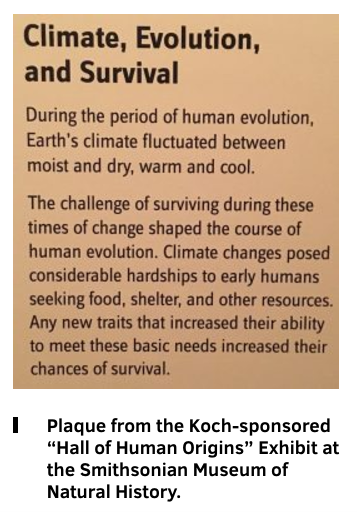
The Hall of Human Origins tells a very different, and ultimately inaccurate, story. It focuses only on the “good” effects of climate change without addressing any of the ways that a warmer planet will make it harder for humans to survive on Earth. Guests learn that dramatic climate change drives human evolution, which apparently means that climate change is good because it makes people more adaptable to the environment.
This message is essentially what David Koch himself has asserted: “The Earth will be able to support enormously more people because a far greater land area will be available to produce food [due to global warming].”
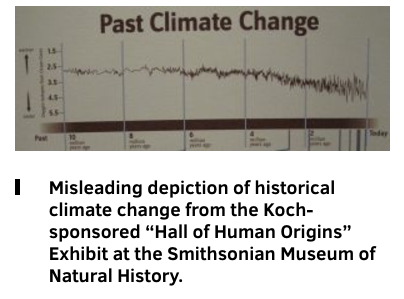
The exhibit has the tendency to exclude anthropogenic climate change from the story of Earth’s climate. Visitors are shown global temperature change from 10 million years ago to today. Presenting climate data in this way is extremely misleading, obscuring the fact that human activity is closely related to the way our climate has changed since the Industrial Revolution. If I took the Smithsonian’s word for it, then I would have the impression that climate change is not really a thing, or at least happens very slowly.
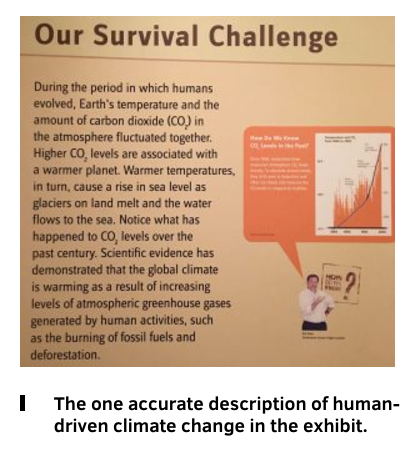
The exhibit does mention greenhouse gases, showing dramatic rising carbon dioxide levels from 400,000 years ago to now. But it doesn’t show the correlation between increasing carbon dioxide level and temperature increase over such a large time span.
Really, there is only one display that makes it clear that human fossil fuel use is changing the global climate.
I left the museum full of curiosity and questions. I found that others, too, have noticed this failure accurately portray climate science. This 2015 article from ThinkProgress’ Joe Romm has turned many heads and non-profit organizations. The Natural History Museum is pushing to kick science meddlers like David Koch off the Smithsonian’s Advisory Board, to name a few.
And I hope these criticisms make an impact, because the last thing cultural institutions like the Smithsonian need is a biased benefactor. The Smithsonian museum is world renowned — coming from China to see this biased and inaccurate exhibit was extremely disappointing.
As a scientist, I knew better than to believe what the Hall of Human Origins is suggesting about the threats of climate change. But the thousands of kids and teenagers that visit the museum every day may not.
The Smithsonian National Museum of Natural History has the responsibility to be unbiased and evidenced-based — and that means refusing to be a pawn in the Koch-funded crusade against climate action.
3 WAYS TO SHOW YOUR SUPPORT



- Log in to post comments


