

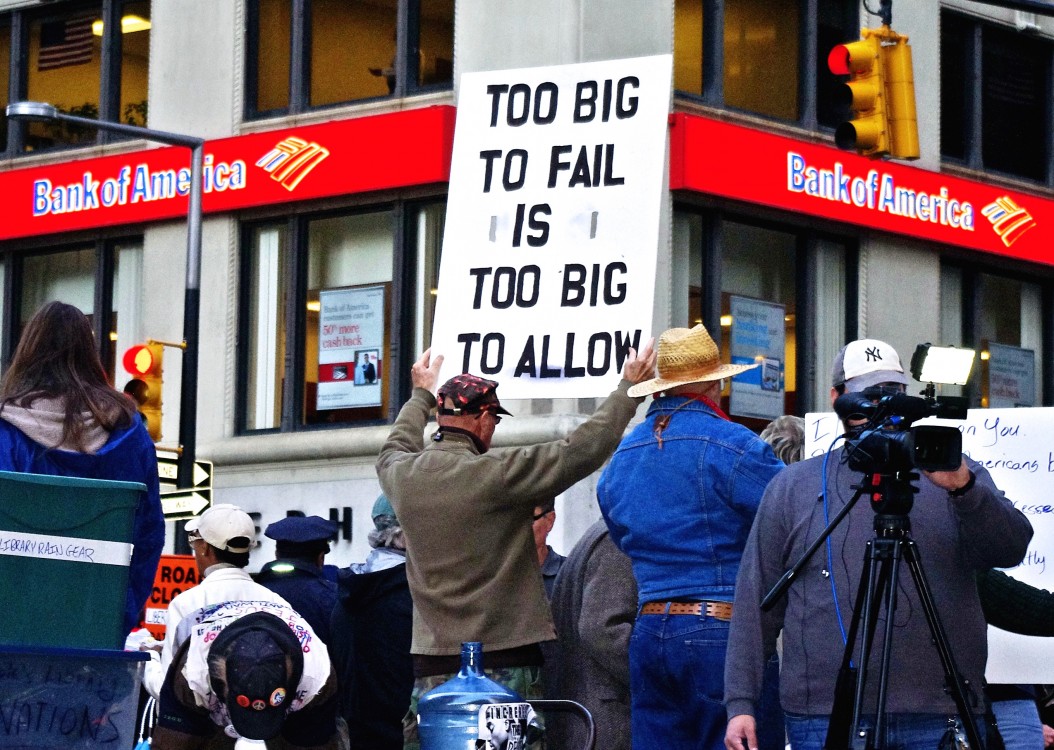
Late last year, the heads of state of the G20, the developed nations, met in Brisbane, Australia. One piece of business was the advancement of new banking rules that will allow what were called the Too Big to Fail Banks, and are now called Global Systemically Important Banks (G-SIBs) to seize depositors’ money to save themselves in the next crash.
The scheme has been orchestrated by the Bank for International Settlements (BIS), the Financial Stability Board (FSB, which is created by the BIS) and the usual crowd of central bank bureaucrats in the banksters’ international cartel.
The official report from the meeting does not, of course, say that in the next crash deposits will be confiscated. The scheme is only alluded to in the meeting's official statement through the citation of a report from the FSB, titled Adequacy of Loss-Absorbing Capacity of Global Systemically Important Banks in Resolution.
The summary provided on the G20 web site states that G-SIBs “must have sufficient loss absorbing and recapitalization capacity available in resolution to implement an orderly resolution that minimizes any impact on financial stability, ensures the continuity of critical functions, and avoids exposing taxpayers to loss.”
Pure obfuscation.
Worried that the politicians they have bought won’t stay bought – that their nerve may fail them when confronted with a demand for trillion dollar bailouts in the next crash, and that democratic government might assert itself – the banksters have a Plan B: an automatic “bail in.”
This is what the FSB calls “robust arrangements for dealing with stress in the financial system.”
They tried out this scheme in Cyprus in 2011. In this soon to be global paradigm, as one commentator explained, “banks [will] no longer recognize your deposits as money, but as liabilities and securitized capital owned and controlled by the bank or institution, just part of a commercial bank’s capital structure.”
In the next crash, depositors will be subordinated to other creditors and will be pushed down through banks’ capital structure to a position of “material capital risk” – just another creditor fighting for a share of the assets of a failed bank, forced to settle for maybe pennies on the dollar.
Small deposits in the U.S. have until now been guaranteed by the Federal Deposit Insurance Corporation (FDIC). But as has been reported, total FDIC reserves are dwarfed by the amount of deposits at risk and the more than $200 trillion exposure to derivatives of the banksters’ cartel.
But municipal deposits are not guaranteed by anything, except the liquidity of the bank that holds them. Cities, counties and states all across America have perhaps several trillion dollars on deposit.
Unprosecuted, unreformed, unregulated and unrepentant, Wall Street parties on. Those deposits are at increasing risk.
You might not see it coming. State and municipal treasurers who manage government deposits might not see it coming. Members of Congress might not see it coming. But central bankers like those of the Fed know it is coming.
So does the FDIC. Months ago it laid out this new scheme to protect Wall Street in a policy document prepared jointly with the central bank of the U.K., the Bank of England.
“Wait a minute,” you say. “Why would the FDIC participate in a scheme to raid the deposits it insures? The FDIC works for the American people.”
Wrong. The FDIC was created in 1933 to calm a jittery public after the 1929 crash, head off runs brought on by panicked depositors and save banks, not depositors.
This may strike you as hard to believe, as prior to the Great Depression Americans thought the ownership of gold and silver was inviolate, almost sacred. But in 1933 the federal government confiscated gold and silver to bail out the banks and Federal Reserve.
The American people must recognize that history can and does repeat itself, that the money we thought was our own, protected in our checking and savings accounts could be taken in an instant should there be a financial crisis even remotely similar to that of 2008.
I said “could be.” In the United Sates these policies must be enacted and signed into the law by the Congress and the president. Whose side are they on?
President Obama calls the banksters “savvy businessmen” and his “friends.” He pushed the 2008 bail out through Congress, surrounded himself with Wall Street advisers and put Wall Street agents in charge of the regulatory agencies.
That may leave it up to Congress to protect Main Street from Wall Street and the banksters in the next crash.
What are the odds? Main Street, we have a problem.
3 WAYS TO SHOW YOUR SUPPORT



- Log in to post comments


