
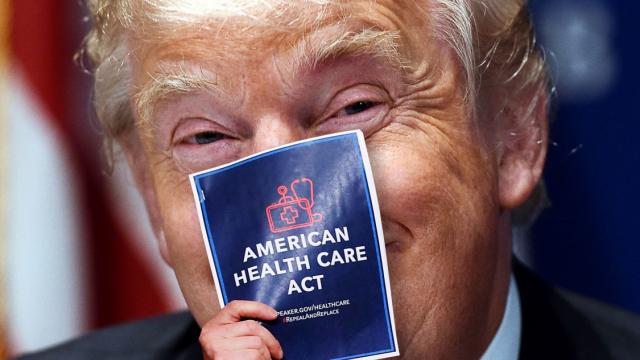
Americans like to indulge the notion that we are exceptional, a conceit that understandably sends non-Americans up the wall. But we are indisputably exceptional in a way that must baffle the rest of the developed world: our failure – or refusal – to implement universal health care.
Even Hong Kong, often and erroneously portrayed as a laboratory experiment in hands-off government, has what amounts to universal health care. The U.S. has never had anything like universal coverage, yet even “Obamacare” – a piecemeal measure that narrows but does not close the uninsured gap – is often vilified as a kind of Bolshevik plot to collectivize medicine.
How is it that such an advanced society is so averse to an idea that’s elemental in most of the developed world? The answer has to do with the individualist and anti-intellectual political culture that Donald Trump has ridden into the White House, and with the political power of a health care industry heavily armed to protect its own interests.
Of course, that’s not the narrative you’ll hear from the sort of people who despise not just Obamacare but the whole notion of a social safety net. They explain our gap-ridden health care by way of a healthy cultural aversion to big government. It’s an interesting storyline, but it doesn’t quite square with national programs like Social Security (an 82-year-old system comparable to Hong Kong’s Mandatory Provident Fund), Medicare (universal “single-payer” health insurance for people over 65) or Medicaid (government health insurance for the poor). Or with the fact that three-fifths of Americans would prefer a universal system.
If, by cultural aversion, conservatives mean cognitive dissonance, they may be on to something. The Tea Party – a populist antecedent to Trumpism – held feverish rallies in the early Obama years where inevitably some faux live-free-or-die insurgent in a tricorn hat would hold up a placard reading, “Keep your government hands off my Medicare”.
Even today, people who are sure they hate Obamacare – essentially a system of government-sponsored exchanges where people buy private insurance – aren’t quite sure what it is. A recent survey by the polling firm Morning Consult found that 80 per cent of Republican voters strongly disapproved of “Obamacare”, while only 60 per cent strongly disapproved of the “Affordable Care Act”. The punchline: They’re one and the same. The very name “Obamacare” helps explain the confusion. It’s a term of derision ginned up by the Great Right Wing Noise Machine that tends to dominate the national conversation.
That gets us to the second problem with the cultural-aversion theory of freedom from health care: it casually omits a long history of scare tactics deployed by corporate propagandists at the mere thought of treating health care as a public good, not just a private privilege. As described by The New Yorker’s Jill Lepore in 2012, an early landmark in the annals of bought-and-paid disinformation was the 1945 defeat of a California proposal for compulsory health insurance. The propaganda provider was Campaigns, Inc – the world’s first “political consulting firm”, wrote Lepore – and the client was the California Medical Association.
By the 1990s, the art of bamboozling folks into mortal terror of accessible health care was a highly refined art. The height of the genre was surely Harry and Louise, a fictional couple despairing at the kitchen table over the Clinton proposal in a series of TV ads sponsored by the Health Insurance Association of America.
Most of the developed world no longer debates the soundness of universal health care for the same reason it doesn’t debate the roundness of the Earth. In America, though, the flat-earthers are still on the scoreboard because they figured out long ago that public opinion is a gullible beast, swayed not by the strongest argument but by the loudest noise machine, and we all know who owns that.
3 WAYS TO SHOW YOUR SUPPORT



- Log in to post comments


