
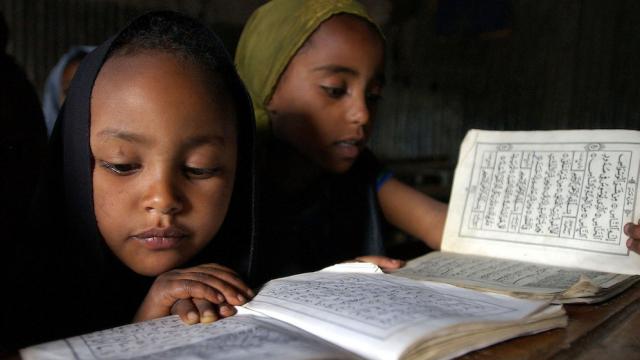
ADDIS ABABA — One year removed from the passing of Ethiopia's Prime Minister and longtime leader, Meles Zenawi, the East African country is still questioning its future. But while the vast majority here hope for change that includes greater freedoms after decades of oppression, for the Muslim community it is a time of rebuilding and developing stronger relationships with leaders across many segments of society.
Mariam is one example. Sitting quietly as she listens to a Friday sermon, Mariam's mind is elsewhere. She believes in change and hopes for improvements in Ethiopia, but life as a Muslim woman here is at times overwhelming, she said.
“I think we have to look at all sorts of solutions to what is happening here politically and socially,” said the 20-year-old, who studies sociology in Addis Ababa. “Muslims have been perceived as violent across the world and this is a danger we all face, but here in Ethiopia, we can be nonviolent and show that things can be different.”
Mariam is not alone. Thousands of Ethiopia's Muslims have openly embraced nonviolence as a means for social and political change. Despite controversial trials that international rights groups have labeled “unfair,” calling on the Ethiopian government to put an end to legal action against Muslim protesters, there is hope in the country that people's attitudes toward faith are beginning to change at a grassroots level.
Leading that charge are the youth, who have been able to start to come together and work for what they say is the common goal of “making Ethiopia better.”
Since last October, a group of concerned students has repeatedly come forward amid the ongoing tension between government and Muslims, demanding an end to what it describes as concerted action on the government’s part to increase sectarian tendencies among myriad groups in the country.
“We believe that the government is creating this tension and fear of sectarian conflict in the country by not allowing the Muslim population to have their will in their own affairs,” said the group, adding that Ethiopia's youth should be more consulted “because we have connections with one another that goes beyond religious lines.”
And it isn’t just Muslims who are lately coming together, but their Christian brothers and sisters.
“We have for so long been a fragmented country in many ways, with Muslims and Christians battling for their power,” said Teresa, a 21-year-old Christian who studies marketing.
"Now, as we have the opportunity to really make a change in how the country is run, we have to move quickly or face the same dictatorship that tore us apart for decades,” she said, referring to the iron grip of late PM Zenawi.
Her Muslim counterparts agree that the time is ripe for social change, but how that will happen through political or legislative channels is still unclear. The youth, however, remain skeptically optimistic that their country can gather around what one person, Hassan Mahammad, calls the country’s most important resource: “the people.”
“Ethiopia is a large country and we are a diverse people, but that is what makes us special," said Mahammad. "We can debate and create a new foundation for all people, Muslim, Christian and others for the bettering of our society.”
For the country's young people who represent their respective communities, unity moving forward is the only solution to creating the new version of Ethiopia they seek: one with a solid foundation in understanding, and which is forward-thinking.
A leading Ethiopian political thinker, Professor Alemayehu G. Mariam, also sees the time is right for Ethiopia to enact “radical improvements” in its social and political climate following the death of the prime minister.
“I say today is the perfect time for all Ethiopians to bury the hatchet of ethnic division, religious sectarianism, regional conflict and human rights violations,” Mariam wrote in an opinion article published here. “It is the perfect time to shake hands, embrace each other and get our noses to the grindstone to build a new democratic Ethiopia where the rule of law is upheld and human rights and democratic institutions respected.”
He argued that the situation facing Ethiopia does not need to be a painful process of change, but that new leadership can learn from the past two decades to "put an end to historic hatreds and resentments and open a new chapter in Ethiopia’s history... to unchain ourselves from the burdens of the past, close the wounds that have festered for generations and declare to future generations that we will no longer be prisoners of resentments of the past,” he added.
There is a tentative hope that democracy and human rights can be part of Ethiopia's transition away from authoritarian rule. Still, many experts maintain a realism that the country is unlikely to see speedy democracy or drastic socio-political change to the status quo, even as two decades of Zenawi rule have come to an end.
But whether fast or slow, the university student group made up of Christians and Muslims is hopeful the change will be for the better.
“We have long faced this kind of attack from the government if we speak out, so we really want to see democratic change in Ethiopia because it will mean a better country for all,” the group said at their recent meeting. “Ethiopia deserves a country that is not ruled by one person, but a place where citizens and the people have a say in our future.”

3 WAYS TO SHOW YOUR SUPPORT



- Log in to post comments


