
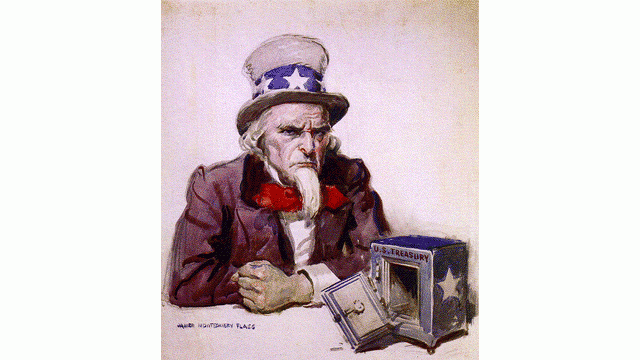
Americans of all political beliefs have been told repeatedly that America is broke, that something must be cut and/or taxes raised or we will drown in debt. While the debt is real, it pales in comparison to the tens of trillions available to us—if we know where to look.
The following multi-trillion dollar economic reforms would completely turn the American economy around to the positive, forever. The first three have all been implemented to some degree in our history. All are consistent with American values of competition, fair play, economic and ecological sustainability, meritocracy, profiting from one's own labor, and Lincoln's ideal of an America by, for and of the People.
1.Debt-free Money: Like coins and stamps (for a limited purpose), debt-free United States Notes can be issued by Congress anytime, for any reason, in any amount under the Constitution's Article 1, Sec. 8. Congress did create these original Greenbacks under the first Legal Tender Law by President Lincoln—$450 million—to fund the Civil War, and they continued through 14 series until 1996. This money would not have to be borrowed, raised in taxes, or backed by gold. It need not cause over-inflation if put toward those sectors that are in deflation. It is a "Public Option for Money." Perhaps $4 trillion, spread over 10 years, could be directed towards infrastructure, or Social Security. Several recent attempts to do this, including Rep. Kucinich's Bill, HR2990, are part of larger reform packages, but we can re-issue U.S. Notes anytime, producing an immediate gain in the government's accounts. Correcting Treasury & GAO's misleading statements on this issue is part of an ongoing lawsuit here (Johnson v. Treasury) featuring my petition (Exhibit B).
2.Land Value Taxation, a.k.a. the Single Tax: This Henry George idea would make public the currently private collection of resource and locational rent. It would end speculation by taxing economic rent, and eliminate Land-based booms and busts like the current one, forever. Furthermore, by taxing the 33 to 40 percent of GDP that is collected by idle rentiers on location and natural resources, one could untax all actual production (wages, sales, fixed capital like buildings), thereby vastly simplifying the tax code, removing opportunities for corruption, and freeing up major American productive capacity in a naturally efficient, green, scalable, and sustainable way. This idea has been successfully applied in towns and cities all over the world and is perhaps the most established theorem in economics.
3.Public Banks: Like the highly successful State Bank of North Dakota, established in 1919, public banks would force state accounts to be invested in State needs, and not in Wall Street speculative gambles—money which was raised through taxes but then has to be borrowed back, at interest rates of 4 to 6 percent. The agency and pension funds of most states are invested in risky, often under-performing asset classes, sometimes below investment grade, by managers who charge millions in fees. The Bank of North Dakota manages $4 billion in loans conservatively and constructively. Public Banks can respond directly to community needs and even occasional emergencies in a way that would decentralize the money power, returning taxpayer money to we the people. Multiplied in all 50 states, and at the community level too, and America could save trillions in unnecessary gambles, bailouts, and interest costs.
4.Audit the local, state, and national Comprehensive Annual Financial Reports (CAFRs): There are 10s of trillions of dollars in the 184,000 CAFRs nationwide. These funds, many invested outside the country, could be used to pay a citizen's dividend in perpetuity, ensuring a Basic Income Guarantee (BIG) for every American. There is $600 billion in California's pension fund alone, paying out just 4% a year to pensioners, whose "managers" rake in billions for often under-performing the market, while government acts as both regulator and investor in the Mother of All Conflicts of Interest! We need impartial accountants to comb through the CAFRs and to do so every year, for the benefit of the American people.
5.Repatriate Offshore Accounts: A new report by the Tax Justice Network shows up to $32 trillion is stored away in offshore accounts, away from tax authorities. These funds are held by the top .001% in private accounts managed by the biggest of the Too Big To Fail banks, while their owners live in other places where middle class taxpayers pay for vital services and infrastructure instead. This subsidy for the wealthy is unsustainable and must be ended by repatriating these accounts or taxing them from foreign lands.
These are just five places to look for trillions in savings and relocatable funds. There are others. Pick one or find your own. Find out about it. Learn. Become Active. Join a group to effectuate change. Fight. And remember, America Iis not broke!
Scott Baker is the president of Common Ground-NYC and coordinator of the NY Public Banking Institute.
3 WAYS TO SHOW YOUR SUPPORT


- Log in to post comments


