
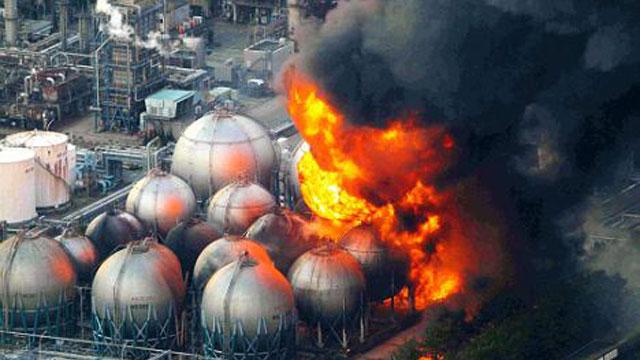
Initial fears over the three reactor meltdowns at Fukushima Daiichi Nuclear Power Plant were intense. I still remember the explosions in March of 2011 and how foreboding they were; then, six months later, most of our anxiety was forgotten as we headed over to Zuccotti Park and into the jubilation and the euphoria of the Occupation. The world largely forgot about Fukushima by year's end, swept up in uprisings around the globe. But for those in Japan, there was no uprising, and things went from bad to much worse.
In that insane act of near genocide, municipal governments had incinerated radioactive disaster debris all over Japan. Today, radiation well beyond safe limits contaminates much of the country, its air, agriculture, and seas. Citizens everywhere test their food and environs with Geiger counters. The results: 43% of children in Fukushima City have thyroid abnormalities, up from 1% before the disaster. People in many parts of Japan are getting sick, most notably the young, with symptoms of radiation poisoning including heart attack, eye disease, diabetes, nosebleed, nausea, skin disease, diarrhea, and pain. The reactors are beyond anyone’s control, emitting over 10,000,000 becquerels per hour of cesium, among many other radio-isotopes, and the molten cores are burrowing down into the earth. The Pacific Ocean is being continuously contaminated with radiation from the reactors, which is slowly spreading around the planet.
Ultimately the most far-ranging threat to the rest of us is not the radiation silently reaching our shores, and our skies, contaminating air, water, and food, but something just as insidiously away from our sight, chillingly absent from the media and our consciousness: a spent fuel pool, packed with 262 tons of highly radioactive used nuclear fuel, sitting 100 feet in the air atop a broken down building in imminent danger of collapse.
The building contains Fukushima Daiichi Nuclear Power Station’s reactor no. 4, which used the fuel, although it only used 5% of the uranium in it. The fuel, still highly irradiated, still lethally hot, is just sitting there, open to the sky (the roof was blown off), in 1,533 fuel rod assemblies, 202 of them new and unused. Almost every day there’s an earthquake, or several, in the region (there have been thousands since the meltdowns).
Tokyo Electric Power Co., or TEPCO, the power station's owner, assures us the building will withstand a magnitude 6 quake. But currently, seismologists in Japan are expecting a truly major earthquake, 90% certain of a magnitude 7 or greater (some say an M8) within the next 1-3 years. To be accurate, an M7 is 10 times the severity of an M6.
If such an event happens, the building will collapse. The pool will collapse. And when the water drains, 262 tons of uranium containing 2.6 tons of plutonium will overheat, catch fire, and melt down (or possibly explode), releasing 10 times more caesium-137 into the atmosphere than the Chernobyl disaster, along with vast amounts of other radio-isotopes. It will also release enough deadly gamma radiation to call an immediate halt to operations at the plant.
And that's not all. There is another nuclear plant located 7 miles away, Fukushima II, which would also likely be abandoned following an earthquake. This means four more reactors, four more fuel pools... you get the picture. Yet neither the government nor the international media are mentioning these stark facts -- and neither TEPCO nor the Japanese government are doing anything substantial or preventative in response.
Japan did hold meetings inaugurating "bilateral commissions" with the U.S., France, the U.K., and the Ukraine to address nuclear issues. The country's Ministry of Foreign Affairs and Ministry of Economy, Trade and Industry met with the U.S. Department of Energy, Nuclear Regulatory Commission, and Department of Defense. They have discussed the independence of regulatory systems, decommissioning and decontamination of Fukushima I, research and development, nuclear nonproliferation, and nuclear security (measures against nuclear terrorism).
In short, they have talked about how to run a nuclear state —but not one the Japanese population, which just voted for 0% nuclear power, want to live in. If official press releases are to be believed, there is no urgency whatsoever. No mention of catastrophic radiation. No mention of spent fuel pools. As if last year's unprecedented disaster never even happened. No one is certain of TEPCO's timetable to remove more the than 1,500 fuel rod assemblies (they have so far removed just two); estimates have already run beyond 2013 to three, 10 and 20 years from now before they will have them removed.
One hero of Fukushima’s accident, now-retired plant manager Masao Yoshida, who defied TEPCO’s orders by flooding the reactors with seawater and thereby saving the plant from catastrophe, said after the establishment of the commissions: “People won’t come back to Fukushima until the plant is stabilized and we still need to find a way to do that. We have to bring people in from around the world. It will require people, technology and wisdom from all corners.”
Awakening from a dream with a future, into a nightmare without one, takes courage, and it takes time. Facing up to the real challenges of Fukushima may sound as difficult as holding back the ocean (or raising the minimum wage). But we have taken the first step. A lot about the Occupy movement is done on faith, unclear where and how the next step will appear. Now, the whole world is awakening to the nuclear threat that threatens all of us. In this alone, Occupy has been successful.
To get started, you can take these actions, and perhaps come up with your own. For example:
- Sign this petition and spread the word.
- Email the Prime Minister of Japan, His Excellency Yoshihiko Noda, and ask him to accept help from other countries.
- Write to Goshi Hosono, Nuclear Disaster Minister, also PM Noda's Minister of the Environment. You can write to him also at the Ministry of the Environment.
- Email TEPCO, addressing either the company's chairman, Tsunehisa Katsumata, or the president Naomi Hirose, and ask them to accept help from other countries.
- The Japanese Emperor, Akihito, is attended to by the Imperial Household Agency.
- Message President Obama and ask him to grant refugee status to all affected Japanese citizens.
- Form a local Fukushima response group to mobilize awareness of the crisis, illuminate its effects here, and express solidarity with the Japanese.
- Visit and support anti-nuke protests online at IWJ Ustream.
- Stay safe, stay connected, and keep fighting - peacefully. As we gird ourselves for another battle, another Occupation, another awakening that may define us, let us rise to our full height and aid those who need it most.
For further information visit fukushimaresponse.org.
3 WAYS TO SHOW YOUR SUPPORT



- Log in to post comments


