
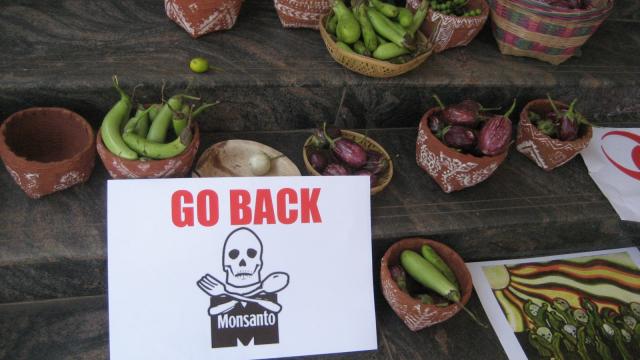
On August 8, thousands of farmers and activists from across 20 Indian states demonstrated in New Delhi against the Biotechnology Regulatory Authority of India (BRAI) Bill, and demanded an end to GMOs in India. 53-year-old farmer Jaswant Sainhara, standing with his son, proudly held up a placard that read, “Monsanto, Quit India.”
August in Delhi is among the hottest months of the year, with temperatures ranging from 40 to 45 degrees Celsius (104 to 113 Fahrenheit). Yet under the sweltering summer sky, the people whose voices rose together that day knew they were not fighting for their justice alone, but were fighting for the basic human right to safe food.
India seems to have awoken to the dangers of GM crops. In a recent move, the courts here rejected two patent appeals by biotech giant Monsanto, dealing a sizable blow to a company that recoups its research investments in large part via patents.
Monsanto wanted to patent its “Methods of Enhancing Stress Tolerance in plants and methods thereof,” and “A method of producing a transgenic plant, with increasing heat tolerance, salt tolerance or drought tolerance.” But both the Patent Appeals Court and the Intellectual Property Appellate Board rejected the company's claims, saying they involved no “inventive steps” as required in the Patents Act of 1970, and that they offered a “mere application” of already known science.
For the many farmers protesting the GM poisoning of their fields, crops and their very livelihoods, the courts' decision was a significant victory and validation for India's food growers. Sainhara, for example, said he didn’t really understand what GM crops were all about until his son — who had been educated through a local NGO — explained to him how GM food and seeds worked.
“For years, I saw my yield going down,” he said. “Where was the strong disease resistant cotton I was promised? I could visibly see the soil quality deteriorating. I was poisoning my sole source of livelihood with my own hands.”
India has a long and contentious history with Monsanto, the multinational ag-biotech corporation headquartered in Creve Coeur, just outside St. Louis, Missouri. The conflict goes back to Monsanto's introduction of BT Cotton here in 2001, when farmers were promised a robust cotton crop that would remain pest resistant.
But there was little warning about the downsides.
GM seeds are prohibitively expensive to start with, as companies like Monsanto charge a premium to offset research costs. But touted as “magic seeds,” the aggressive marketing tactics ensured that many farmers fell victim. They were convinced that the high cost of seeds would be offset by the yield and savings on pesticides. Soon, farmers realized that their age-old pest control was no protection against the vicious bollworms that started attacking the crop.
Forced to buy pesticide from Monsanto at high prices, India's farmers incurred unforeseen debts that tripled once their crops failed and they were forced to buy new GM seeds for the new planting cycle. Still, their crops failed with alarming regularity.
Indian agriculture is very rain dependent, and plants growing from GM seeds need twice as much water as traditional crops. Traditional agriculture here works with the monsoons and the great amount of rain. But by this time the monsoons weren’t enough, and when the rains didn’t come — as they often don’t in India — the crops dried up and died.
A step that was touted to revolutionize food growth in India turned into a vicious cycle of forced debt, poverty and eventually mass suicides that pushed the issue to receive national attention. In a 2008 article titled “The GM Genocide,” the UK-based Mail Online noted that an estimated 125,000 farmers had committed suicide “as a result of the ruthless drive to use India as a testing ground for genetically modified crops.”
The Maharashtra region was touted as a “suicide belt” and the Indian Ministry of Agriculture confirmed that “more than 1,000 farmers kill themselves here each month.”
Nonetheless, the government pushed ahead and allowed companies like Monsanto to use the country's fields and food supply as a giant laboratory. In return for opening up its economy, the Indian government was granted massive loans by the International Monetary Fund (IMF). Not all of that money was lost in corruption. The country’s cities boomed while its agriculture lay doomed.
The Center for Human Rights and Global Justice (CHRGJ) at the New York University School of Law stated in a report that “more than a quarter of a million Indian farmers have committed suicide in the last 16 years—the largest wave of recorded suicides in human history.”
In 2010 after massive protests, the government banned the commercial farming of Bt brinjal — India’s first GM food crop — from mass cultivation. The Bt brinjal was developed in conjunction with Mahyco (the Indian subsidiary of Monsanto) and the University of Agricultural Sciences in Dharwad and Coimbatore, Tamil Nadu.
But the country isn't past its GM food danger yet.
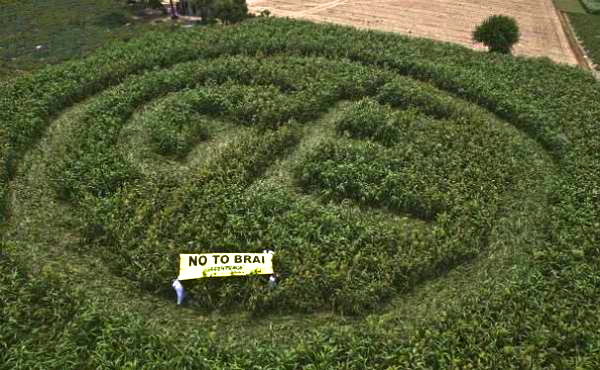
In a bid to ensure that GM food and seed corporations still retain a stranglehold over the country’s food production, the Ministry of Science and Technology drafted the Biotechnology Regulatory Authority of India (BRAI) Bill. The government initially gave the public 30 days to respond to the bill, and after vociferous protests, an extension of 45 days was granted.
The proposed law “doesn’t make mandatory the labeling of GM food products,” said Ruma Ghosh, a lawyer in Kolkata. “It classifies some information as 'confidential commercial information' which even officials have to take an oath not to reveal.”
Greenpeace India has said the bill reads like "India’s Monsanto Protection and Promotion Act." In a report released in January this year, it also stated that Monsanto has been conducting final biosafety research and field trials for its genetically modified corn, which could be considered for commercialization in India.
For once, India isn’t alone in its protest. Global awareness of the dangers of GM foods has produced a March against Monsanto movement that saw 2 million people worldwide take part in May. The next global action is scheduled for October 12.
In the meantime, the farmer Sainhara knows he has to walk the mean streets of the capital, Delhi, and do his best to make apathetic officials listen.
“I would rather be tending my fields,” he said. “But if I don’t walk now, I won’t have any fields left.”
Jainuddin Bagra, a farmer who came all the way from Maharashtrato to attend the August 8 demonstration, said he won’t move until he knows that the crops he grows won't poison the country. “Nahin jayenge (won’t go)”, he said firmly.
Also in attendance was a 40-year-old farmer named Shankar, who became his family's sole earning member after his father committed suicide. “I worked as bonded labor to pay our debts,” he said. “Now I realize that it’s not just about me. I can poison you and your children also by what I grow in my fields. What will absolve me of murder?”
What will pardon a government that’s determined to barter its country’s health for mere profit? Monsanto recently was forced to pull GM crops out of Europe. The company has now stated that it will focus its European efforts on more conventional agriculture.
There is a clear lesson here for India: a country can survive without big corporations controlling its food. The question is: will the government listen to the people's demands? Meanwhile, a country holds its breath.
3 WAYS TO SHOW YOUR SUPPORT



- Log in to post comments


