
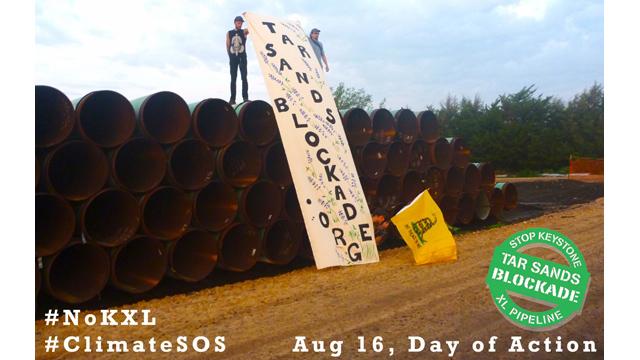
Photo: Candice Bernd
Blockaders braved a wall of bulldozers early Thursday morning and unfurled banners that warned TransCanada to expect resistance the size of Texas if the company proceeds with construction of a pipeline to carry Canadian tar sands through the region as part of Keystone XL’s hastily rebranded “Gulf Coast Project.”
TransCanada broke ground last week on the southern leg of the Keystone XL pipeline, bucking more than four years of intense opposition to the project from farmers, ranchers and local communities representing thousands of people affected across Texas and Oklahoma.
There was no official ribbon-cutting ceremony to inaugurate construction at the pipeline’s staging area last week—in fact, TransCanada’s careful PR control and political pressures led to a virtual media blackout on the subject.
Instead, members of the Tar Sands Blockade a broad affiliation of activists opposing the project, traveled Thursday seven miles west of Paris, Texas, to christen the construction site in their own way: with a day of defiance, and the promise of rolling actions for as long as the pipeline plan proceeds.
“TransCanada is putting families that wanted nothing to do with this pipeline in harm’s way,” says blockade organizer Ron Seifert. “Since our leaders and representatives will do nothing to protect our friends and neighbors, the Tar Sands Blockade is calling for people everywhere to join us and defend our local communities from a multinational bully.”
Plans to integrate the proposed Gulf Coast Segment with the existing Keystone System would allow extractors in Canada to send a toxic tar sands slurry to the export market on the Gulf Coast. Creating minimal short-term construction jobs, the expansion of the oil industry will pad the pockets of Gulf Coast refineries—which operate in a foreign trade zone that evades state and federal taxes—while endangering the health and livelihoods of hundreds of communities between Cushing, Okla., and Port Arthur, Tex.
TransCanada’s desperate reshuffling of the project, re-routing the pipeline through Oklahoma rather than much-contested Nebraska, came after 1,253 people were arrested in Washington, DC, last fall. The sustained protests at the White House, including another demonstration in November in which more than 12,000 encircled the White House, pushed President Obama to reject the permit for the $7 billion Keystone expansion, stating that not enough time had been given for a proper environmental review.
But in March, the president traveled to Cushing, Okla., where he announced plans to expedite the pipeline’s southern portion as part of his “all of the above” energy strategy—leaving landowners, ranchers, indigenous communities and thousands of local citizens in the shadow of the refineries, with the deadly pollution they imply.
“I am told the pipeline is so we won't have to buy ‘blood oil,’” says Cherokee activist and Grand River Keeper Earl Hatley, who is co-founder of Clean Energy Future Oklahoma. “The pollution killing First Nations peoples [in Canada] and destruction of their culture by greedy multi-national oil barons is akin to the long ago practice of providing small pox blankets to our people here in America.
“We native peoples who fight the destruction of the great Boreal Forest for our relatives in Alberta call tar sands blood oil," he says.
Events on Thursday were also staged in Dallas and Houston, where protestors standing in solidarity with rural landowners say TransCanada bullied and manipulated residents across the state, forcing the pipeline’s construction through the use of eminent domain—a legal maneuver that allows corporations to seize private citizens’ property without their consent.
“TransCanada lied to me from day one,” says Susan Scott, a landowner in East Texas whose property will be condemned. “I worked 37 years for my farm, and TransCanada believes it is entitled to a piece of my home.”
While many landowners along the pipeline route in Texas said they signed easement agreements with TransCanada out of fear of being sued, another landowner, Julia Trigg Crawford, is still holding out. Her case went to court in Paris on Friday, with a ruling to be issued shortly.
Cases like Crawford’s display the immense legal power and strategies employed by multinational corporations in the fossil fuel industry, whose arguments for eminent domain enable them to continue profiting from the extraction and burning of fossil fuels at the expense of local communities and the climate.
"In the midst of record heat and drought, this just adds insult to injury," says 350.org founder Bill McKibben, who has led the fight against the Keystone pipeline since last year. July was the hottest month ever recorded in the U.S., bringing with it drought conditions that now threaten more than half the nation. "More risk, more carbon, more heat,” adds McKibben, “all the things farmers and ranchers don't need."
The Tar Sands Blockade is part of a burgeoning direct action movement against fossil fuel extraction—coined as the “Summer of Solidarity”—now taking shape across the nation. This week in Montana, residents occupied the state capitol in Helena to begin eight days of civil disobedience as part of the Coal Export Action aimed at halting mining operations at Otter Creek and shipments of coal westward to Asian markets from the Powder River Basin.
Over the summer, other direct actions have focused on stopping mountaintop coal removal, or strip mining, in West Virginia; barring fracking operations in Ohio, Pennsylvania, and New York; and enacting a “human oil spill” in Vermont to protest a proposed Tar Sands pipeline and other polluting energy projects slated to be built through the heart of New England.
And so, in the Lone Star State, it too begins. The board is set and the pieces are moving.
3 WAYS TO SHOW YOUR SUPPORT


- Log in to post comments


