
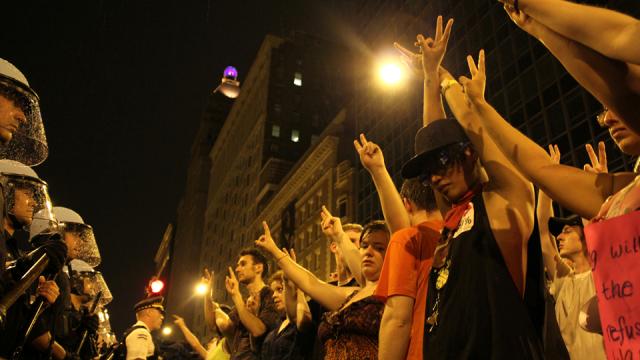
Photo: Katie Moore. Occupiers tell the cops they will lower their peace signs when the cops lower their batons. Chicago, May 20th, 2012.
On an intersection in Chicago on Sunday, a line of United States Army and Marine Corps veterans stood in uniform, preparing to discard their medals of honor.
A haze lingered in the blazing 89-degree heat as thunderheads built over the Hyatt Regency, just four blocks away, where global military leaders were discussing the war in Afghanistan at the North Atlantic Treaty Organization (NATO) Summit.
Many thousands of people had marched south down Michigan Avenue to join the veterans. Miles away from Chicago's financial district, civilians from Los Angeles to Rhode Island aimed to confront the largest meeting of NATO officials since the group’s inception 63 years ago.
One by one, the Iraq Veterans Against the War stepped up to the mic to explain, in a few sentences, why they had chosen to reject the accolades they garnered in the army. Then, one by one, they turned towards the NATO Summit that loomed beyond. With all their might, they flung the medals through the air and the ribbons fluttered just an instant before their weight sank them at the feet of a row of riot police.
Cops surrounded the marchers entirely: NATO police, Federal Protective Services, state police, Chicago cops and mercenaries from private military companies like Academi (formerly Blackwater). There were the ones wearing shiny, baby blue helmets; the ones in black with camo camelbacks; there were bicycle cops floating around in short-sleeve shirts; some cops in khaki; high-waisted forest green; and other thick-necked ones wearing 30 pounds of bulletproof turtlesuits. They carried three-foot-long wooden sticks, two-foot-long rubber billy-clubs, and metal whips. They brought trucks and vans, bikes and buses to shuttle whole armies and block intersections, their lit signs reading: “Chicago, My Kind of Town.”
Chicago media had been regurgitating official hype about supposedly fearsome Black Bloc protestors for weeks. But save for this march of thousands, the streets of Chicago stood bleak and lifeless, with most shops closed and streets blocked on all sides. The street signal over the vets' heads changed from green to yellow to red, regulating a non-existent wave of traffic as more marchers, holding banners reading “Health Care, Not Warfare,” kept rolling into the junction.
Today, only eight percent of Americans "strongly" support the war in Afghanistan, along with another 19 percent who say they simply agree with it. These are the lowest numbers ever. Just two years ago, almost half the country supported the war.
“I'm doing this for the Iraqi and Afghani people. And I'm doing this for our real forefathers, the Student Nonviolent Coordinating Committee – SNCC, the Black Panthers, the civil rights movement, the anarchist movement,” said Vincent Emmanueli, who participated on Sunday. “And I'm doing this here, now, because our enemy is not overseas, our enemy is in the corporate boardrooms, right over there in those NATO conference rooms, right here at home.”
Many of the Iraq Veterans Against the War said they relinquished their medals of honor in disgust at the ongoing occupations of Iraq and Afghanistan, and also Palestine. A mother soldier, who'd come back from Kosovo years earlier, said the only thing worth fighting for was the peaceful fight on the streets for a world without war, for her children.
A father said that since he'd returned from Iraq three years earlier, nothing had been clear to him; his three daughters never stopped asking when he would be okay. One soldier said bitterly, “I have PTSD,” and after throwing away his medals, declared hoarsely, “I am reclaiming my right to heal.”
Aaron Hughes, his voice breaking, said, “This is for the one-third of female soldiers who are sexually assaulted. We talk about taking care of our sisters overseas, but we can't take care of our sisters here.” Hughes, of the National Guard, left university in 2003 to go to Iraq and Kuwait. He was in the army for six years.
Two Afghan women concluded the day with a request for sixty seconds of silence, following their own tortured, impassioned testimonies. A trumpet alerted the crowd, still chanting, to collect themselves and reflect. “Hold this, just a moment longer,” said one of the soldiers as they readied to exit in peaceful formation. “Respect that moment of nonviolence a moment more.”
Not fifteen minutes later, as the vets stood talking and hugging in a field nearby - and as Iraq Marine veteran Scott Olsen sat cross-legged in the grass speaking with the crew from Democracy Now! - riot police moved in on the thousand-some demonstrators that remained behind. Some Black Bloc youth physically pushed back at police; others merely sat in lock-down, and a few meditated. One youth from Occupy Madison had her kneecap shattered. Police knocked out the teeth of another young man nearby.
“Do you think they can debate us?” asked Chuck Winant, one of the Vietnam Veterans Against the War who staged an occupation of the National Mall in 1971. “May 20, 2012 is a historic day.” And yet this was not the first time soldiers in the United States have rejected their medals of honor, Winant recalled. Almost exactly forty-one years ago, on the final day of the occupation of the National Mall, 800 veterans discarded their medals, ribbons, discharge papers and other war mementos on the Capitol steps. “Back then, the Attorney General of the United States said, after they suppressed the Black Panthers, that we were the greatest threat to America. When they called us a threat, it was because they couldn't debate us.”
Several months ago, the U.S. Department of Homeland Security declared the NATO gathering in Chicago a “National Special Security Event,” drastically curtailing the public's First Amendment right to assemble freely and dissent. “The battle is going on still, and you can tell we're getting somewhere,” Winant added, “because they came up with all these draconian laws. They want us to just keep quiet, but this is just a continuation of what we've been working for all along, and we're making progress.”
3 WAYS TO SHOW YOUR SUPPORT



- Log in to post comments


