
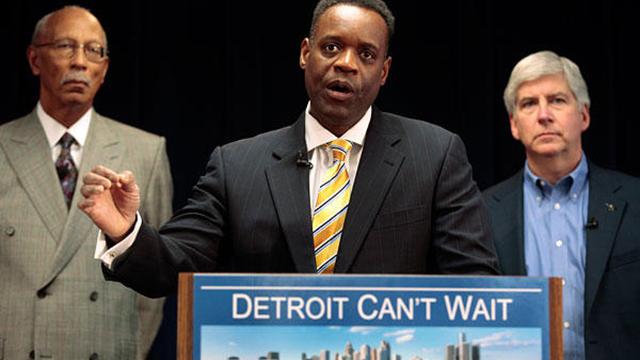
Fresh from shoving his "Right to Work for Less" legislation down the throats of Michigan's workers, Governor Rick Snyder has grown bolder in pursuing a corporate agenda. He has now appointed Kevyn Orr of Jones Day Law firm to act as an Emergency Financial Manager (EFM) of Detroit.
As an EFM, Orr can dismiss elected officials, tear up union contracts, privatize public assets and impose new taxes without a vote. The trappings of democracy are swept away like so many cobwebs. Nearly half of all of Michigan's African-American citizens are now effectively left with no vote in local government; they are stuck with taxation without representation.
With the appointment of an EFM, Governor Snyder is transforming Detroit into an occupied colony within the State. Instead of guns, the armies sent into Detroit will carry briefcases filled with lucrative contracts to ensure complete corporate domination at the expense of the city's residents.
Their task will be to find ways to squeeze more labor out of Detroit's workers while paying them less, open up publicly owned services for private investment, and cut social programs that do not contribute to the enrichment of the 1% by enforcing an austerity program. And the results are predictable: austerity will cause even more unemployment and increase the deficit further just as it has done in Europe.
This development is a bi-partisan affair. While Governor Snyder is a Republican, Kevyn Orr is a Democrat who worked for President Obama's election. Detroit's Democratic Mayor, Dave Bing, said of his relationship with Snyder that they are "joined at the hip."
Who Created the Crisis?
To justify his appointment of an EFM for Detroit, Governor Snyder is citing a state-appointed review team report. The report noted Detroit's $14 billion debt and the $327 million budget deficit, as well as other issues. What it failed to examine is the billions of dollars banks and corporations make every year as a result of doing business in Detroit.
The city business income tax is only 2 percent while individual Detroit residents pay 3 percent. Michigan's corporate income tax is a flat rate of only 6 percent, the same rate as the state sales tax, which impacts middle and low-income individuals the most.
The city's debt would vanish and its budget would flourish if the banks and corporations were paying their fair share for the privilege of doing business in Detroit, Michigan. This is not to mention the $1.1 trillion in annual deductions, credits and other tax breaks that flow disproportionately to the highest income Americans each year on a national scale.
Nor does the report mention that many of the banks in Detroit were bailed out at the onset of the Great Recession with trillions of taxpayer dollars — money that should have been used for jobs and public services. Not only are these banks getting off cheap on taxes while being bailed out, they have actively swindled massive amounts of revenue from Detroit’s citizens.
Credit agencies, like Standard & Poor’s, aggressively targeted homeowners with subprime loans. This has led to fraudulent foreclosures that have driven 200,000 people from Detroit, leaving one-quarter of the city's houses empty. As a result, both real-estate values and tax revenue have been depressed.
These banks also sold the city interest rate swaps, a financial tool they assured would save Detroit money. Then they set the interest rates artificially low (the LIBOR scandal) so they would make money hand over fist and leave Detroit holding the bill or pay a fee for getting out of their trap.
The banks and corporations are the ones responsible for Detroit's financial crisis. Yet they are the ones who will reap the rewards of an Emergency Financial Manager. It will be their interests that Kevyn Orr is there to serve, by making sure they get paid first and foremost, above all other considerations.
In a city with an official 10.2 percent unemployment rate, where 57 percent of children live below the poverty line, where street lights are left off, roads left unrepaired, and bus service is spotty, it would be hard to imagine a scheme worse than appointing an EFM. The priorities of this "solution" are in opposition to the values of a community most workers hold dear.
Fighting Back
In defense of these values, Detroit has a long militant Labor and Civil Rights history. It is a sleeping giant that Kevyn Orr's appointment may arouse. There have already been numerous protests before he has had a chance to get to work, as well as militant sounding statements from some of the city's elected council people.
What is needed is a social movement that will unite Labor and Civil Rights organizations and get Detroit's residents out into the streets in mass protest actions. To do this it will not be enough to demand the ouster of the EFM and a return to the way things were before. Detroit citizens have already endured numerous cuts at the cost of their community's health and the economy's strength without Governor Synder's latest extreme measure.
What will involve the most people in struggle is a fight that reflects their values and addresses their immediate demands. Detroit needs good jobs, good schools, repaired roads and city services as well as public programs that will lift up everyone's standard of living.
In order to do this, debt-service payments should be suspended. Last year alone Detroit paid $597 million for these payments. Even more, the banks and corporations responsible for the city's crisis should be made to pay billions of dollars in reparations. In addition, they must be made to pay their fair share in taxes.
These measures will revitalize the city and provide it with a stable revenue base for the future. However, because they run into sharp conflict with the corporate agenda pursued by politicians from both the Republican and Democratic parties, it will take a popular independent movement of working people to champion them.
Such a struggle may start in Detroit. If so, its example will quickly spread. This will breathe new life into the Labor and Civil Rights movements if their leaderships are compelled to take on the challenge, rather than depend on the twin corporate parties for the illusion of a national political voice.
That is why what is happening in Detroit deserves our fullest attention. The AFL-CIO and other national organizations must commit to turning around developments in the city with a mass-based national campaign to put workers' needs above corporate profits.
3 WAYS TO SHOW YOUR SUPPORT



- Log in to post comments


