
The Botswana government has quietly sold the rights to frack for shale gas in one of Africa’s largest protected conservation areas, it has emerged.
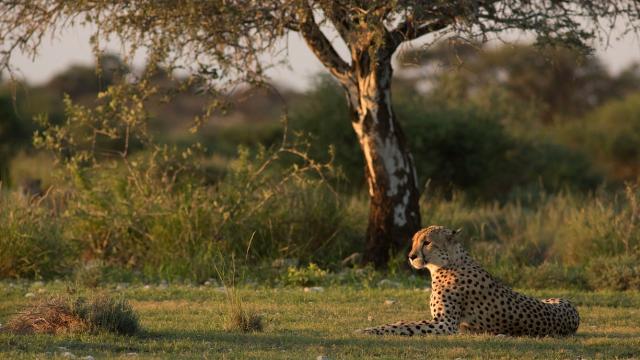
The Kgalagadi transfrontier park, which spans the border with South Africa, is an immense 36,000 sq km wilderness, home to gemsbok desert antelope, black-maned Kalahari lions and pygmy falcons. But conservationists and top park officials – who were not informed of the fracking rights sale – are now worried about the impact of drilling on wildlife.
Prospecting licenses for more than half of the park were granted to a UK-listed company called Nodding Donkey in September 2014, although the sale has not been reported previously. That company changed its name earlier this month to Karoo Energy.
Park officials said that no drilling has yet taken place, but the Guardian found oil sediment on the ground near a popular camp site. There was an overwhelming smell of tar and a drill stem protruded from an apparently recently drilled hole. It is not known who had carried out the drilling or when.
Scientist Gus Mills worked and lived in Kgalagadi for 18 years studying cheetahs and hyenas. He said he is worried about the impact on wildlife and environment.
“The development that is going to have to go on there, with infrastructure that has to be moved in, seems to be yet another nail in the coffin of wild areas in the world.”
Dr. Peter Apps, who studies large predators for the Botswana Predator Conservation Trust, said drilling could have a range of impacts, notably on water sources in the park.
He said that if companies develop commercial gas wells here “then that is not good for nature conservation, and because large carnivores are an apex species, they tend to suffer more than anything else.”
Ben van Eerden, the tourism manager for the South African side of the park, and Leabaneng Bontshetse, the Botswana Kgalagadi park manager, were not aware of licences being issued. “We haven’t seen any licenses being issued, we haven’t been told of anything and there is no company drilling in the park,” said Bontshetse.
He was concerned that the Botswana department of minerals may have already issued licenses: “I am surprised and I am shocked.”
A map of the 2014 drilling licenses shows more than half of the Kgalagadi park on the Botswana side was up for sale to gas prospecting companies last year.
In a company statement issued in April, Karoo Energy under its previous name of Nodding Donkey said it had acquired three fracking licenses covering 29,291, 34,435 and 23,980 sq km in September 2014 through two of its majority-owned subsidiaries, Equatorial Oil and Tamboran.
The Guardian made several efforts to contact Karoo Energy but the company did not respond. The Botswana government was also approached for comment but did not reply.
The government previously acknowledged that foreign companies had been fracking for gas in the country after the Guardian uncovered gas developments in other national parks.
Olmo von Meijenfeldt, director of the South African organization Democracy Works, is concerned about the impact on rural communities. “Governments should be reluctant if not downright hostile towards extracting natural resources for a short-term benefit that will contribute to a deterioration of habitat and our long-term capacity for sustainable development and poverty alleviation.”
According to the World Travel and Tourism Council, Botswana’s growing tourism industry is the second biggest income earner after diamonds and employs 32,000 people.
Mills says he believes that commercial development in the park will make it much less attractive to visitors and “devastate” tourist income. He sees the move as driven by short-term economic motives. “It’s a microcosm of what we are doing to the whole planet, as long as its going to make someone some money that seems to be all that’s important.”
3 WAYS TO SHOW YOUR SUPPORT


- Log in to post comments


