

Austerity is often made to seem vital, the only route out of a fiscal disaster. But a closer look at the reality of the current crises—in municipalities like Detroit and Stockton, Calif., the state of Illinois, and even the U.S. Postal Service—reveals a much more deliberate progression.
In each case, the same pattern develops: beleaguered public services are attacked with additional debts to private interests or constraints serving those same interests, until calamity sets in. The resulting emergency serves as excuse to remove legal protections covering public assets in favor of satisfying the private claims. The process is often compared, with good cause, to looting.
Robbing Workers to Pay Wall Street
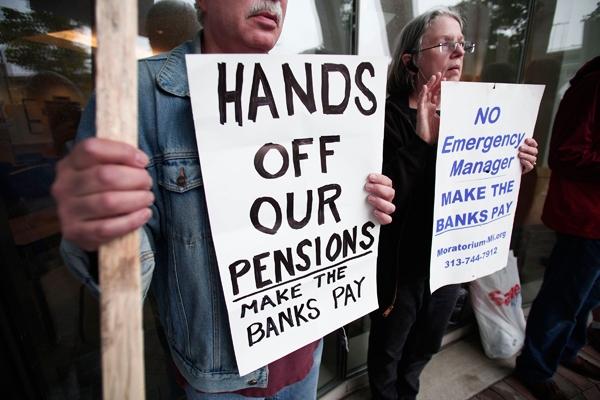
A common target is pension funds. Last week, a federal judge overrode the Michigan state constitution and ruled that Detroit’s pension obligations are not protected from creditors in its bankruptcy, while upholding Congressional protections for the Wall Street counterparties of its derivatives and other financial instruments.
In the two-tiered logic of contemporary austerity, the latter type of contract is sacrosanct while the former is not worth the paper that it promises. It should come as little surprise that Detroit, though certainly beleaguered after decades of short-sighted management, had a number of other options for satisfying the terms of its bankruptcy. Indeed, on the eve of the filing, the state approved $450 million in public funds towards a massive new sports arena.
But the city manager and the court chose the route that would cause maximum suffering to the poorest—pensioners draw about $19,000 per year, on average, often without social security. The end result is literally taking the life savings of the working class in order to further enrich the banking class.
Post Office Manufactured Crisis
The looting of Detroit’s public-worker pensions is only the most recent egregious example in a growing list. Just as Detroit’s public sector workers are being made to suffer for externally-imposed debts, the United States Postal Service has operated under an imposed debt in the form of a Congressional mandate to pre-fund its health obligations for 75 years—a remarkable fiscal conservatism unheard of in even the most risk-averse of private sector employers.
The Postal Service is a unique case, because it is an independently run, self-funded corporation that has a special mandate from the United States government, opening it to a unique regulatory relationship. At the core of the Postal Service’s mission is the universal service obligation (Section 101(a), Title 39 of the U.S. Code). Revenues are to be used to keep postage rates as low as possible, to “provide a maximum degree of effective and regular postal services to rural areas, communities, and small towns where post offices are not self-sustaining”, to assure the security of the mail, and to offer “worthwhile and satisfying careers in the service of the United States.” Austerity is being used to force the USPS to undermine every one of these obligations.
Like any business adjusting to rapidly shifting technology, the USPS must make a number of consequential strategic decisions over the next several years. But unlike most narrowly focused service providers, the Postal Service has an enormous asset base—e.g., post office branches and distribution infrastructure—that it can use to deliver an array of in-person services. For instance, USPS branches have in the past provided low-cost banking services—and could very easily do so again. Particularly effective would be to offer check cashing, which would undercut notoriously exploitative payday lenders.
However, in 2006 Congress passed the Orwellian-sounding Postal Accountability Enhancement Act. In a suspiciously out-of-character change of strategy for the austerity classes, which prefer to unwind pension obligations rather than fund them, this act required the USPS to sock away $56 billion in their Retiree’s Health Benefit Fund. This amount would cover estimated claims for the next 75 years—pre-paying benefits for most of a century’s worth of workers, many have not even been born, let alone hired.
The Postal Service was given ten years to cough up the funds—a hit of $5.6 billion per year on revenues of about $67 billion. At the end of this past fiscal year, USPS accounts tell us that revenues fell short of expenditures by just under $5 billion. Without the pre-funding requirement, that figure would have instead been a profit of over $600 million.
If this sounds to you like it was intended to destabilize the finances of the USPS, you are not alone in that conclusion. Astute observers from Felix Salmon at Reuters to Senator Bernie Sanders have sounded the alarm about this unprecedented attack. Senator Sanders introduced S.316, which would rescind the pre-payment requirement.
Unfortunately, it seems that the Postal Service’s Board of Governors is choosing privatization. They’ve expressed no support for the Sanders Bill (S.316), which would rescind the pre-payment mandate. Instead, they are actively selling off that asset base, the post offices—often below market value, thus divesting the Postal Service of fixed capital that could be more effectively deployed to restore and expand service for a growing population.
Even worse, the board has also continued contracting out USPS services to Pitney-Bowes, FedEx, and, most recently, to Staples office supply stores. The outsourced employees at these firms are paid very low wages, and aren’t employed full-time, meaning they are denied the very benefits that the USPS is scrambling to fund, beyond the horizon of all reasonable expectation, three-quarters of a century into the future.

A Growing Movement to Seize Public Assets
At municipal, state, and federal levels—from Detroit, to Stockton, to Illinois, to the USPS—fiscal crises are being exaggerated, or even manufactured, in order to loot retirement benefits of millions of public service workers. This is exactly the pattern we are seeing take shape with Social Security.
In context, then, these are not merely “local” issues, but all effects of the same cause: a nationwide effort to take public assets and place them in private hands. A long-term solution will involve not just re-establishing those protections, but developing new kinds of institutions that can better resist future attempts to privatize the commons.
3 WAYS TO SHOW YOUR SUPPORT



- Log in to post comments


