
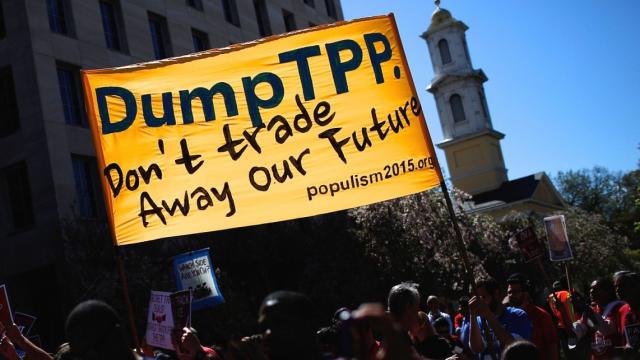
WASHINGTON - As the trade debate heats up in Washington, city councils are fighting back against controversial legislation that would grant the president the authority to fast-track international trade deals without congressional amendments.
On the Hill, lawmakers are pushing full steam ahead on legislation the Obama administration is seeking in order to pass the Trans-Pacific Partnership (TPP), a trade deal with Asian-Pacific countries. Some Democrats don't support the deal, arguing that certain trade provisions are worrisome and haven't received enough scrutiny. Nonetheless, a key Senate committee moved the bill forward on Wednesday.
Across the country, city officials are making their own concerns about the legislation crystal clear. This week, San Francisco adopted a resolution opposing fast-track, following similar efforts in other cities, including Seattle and Bellingham, Washington, and Fort Bragg and Richmond, California. A Pittsburgh official introduced a "Will of Council" against the deal on Tuesday. And next week, New York City officials will consider a resolution declaring the Big Apple a "TPP-Free Zone." The sponsor expects it to quickly pass.
These resolutions are symbolic. Some of them urge representatives in Congress to oppose fast-track. Others claim that TPP's regulations will not be respected within city limits - although of course, people must still follow federal and state law. Nonetheless, Celeste Drake, a trade policy specialist at AFL-CIO, a union federation that opposes the deal, called the resolutions "important statements of citizen sentiment."
New York City Council member Helen Rosenthal, who is sponsoring the resolution in her city, told The Huffington Post that she seeks to make it clear how TPP will affect New Yorkers. For example, Rosenthal said she's uncomfortable with certain provisions in the deal that concern investor-state dispute settlement (ISDS). Those provisions, she said, might potentially grant a major tobacco corporation the right to sue the city in order to overturn a law that bans smoking in restaurants. "That's outrageous," she said.
The Office of the United States Trade Representative, for its part, says that "the United States has taken important steps to ensure that our agreements are carefully crafted both to preserve governments’ right to regulate and minimize abuse of the ISDS process."
A number of resolutions have come out of places where the local economy is deeply rooted in manufacturing or trade, like Wisconsin. Six locales where city councils have passed or are expected to pass anti-TPP resolutions have merchandise exports collectively worth over $200 billion, according to 2013 data from the U.S. Department of Commerce. Trade advocates say the deal will benefit U.S. exporters, but critics worry that it will incentivize companies to send U.S. manufacturing jobs overseas.
In Pittsburgh, the Will of Council specifically notes that Pennsylvania is a "trade-dependent state" and that its exports support some 1.6 million jobs. The United Steelworkers union, which is based in Pittsburgh, put out a statement earlier this week applauding the local anti-TPP effort.
Not all local officials oppose the deal. On Wednesday, Tom Cochran, the CEO and executive director of the U.S. Conference of Mayors, which represents cities with populations of more than 30,000, said that the group supports fast-track. The White House has also cited a number of U.S. mayors who support the deal, including the mayors of Birmingham, Alabama, and Tampa, Florida.
But Jason Stanford, a spokesman for the Coalition to Stop Fast Track, an activist group, told HuffPost in an email that the growing opposition in some major cities indicates "the only place fast track is popular is on K Street and in editorial boards."
3 WAYS TO SHOW YOUR SUPPORT



- Log in to post comments


