
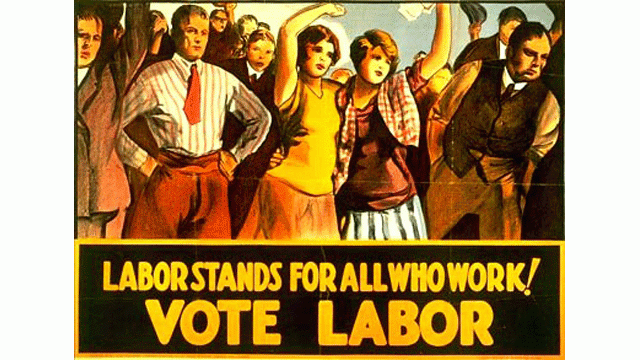
For some time now, Labor has been punched into a corner when it comes to state legislation. Over the last two years legislation has been passed in Wisconsin, Indiana, Ohio, and Michigan that has attempted to gut largely public workers of their union rights.
In addition, right-to-work laws now exist in 23 states. These are Big Business's biggest legislative weapons because they prevent Labor from bargaining contracts that require dues-paying union membership for all employees at a workplace. Without a united work force financially contributing to the resources of a union to defend its membership's interests, it is left with a shoestring budget and a membership divided between dues payers and freeloaders. This has resulted in a 9.4 percent decline for both organized and unorganized workers' wages as well as declining safety and health conditions.
Union leaders have been looking for ways to put a halt to this onslaught. One example is Proposal 2, "Protect Our Jobs," in Michigan, a measure which could serve as a model for future efforts nationwide. It would amend the state constitution to grant the right of public and private employees to organize and bargain collectively through labor unions. It would create a block to much of the anti-union laws that have been enacted over the last two years as well as right-to-work legislation. In addition, it could override current state laws that limit the ability of workers to join unions, bargain collectively, enforce collective bargaining agreements and defend hours and conditions of employment from state laws that conflict with union contracts.
Opponents include the Michigan Chamber of Commerce and other business groups, as well as Gov. Rick Snyder and Attorney General Bill Schuette. They claim that Proposal 2 would make union leaders more powerful than elected leaders, roll back dozens of laws and hurt their ability to get budgets under control.
Considering that Gov. Rick Snyder has appointed emergency managers over several cities that have the power to gut union contracts, the charge that union leaders are making a grab for power is the same line of reasoning of any boss threatened by his subordinates when they stand up for themselves.
What is bothering the opponents of Proposal 2 is that it would strengthen Labor's defensive position against their attacks. They want a free hand in their attempts to make workers pay for the economic crisis rather than their rich contributors who are getting massive tax breaks and hoarding trillions of dollars while social programs are being slashed.
The campaign for a "yes" vote is being led by a union and community coalition which turned in 684,286 signatures to get it on the ballot; only 322,609 were necessary.
Anyone who cares about workers having a voice on the job and being able to defend citizens’ interests in education, as well as public safety and services, should vote yes. If Proposal 2 passes, it will be a victory for all Michigan workers with likely national ramifications. Eighteen states permit their constitutions to be amended through referendums. Twenty-one states allow for public votes on proposed laws. A victory for Proposal 2 would encourage unions to bypass corporate politicians and take similar legislation to the voters instead.
With 18 percent of its workforce in unions, compared to the national average of 12.1 percent, Michigan would appear to be an ideal state to launch a national campaign to protect collective bargaining. So far, however, the polls are tight, with 48 percent for the proposal, 43 percent opposed, and 9 percent undecided.
Why is this? Many workers do not understand what collective bargaining is and how they benefit from it even if they are not union members. They do know, on the other hand, that they need jobs, better wages and benefits, universal healthcare, improved education and strengthened public services.
If Labor was acting as a social movement and launching an independent campaign for these needs, the passage of Proposal 2 would be a more simple matter. Instead the unions have put their resources behind getting Democratic politicians elected, even though Democrats share equal responsibility with Republicans in presiding over workers' declining standard of living and rights. In addition, they push cuts to Medicare, Medicaid, likely Social Security, as well as other necessary public services while rewarding corporations with trillions in bailouts, loans and tax breaks.
Consequently, for too many workers, unions are viewed as just another special interest lobbying machine. By focusing exclusively on collective bargaining in the vacuum of a greater social fightback, Proposal 2 leaves itself open to the judgment that Labor's leaders are more concerned with their own positions rather than fighting to improve the conditions for all workers.
Unions also need to be willing to boldly defend their membership's interests rather than start from a position of making concessions to employers, as is usually done these days. Unfortunately, Proposal 2 is not free from this losing approach. It states: "Laws may be enacted that prohibit public employees from striking." Why agree to disarm public employees from using their most powerful weapon? Any general who agreed to such a tactic before going into battle would rightfully be judged as incompetent. It appears that the purpose of this concession is to avoid upsetting Democratic politicians whose influence over the unions’ leadership is Labor's Achilles heel.
In spite of this significant shortcoming, a victory for Proposal 2 would be an important step forward for Labor. Would it mean that the unions were turning around the one-sided class war of Big Business? Its victory could be a contributing factor. However, in order to reverse the direction in this country, Labor must be willing to fight for all workers' interests with mass demonstrations and strikes over issues that effect us all against the corporate interests that dominate the Democratic and Republican Parties.
Mark Vorpahl is an union steward, social justice activist, and writer for Workers Action.
3 WAYS TO SHOW YOUR SUPPORT



- Log in to post comments


