
Many mocked us, many vilified us, many told us we would achieve nothing.
But after a wave of student mobilization in Quebec through the spring and summer, we can count our victories: on the first day of the new Parti Québécois government’s term, it cancelled a tuition hike and repealed an anti-protest law that curbed basic freedoms of expression and assembly.
If the PQ yielded so quickly to some of our demands, it is because we organized a strike movement whose support was popular and broad, which allowed people of all ages and walks of life to express their grievances about our political and economic system, and which helped defeat the Charest Liberal government.
That might be hard to believe, going by the depictions of us in English Canada: halfwitted hooligans, spoiled brats or frightening extremists.
But if we are guilty of anything, it is of questioning the dogmas of the rich and powerful, who have spent the last decades trying to lower our expectations for what is politically possible.
The purveyors of such dogmas insisted we be quiet and content, because our tuition was already the lowest in Canada. But it remains lowest precisely because we have fought our government every time it tried to raise it.
As with education, the fundamental rights we value today — of abortion, collective bargaining, health care and many more — are not gifts from politicians, but a legacy of the struggles of ordinary people.
The struggle of CLASSE has been not merely to stop the tuition hike, but to campaign for high-quality, public and free university education. This is education as a right accessible to all, not as a commodity available to those with the thickest wallets. This is education dedicated to the common good, serving freethinking and the flourishing of the potential in each person. It is an investment in our generations to come.
Our commitment to genuine democracy is a reflection of the type of society we seek to build: one that is more equal, not less, and revolves around the needs of people, not corporations.
It is also within reach. No wonder the Globe and Mail would label us “irrational,” the better to distract the public from our proposal, feasible across Canada, to fund free university education with a tiny tax on the transactions of banks — the same banks that shackle families in debt, while making billions of dollars of profit.
What we raised with such arguments and peaceful, creative protest, the government tried to silence with “emergency” laws, riot squads and tear gas. More than 3,000 have been arrested and are still charged, three times more than during G20 policing debacle in Toronto in 2010.
Such scenarios are possible only in a broken system of democracy that comes up for air once every four years, in which politicians prefer the murmurs of business lobbyists to the voices of those they supposedly represent. Our faith is in direct, participatory democracy, which we practice in assemblies of thousands where every student can give input into the decisions that impact them.
Our commitment to genuine democracy is a reflection of the type of society we seek to build: one that is more equal, not less, and revolves around the needs of people, not corporations.
Ours is an age of cynicism, but we are learning that our dreams can be made real.
What we are fighting in Quebec, many are fighting across Canada: the privatization and degradation of public services, cuts to people’s wages and old age pensions, and the free rein corporations have to destroy our environment and fuel climate change. If our rights can be taken from us by throwing our educational system into the marketplace, we can say the same for our hospitals, our water, our forests, and the soil beneath our feet.
This has always been the essence of our strike and our mobilization: a shared, collective vision whose scope lies well beyond student interests. In our campuses, in our workplaces, in cities and villages across our province, people have come together like never before: to talk, to debate, and to imagine a new society with us. And we are making new alliances, overcoming old divisions, all across Canada.
At the upcoming provincial summit on the future of education, the Parti Québécois will aim to increase tuition fees by indexing them to the cost of living, their stated policy. But we think the time has come for free post-secondary education.
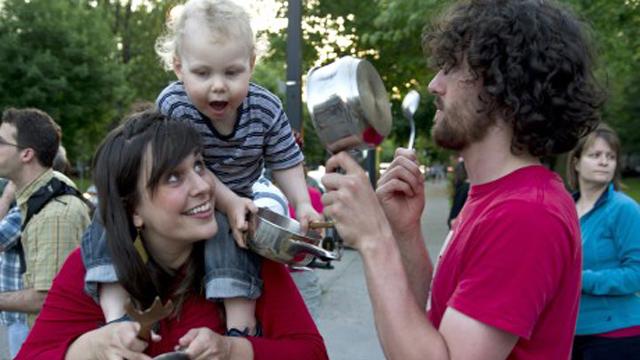
This is what we demanded on Saturday, marching as we have on the 22nd of each month since the spring. If we have demonstrated anything in Quebec, it is that a condition for social change is not that people should hunger for it — we know they do. It is that they believe their actions matter.
The social movement of the past year has taught us that police batons and corrupt politicians will not always prevail over the power of ideas. Ours is an age of cynicism, but we are learning that our dreams can be made real.
3 WAYS TO SHOW YOUR SUPPORT



- Log in to post comments


