
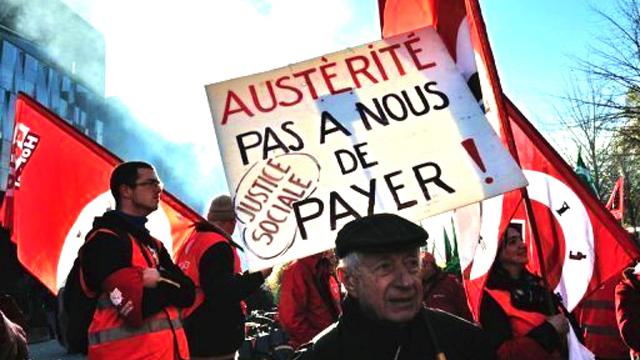
London activists used satirical theatre to draw attention to an "obscene congregation of wealth and gluttony" ahead of the European international anti-austerity general strike that is currently shaking Europe. The message: "They don’t represent us."
"Some criticize us for 50% unemployment," the faux-premier of Spain suggested, adding, "well, at least that means 50% of the plebs are in work." The speech received guffaws and cheers by other elites who wafted champagne glasses while activists jeered. Then a faux-David Cameron climbed atop a skyscraper and regurgitated the callous line he's now known for: "We’re all in this together." He fleshed out the benefits of austerity for the suits who flanked his side, and he too received shouts of disdain from the crowd.
The satirical theater was one centerpiece of the PIIGS and Plebs Banquet, a political action outside the Lord Mayor’s Banquet in London on Monday, November 12. It was part of the build-up towards the international anti-austerity strikes that are gripping Spain, Portugal, Greece, Italy, Cyprus and Malta, with further actions across Europe aimed against the Troika, debt and austerity.
Southern European countries are widely forced to "balance" their economies by privatizing, deregulating and cutting spending on public services. The austerity measures are forced upon them by the Troika – the European Central Bank, European Union and IMF – which holds the keys to future bail-outs for these countries. Monday's protest was organized by a coalition of groups united in demanding that the public should not pay off the deficits created by the bankers.
Their political action’s message was, as written:
It’s time that people who are being affected by unnecessary and failing austerity measures across Europe begin to work in solidarity to address economic injustice internationally. We are all Greeks, we are all Irish, we are all Spanish, we are all Italian, we are all Portuguese. We are all the disabled, the jobless, the homeless, the ones unable to afford education, the young without any future. We are of all racial minorities, all elderly and fearful of fuel poverty, all sick but unable to pay for good health care. We are suffering under an unjust, undemocratic, unsustainable economic system that destroys peoples’ lives – it is time for change and real action, rather than empty words and promises."
The elitist caricatures outside the banquet portrayed bankers', politicians' and corporate bosses' vicious attacks on the poor whilst gorging on their profitable returns; this was matched by the country's real Prime Minister inside, who spoke of extending the destruction.
His sinister vision, given in the Guildhall, included British financiers and corporate chieftains amplifying their wealth, increasing arms sales to countries with poor human rights and growing the corrosive financial services industry that took down the global economy. He boasted about "cutting corporation tax rates to the lowest in the G20," and claimed he had "introduced some of the most generous tax breaks for early stage investment in start-ups of any developed economy."
As waiters at the PIIGS and Plebs Banquet served champagne, and a Rhythms of Resistance Samba band added a beat to accompany the austerity soup, Prime Minister Cameron also announced he would not keep "dead industries on life support like the industrial strategy of the 1970s, but supporting industries where we have a competitive edge." He actually said this to the City of London Corporation, to an audience that included bankers whose high-risk investments in toxic loans and involvement in casino gambling cost taxpayers £850 billion in the bailout, handing England its sky-high deficit.
The deficit, after all, is the excuse Cameron's government uses for privatizing the National Health Service, cutting welfare, gutting education funding and exploding the gap between the rich and poor: the very same measures that are making a great deal of the phenomenally rich people in his audience, well, richer.
People should not pay for the debt crisis created by bankers, and there is now momentum building in Britain to support the Won't Pay, Can’t Pay campaign which rejects the "national" debts created by banks. Many turned out Wednesday at the European Commission building in Westminster to voice this message. However, in Britain there still seems a great need for awakening as to what exactly is going on. This means increasing the awareness of how the debt in both the UK and the Euro-zone was created, and how the leverage it creates redistributes wealth to the elites.
As yet the impact of British austerity is less severe than Southern European countries, which is one reason there was no national strike here. However, far deeper cuts are planned, so don't count out what may well happen here in the streets as well.
At the turn of the last financial year, in April 2012, only 6% of the intended cuts were implemented. Already this program means that the National Health Service is being privatized, the welfare state is being eroded and the gap between the rich and poor is accelerating — reportedly at its greatest level in over 70 years.
People who suffer disabilities are now assessed for benefits by a private company. Hundreds of these people have died working as a result of being incorrectly diagnosed fit to work. Even today, the government has announced possible plans to slash the majority of departmental budgets by an extra 20% at the start of the next parliament, on top of the other cuts already mentioned.
Britain’s self imposed austerity, like that imposed by the Troika, is an attack on democracy. Those enforcing it have the same underlying messages: one, that the debt burden must be paid for the sake of the economic stability, and two, that the crisis must be dealt with by economists and is therefore not open to political, "open" debate. They assert we need listen only to the "experts."
However, in Italy, the nation's leader is no longer chosen by the people but installed by the European Central Bank. Thus, the idea of "crisis" enables the very same people who created the problem to socialize the debts. The main difference between the British and European privatizations is that in southern Europe, the austerity measures are imposed from outside, whereas the architect of British austerity policies is the British government itself.
Outside the Guildhall, Occupy supporter Pedro Lima explained austerity’s impact on his home country of Portugal. "The situation is worse than most people in this country might think. Many British people may go on holidays there without realizing [that] there are no conditions or prospects for a future for anyone, unless of course you are part of the political elitist class."
Last week at Agora 99, a convergence in Madrid with activists from across Europe, a Greek activist said what he saw happening in Spain and other southern countries was like watching a repeat of what had happened to Greece just a few months ago. A Greek doctor explained how patients were turned away from life-saving procedures because they did not have money to pay for them. Before the crisis, health care was free in Greece. This is not the case anymore.
What is necessary now is that the British public stands united with other Europeans in saying no to austerity, debt and the Troika. The sooner we do this, the better for everyone’s sake. In Britain, it will mean we can keep our National Health Service and public services while ending one of the greatest money and power grabs ever, executed by a small group of bankers, CEOs and politicians.
The world’s third richest man, Warren Buffett, said: "There’s class warfare, all right: but it’s my class, the rich class, that’s making war, and we’re winning." To alter this, the majority being exploited needs to unite, possibly around a few key issues of inequality. Odious debt must be one of these issues.
3 WAYS TO SHOW YOUR SUPPORT



- Log in to post comments


