
A coalition of environmental protesters last week targeted Shell – a corporation engaged in the world’s “most destructive project” – for co-opting one of the world’s most prestigious universities.
The Shell Geo-Science Laboratory at Oxford University was opened Thursday by British Secretary of State for Energy and Climate, Ed Davey; joined by Alison Goligher, who is responsible for unconventional oils at Shell; and Andrew Hamiliton, Oxford’s vice chancellor. Danny Chivers, a campaigner from [UK Tar Sands Network](http://www.no-tar-sands.org/, explained how the ceremony was shrouded in secrecy and the group was tipped off about it just before the event.
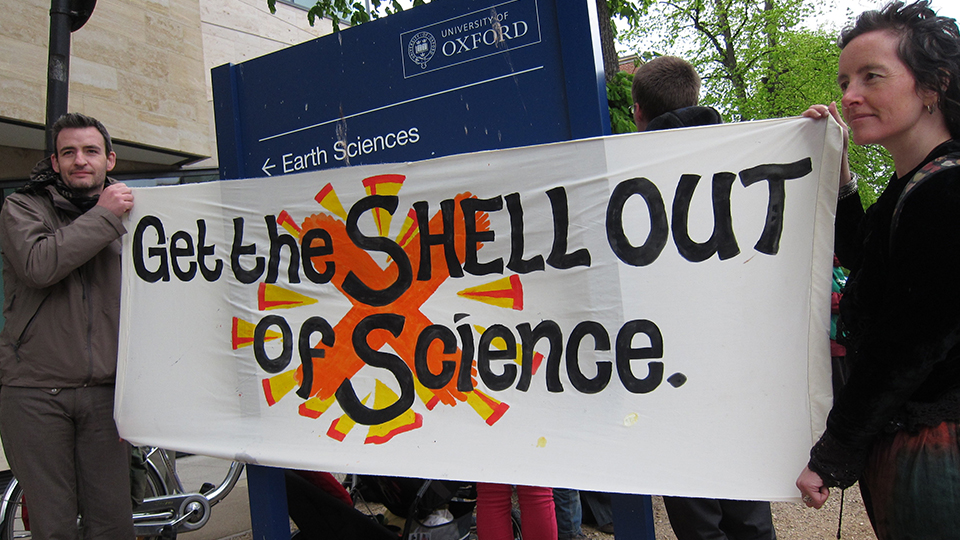
Within the small time-frame to respond, Chivers explained how around 40 protestors gathered outside, staging a mock 2018 closing ceremony. In this, the Energy Secretary, since ousted from office, explained how it was a terrible partnership while a campaigner playing the Shell representative grovelled apologetically to his Shell shareholders about how the Carbon Bubble had bust and all their assets had been liquidated.
Another protestor dressed as a polar bear received apologies from the speakers, in a crowd that included Brenda Boardman, a senior environmental academic from the university alongside a student health organization. Chivers described the lack of logic or fairness that Shell, on the one hand, receives massive tax breaks from the government, while paying a pittance in return to sponsor education and the arts that greenwashes its image.
In another impromptu direct action later in the day, UK Tar Sands Network supporters interrupted a lavish meal held to celebrate the launch of the lab. Walking into the room, the campaigners announced to the audience, which included senior recruitment officers for Shell, what the company’s impact to the planet meant while they enjoyed fine food and wine.
In additional support, an open letter from 100 past and present students asserted how the oil giant is a "particularly inappropriate choice of funder for an earth sciences laboratory." It highlighted how the partnership creates a direct challenge to the scientific integrity of the University, which stands directly in conflict with the corporation's desire to extract oil.
"Oxford's own climate scientists are warning us that we need to leave the majority of known fossil fuels in the ground, and yet this new partnership will undertake research that will help Shell to find and extract even more hydrocarbons," the letter said. The partnership is reported to also give Shell an oversight role on PhD students’ studies.
The broad coalition involved in the ceremony protest included Occupy London’s Energy, Equity & Environment (EEE) working group,Greenpeace, UK Tar Sands Network and the student network People and Planet. They asserted how Shell tarnishes Oxford’s reputation and pointed out a long list of corporate crimes.
For one, the United Nations has found the company guilty of devastating the lands of the Ogoni people of Nigeria, with oil spills that will take decades to clean up. The Dutch-British company is also accused of destroying vast swathes of land in Canada through its extraction of tar sands, for which the Athabasca Chipewyan First Nation are fighting them in court.
The global destruction carried out by Shell – the world's seventh largest oil producer – can be mapped from the Arctic, where it plans to intensify oil extraction despite recent disasters like the grounding of its drill rig, to 200 miles south of New Orleans where it plans to build a deepwater offshore oil well in the Gulf, akin to the one that caused the BP disaster. Meanwhile Shell is aiming to become a key player in fracking.
The opening of the laboratory in Oxford is only the latest example of Shell’s efforts to greenwash its dire impacts and expand its misinformation campaign. The company intensively lobbies governments, perhaps most notably in Britain. From freedom of information requests, Corporate Watch discovered how Shell pressured the British government – via business secretary Vince Cable – to vote against the European Fuel Directive because it would ban tar sands sales in Europe. Cable is a former Shell employee and they knew him as the “Minister for Shell.”
The partnership with Oxford serves to further boost Shell in its efforts to misinform the public about climate change and the role the fossil fuel industry plays in exacerbating it. It seems to have come at a cheap cost, too: only £5.9 million, a drop of oil in the ocean for Shell. Graver still, not only will the corporation attempt to legitimize its ecological destruction through its connections with the Oxford lab, but the deal means the university will be actively looking at new ways of expanding non conventional oils like tar sands and gas produced by fracking.
The Big Oil agenda in British education is not confined to Shell or universities. Research published on London’s Occupy News Networkshows how BP has created an extensive range of school lessons driven into Britain’s classrooms through its educational sponsorship and widening partnerships with schools. These portray the oil giant as forward thinking and ecologically responsible, which is fully contradicted by its activities.
In broader terms, the tightening links between education and corporations are squeezing out the ideals within learning institutions, suggesting that education is about learning what businesses wants you to think. Even as an elite university, with its enormous fees that bar many from attending, Oxford is known as a place of academic rigor and a symbol of free-minded education that has inspired great thinkers through the ages. But the dirty oil takeover of Oxford now begs the question: would Britain’s post-War Prime Minister Clement Atlee have been inspired to push through universal healthcare if his History department were directed by industrialists?
Aung San Suu Kyi, the human rights activist from Burma, has reflected on the ways Oxford gave her strength and confidence in humankind. Likewise, the influential militant suffragette Emily Davison was one of this university's graduates. Would these historic figures have been attracted to Oxford if it had sponsors engaged in human rights abuses? Free education – free of cost and free of corporate pollution – is a vital battleground for those who want to engender a world free of the destruction wrought by companies like Shell.
3 WAYS TO SHOW YOUR SUPPORT



- Log in to post comments


