

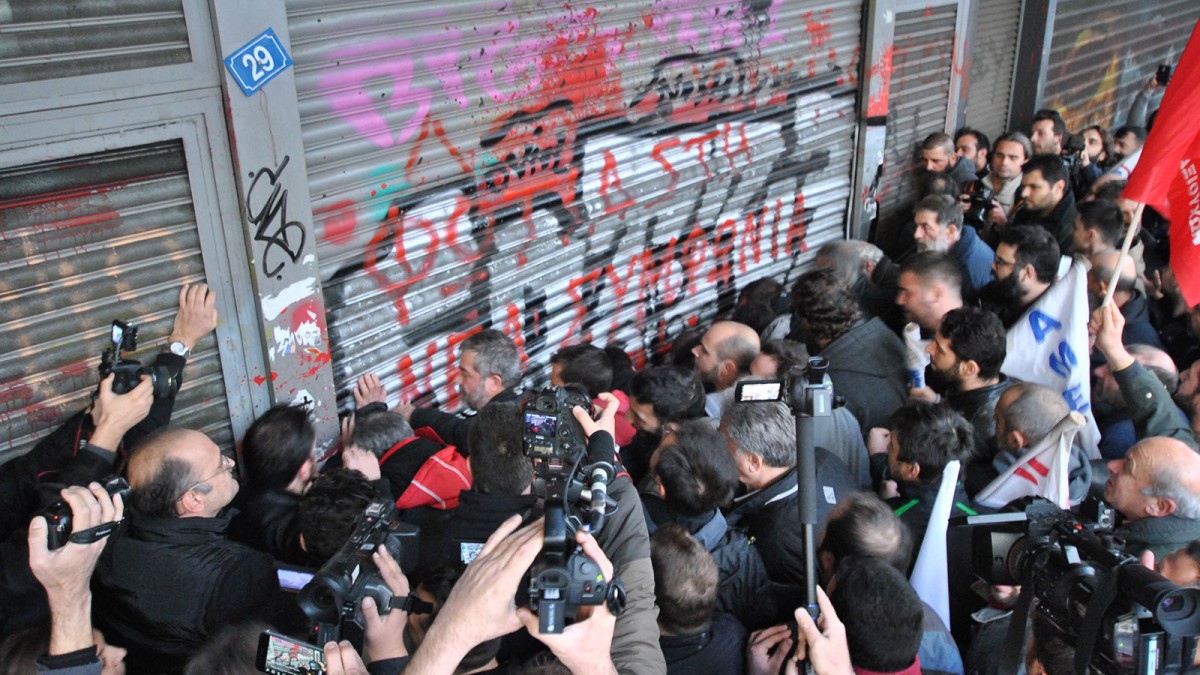
ATHENS – On Jan. 14, the General Confederation of Greek Workers (GSEE) mobilized a 24-hour strike that paralyzed Athens, as public transit worker unions, healthcare professionals and air traffic controllers, among others, joined to protest against the country's upcoming E.U. bailout review and a new series of proposed austerity measures announced by Greece's governing Coalition of the Radical Left, or Syriza party.
During much of the afternoon, Athens International Airport stood at a standstill with all domestic and international flights halted. In the capital's center, locals zipped to and from work on bicycles as all public transportation in the city and its suburbs ground to a stop. While tens of thousands of protestors gathered in Athens, smaller demonstrations took place across the Greek countryside, and similarly extensive strikes were held the following week – this time with the participation of the powerful sailors union.
The protests brought the number of general strikes held in the Greek capital to 50 since 2010. However, unlike the dozens of strikes before it, last month's protests were a direct – and existential – response to a measure that could end Greek unions' ability to strike in the future.

Upholding the Right to Protest
The austerity reforms that provoked the strikes were outlined extensively in a 1,300-page document, which was submitted in December for consideration during Greece's latest talks with its E.U. creditors as it seeks a new 4.5 billion euro bailout. But among a number of alarming proposals in the bill – including a call for online home foreclosure auctions – one stood out in particular:
The reform in question regarded an amendment made to a 1982 law that allowed unions to strike provided that 20 percent of the union's paying members agreed to the strike. The new proposal raised the minimum percentage of required union member support to 50 percent.
To the outrage of many, the Syriza administration was more than happy to oblige Greece's creditors with this measure, effectively putting an end to most strikes and protests held by any one workers union. In blunt terms, the amendment would force the GSEE to either sustain a complete shutdown of the capital, or let smaller unions endure any onerous reforms without the chance to mount a popular response.
More importantly, within the context of Greek law, the wording of the proposed reform doesn't guarantee that union strikes would be legal outside the urban centers of Athens and Thessaloniki, Greece's second largest city, since the more diffuse worker unions in the countryside would by definition be unable to muster the necessary numbers to carry out a "legal" strike.
Giorgos Perros, the lead organizer of one of the January protests and a member of the Greek Communist Party, responded defiantly: "Let them vote for whatever they like. We won't stop."
This latest "reform" proposal coupled with a slew of asset seizures that have taken place since late 2017, when the government made a mad dash to meet its bailout deadline, appears to have finally turned the broader Greek left against Syriza, a party once lauded for bringing the left back to the forefront of Greek politics. Slowly but surely, the party under Alexis Tsipras has managed to alienate those that had once been its more outspoken allies.
Retreat Instead of Revolution
According to World Bank estimates, Greece's latest international bond price dropped by 4 percent from its price in 2010. Most economists see this as a result of continual austerity measures set in place by the E.U., which have crippled small business owners and led to a steady rise in unemployment that have only hobbled the country further.
Further, the income gap in Greece has steadily increased, with the middle class shrinking further due to new taxation imposed by the government in an attempt to maintain an already bloated public sector, while cutting public healthcare and education.
Currently, almost half of Greek households are in debt and consumer spending is at an all-time low – making this a less likely moment than ever for Greece to qualify for billions more in financial aid.
Nonetheless, in a much publicized announcement, Klaus Regling, head of the European Stability Mechanism (ESM), claimed: “Greece can exit the current aid programme in 10 months and be financed independently through the markets." According to the optimistic ESM timeline, Greece will be able to halt its austerity measures by July 2018. In effect, creditors are arguing that the next bailout package represents the next step to helping the country escape its decade-long financial predicament.
The Greeks' response: We'll believe it when we see it. Until then, if its recent "reforms" are anything to go by, the Syriza administration seems determined to stifle any further resistance to its policies – a position that citizens in the world's oldest democracy may have a hard time accepting.
3 WAYS TO SHOW YOUR SUPPORT



- Log in to post comments


