
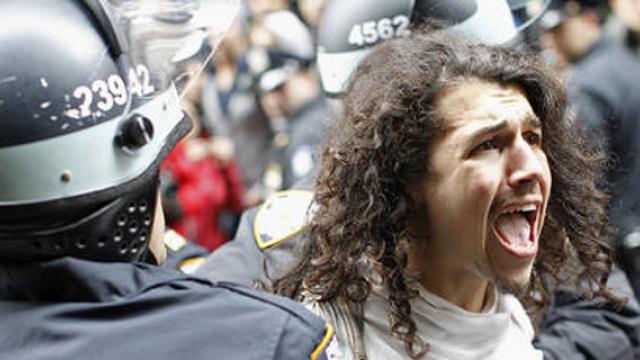
Photo: Brendan McDermid.
After serving as the epicenter for press suppression and journalist arrests over the last nine months, the NYPD is trying to rewrite history and pretend like nothing ever happened.
On Friday, Police Commissioner Raymond Kelly and NYPD spokesman Paul Browne discussed the now-infamous raid on Zuccotti Park last November. In an exclusive interview with the Queens Chronicle, Browne is reported to have said that only one journalist was arrested during the operation. He called stories to the contrary a “total myth.” He continued, arguing that “Occupy Wall Street protesters were forging press credentials in an effort to get through the police lines...but that doesn’t mean actual reporters were arrested.”
There is so much wrong with this statement it’s hard to know where to start. I have been tracking journalist arrests at Occupy protests around the country since last September, so I feel compelled to set the record straight.
1.The Mayor Disagrees
Back in November, New York City Mayor Michael Bloomberg went into damage-control mode. His spokesman, Stu Loesser, sent a memo to media outlets confirming that five journalists with NYPD press credentials had been arrested, but discounted and dismissed claims by other journalists regarding their arrests. Given that, Paul Browne’s comments are clearly uninformed or intentionally misleading.
2.The Real Numbers
In fact, the NYPD arrested 11 journalists on the day of the Zuccotti raid. You can click here to see the details of their arrests, as well as the names of the publications they work for. This information was independently verified by Choire Sicha at The Awl. Since the Occupy Wall Street movement began, the NYPD has arrested nearly 40 journalists. That is almost half of the 85 people who have been detained around the country while covering Occupy protests.
3.Are You an “Actual Reporter”?
Finally, embedded in Paul Browne’s comments to the Queens Chronicle is a troubling statement about the First Amendment. Mr. Browne believes that it is the role of the NYPD to decide who is an “actual reporter.” After the November arrests, Elizabeth Spiers wrote a post, “Notes on the NYPD Press Credentialing Process, from the (Ineligible) Editor-in-Chief of the New York Observer,” in which she questioned “whether credentialing by law enforcement is appropriate in the first place (inasmuch as it can potentially conflict with First Amendment protections).” Spiers detailed how “the NYPD’s processes for acquiring credentials are, to put it nicely, Kafkaesque. To put it bluntly: they’re ridiculous.”
Some of the people arrested last November didn’t have NYPD press credentials, but they had press badges on and were working for well established outlets like the New York Daily News, Vanity Fair, Agence France-Presse, and TV New Zealand. Even so, recent court cases and statements from the Department of Justice have made clear that as we enter an age of participatory media making, the protections of the First Amendment extend to all people.
In its recent letter to Baltimore police, the Department of Justice states:
"Police departments should not place a higher burden on individuals to exercise their right to record police activity than they place on members of the press. The Supreme Court has established that “the press does not have a monopoly on either the First Amendment or the ability to enlighten.” Indeed, numerous courts have held that a private individual’s right to record is coextensive with that of the press. A private individual does not need “press credentials” to record police officers engaged in the public discharge of their duties.
While it’s troubling to see the NYPD trying to rewrite the history of its shameful journalist arrests, it’s perhaps even more concerning to see them also trying to rewrite our fundamental freedoms.
Josh Stearns is the journalism and public media campaign director for Free Press and the Free Press Action Fund.
3 WAYS TO SHOW YOUR SUPPORT



- Log in to post comments


