
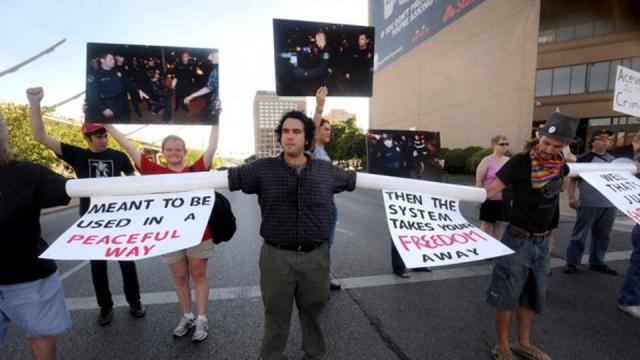
Six members of Occupy Austin pleaded guilty to misdemeanor charges in a Houston court last week after more serious felony charges were dropped. Like others involved in the once robust protest movement, the six protesters succumbed to police entrapment when members of the Austin Police Department gave demonstrators “criminal instruments” during a nonviolent demonstration at the port of Houston in December 2011.
The demonstration was part of a national action against runaway corporate greed. By engaging in civil disobedience, Occupy protesters attempted to close the port as a means to signal discontent and reduce corporate profits.
The six protesters were arrested and charged with possession of a criminal instrument, using a “lockbox,” a PVC sleeve that allows protesters to link themselves together.
Three individuals later identified as members of the Austin Police Department infiltrated the group and built the lockboxes used in a protest at the port of Houston. The police officers were later identified in November 2012 as Shannon Dowell “Butch,” Deek Moore “Dirk” and Rick Reza “Rick.” The three entrapped protesters into committing a criminal felony.
If the charges had not been dropped, the six Occupy Austin protesters would have faced two years in prison. In most cases, entrapment is not a permissible police tactic, especially if it can be proven that an individual would not have committed a crime without being guided by undercover officers.
Greg Gladden, a lawyer who represented Austin protester Ronnie Garza believes that as many as six Austin police officers were involved in surveillance and intelligence gathering operations leading up to the arrests. The other officers’ names were not released because an Austin court determined that they were not involved in the “manufacture, adaptation, purchase or delivery” of the lockboxes crafted by Moore, Dowell and Reza.
FBI infiltrates Occupy Wall Street
Inspired by the Arab Spring, Occupy Wall Street erupted as a vibrant, non-violent protest movement advocating for increased regulation of big banks and campaign finance reform using their famous slogan of “We are the 99%,” promoting economic equality for all.
What began in New York was debilitated by widespread crackdowns organized by the Federal Bureau of Investigation working with police departments. According to the Partnership for Civil Justice Fund, documents obtained through the FBI using a Freedom of Information Request, show that authorities classified OWS as a terrorist threat despite members being wholly committed to nonviolence.
The FBI shared information with corporations and universities helping officials anticipate OWS demonstrations and occupations.
Naomi Wolf, a feminist author and scholar, commented on the elaborate coordination, writing in 2012, “Banks sat down with FBI officials to pool information about OWS protesters harvested by private security; plans to crush Occupy events, planned for a month down the road, were made by the FBI – and offered to the representatives of the same organizations that the protests would target; and even threats of the assassination of OWS leaders by sniper fire – by whom? Where? – now remain redacted and undisclosed to those American citizens in danger, contrary to standard FBI practice to inform the person concerned when there is a threat against a political leader.”
The FBI has previously used informants to infiltrate protest groups and use entrapment methods to arrest activists.
Brandon Darby, a former activist involved in environmentalist causes turned into an FBI informant, helping to arrest activists convicted with plotting terrorist attacks during the 2008 Republican National Convention in St. Paul, Minn.
David McKay and Bradley Crowder, both from Austin, Texas, were arrested for plotting to firebomb the Xcel Energy Center, the site of the RNC. The two had no known links to other nonviolent protest movements prior to their arrests.
Surveillance and infiltration has undermined prominent social movements in the past, most notably during J. Edgar Hoover’s stint as director of the FBI. Hoover expanded FBI surveillance during the 1970s with his counter intelligence, COINTELPRO era infiltration of the Black Panthers, the American Indian Movement, Students for a Democratic Society and other activist groups.
Much of the surveillance included warrantless wiretaps, considered unconstitutional. The Church Committee, a Congressional inquiry into the clandestine FBI surveillance program found that the Bureau had also opened and photographed more than 215,000 pieces of mail.
3 WAYS TO SHOW YOUR SUPPORT



- Log in to post comments


